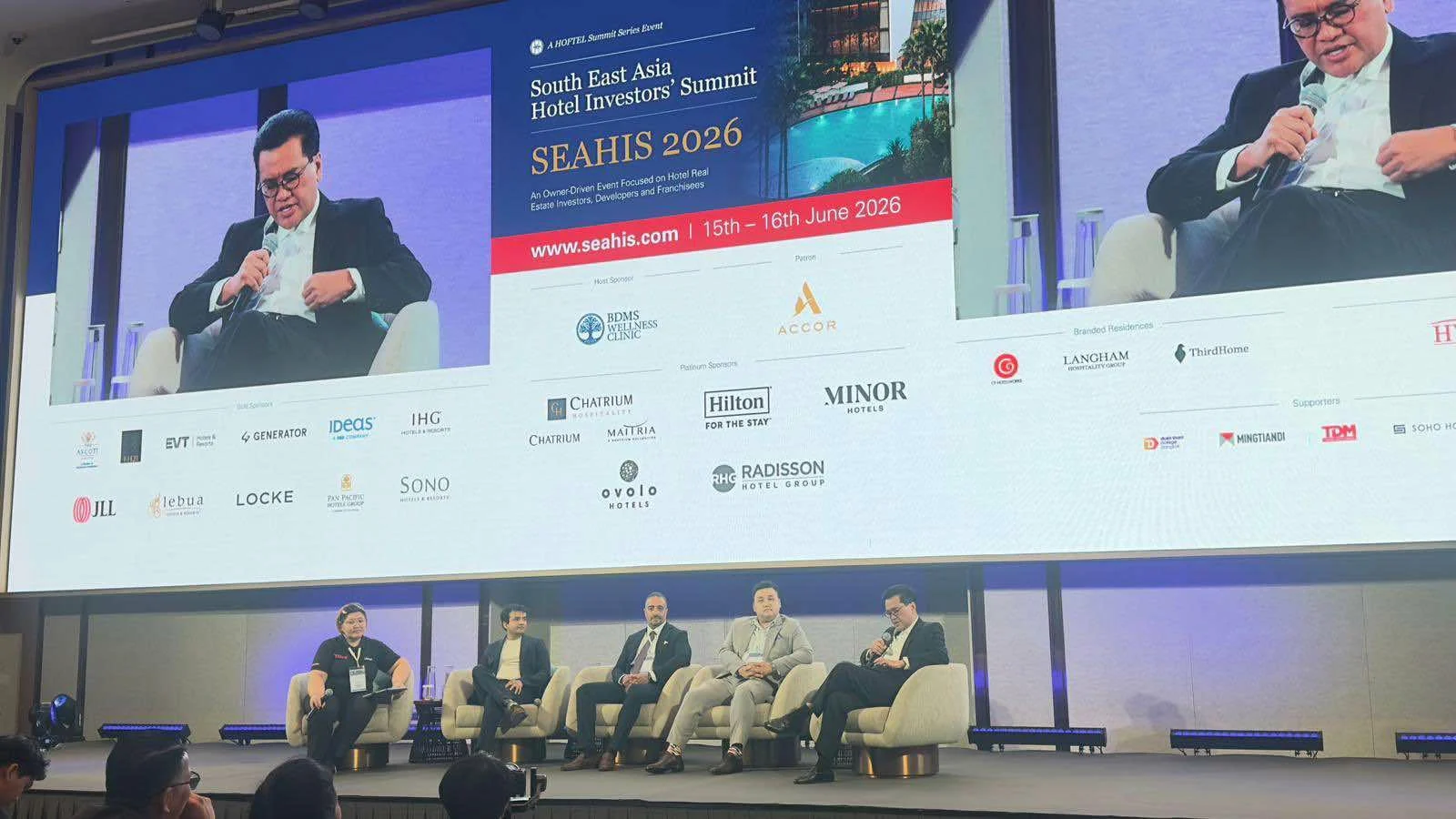
Independent hotel groups across Southeast Asia are increasingly turning to global alliances and franchise agreements as a strategic response to mounting distribution costs and the need for scale. At the South East Asia Hotel Investors’ Summit (SEAHIS) 2026, a panel moderated by Travel Daily Media brought together leaders from both sides of the independence debate to examine the trade-offs between loyalty alliances, franchising, and third-party management.
Plataran’s Collaborative Model
Dr. Yozua Makes, CEO of Plataran Hospitality, argued that independence need not mean isolation. “We believe there shouldn’t be a compromise per se between maintaining identity and brand collaboration,” he said. “In the hospitality business there are two very powerful words: authenticity and experience, and that’s where Plataran fits in.”
Plataran, one of Indonesia’s few comprehensive hospitality platforms, has built its strategy around flexibility. Rather than ceding control, the group partners with complementary brands. Makes highlighted the agreement with Japan’s Okura Hotels as a model: both entities retain their identities while collaborating on guest experiences that emphasize nature, Indonesian culture, and community spirit.
Ovolo’s Long-Term Partnership with Wyndham
Shivang Jhunjhnuwala, COO of Ovolo Group, shared insights from the group’s recent alliance with Wyndham Hotels & Resorts, announced in November 2025. “Since we opened with Wyndham, we've understood a lot of different things about each other,” he said. “When you go into a relationship, it's a lot of push and pull; it's a bit of a dance. Our partnership is a lot more robust because we do have a long-term commitment.”
Ovolo previously partnered with Small Luxury Hotels of the World (SLH), which in turn worked with Hilton. Jhunjhnuwala noted that Wyndham’s “arsenal of tools and different levers” allows Ovolo to remain 100% independently owned while accessing global distribution and sales support. The partnership is structured around two pillars: development, and distribution and sales. Ovolo can scale via management agreements and franchises but retains the right to decline deals that conflict with its values.
Wink Hotels’ Franchise Success with Hyatt
Michael Piro, co-CEO of Indochina Capital Corporation, presented a compelling case for franchising. His Wink Hotels portfolio—six properties totaling 1,500 keys—entered a franchise agreement with Hyatt that delivered immediate results: average daily rate (ADR) increased up to 35%, direct bookings rose sixfold, and corporate account penetration among Fortune 500 firms expanded significantly, while OTA commissions were negotiated lower.
Piro noted that further optimization is underway. “There is definitely still some redundancy and overlap that I need to work through,” he said. “As part of our arrangement, we negotiated that Hyatt had to have Vietnamese language provided by native Vietnamese speakers added to their call centres and reservation centres, so that we could reduce our burden of having an entire office full of reservation staff.”
Asset Manager’s Perspective: Location, Scale, Future-Proofing
Cuong Vu, head of hospitality asset management at Rox Asset, offered an owner’s viewpoint. He identified three critical factors: location, scale, and future-proofing. While distribution networks have historically driven alliances, Vu warned that AI and other technologies are rapidly reshaping consumer behavior. Travelers increasingly bypass traditional search and ask AI engines for highly contextualized recommendations.
“At the end of the day, when we're looking at solutions, we want to make sure that we're delivering something that our partners have the capabilities to do so,” Vu said. He advised owners to assess a partner’s execution capabilities over a five-year horizon, noting that the choice between independence and an alliance must serve the specific asset—whether a remote eco-resort or a city-center corporate hub.
For travel professionals, the message is clear: growth matters more than mere survival. As independent hotels navigate rising distribution costs and the need for scale, alliances and franchises offer viable paths—provided the partnership aligns with the property’s identity and long-term strategy. For more on how technology is reshaping hospitality, see our coverage of PHAL’s new agentic AI advisory for hospitality.