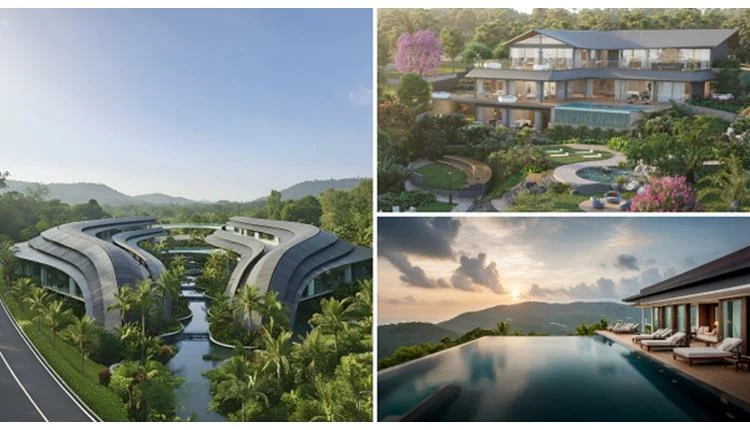
Vietnam has overtaken Thailand to become the largest market for branded residences in the Asia-Pacific region, according to the inaugural annual report from Global Branded Residences (GBR). The country now counts 16,135 units across 68 developments, edging out Thailand's 14,141 residences, which are spread across a larger number of 73 projects. Globally, Vietnam ranks third, behind only the United Arab Emirates and the United States.
The report, which tracks the sector's expansion worldwide, shows the Asia-Pacific region's branded residence pipeline has grown by 36% over the past year, now exceeding its completed stock. This mirrors a global trend that has pushed the total number of branded residence schemes past 1,972 across more than 100 countries. Asia-Pacific accounts for 20% of that global inventory, with Thailand, Vietnam, and India leading the way.
Phuket remains a resort powerhouse
Despite losing the regional top spot, Thailand remains a key player, particularly in the resort segment. Phuket alone hosts 32 branded residential schemes, making it the largest resort market in the world. The island's continued appeal is underscored by recent developments such as the Blue Tree Phuket community initiative, which won a Thailand Travel Trade Excellence Award in 2026.
Riyan Itani, founder of Global Branded Residences, emphasized the importance of counting actual units rather than just developments. "Counting the residences inside those developments tells you how much product is actually coming to market and how significant the buyer demand actually is," he said.
Vietnam's branded residence stock is concentrated in coastal destinations, with Ho Chi Minh City leading in the number of residences. Accor dominates the Vietnamese market, operating nearly half of the country's branded residences. This strong presence aligns with the group's broader regional strategy, which has also seen success in Thailand, as evidenced by the Chiang Mai Marriott's MICE Hotel of the Year win.
Price premiums and buyer diversity
The report also highlights that branded residences globally command a 44% price premium over non-branded equivalents. In Asia-Pacific, the market's diverse price positioning allows it to cater to a broader buyer base, with luxury developments accounting for 61% of the region's projects. This mix of ultra-high-end and more accessible offerings is helping to sustain demand across different investor segments.
The launch of the GBR Data Hub alongside the report provides stakeholders—from hotel groups to real estate developers—with comprehensive market intelligence. This tool is expected to become a reference for tracking supply, pricing, and trends in the branded residence sector.
For travel professionals, the shift in regional leadership has implications beyond real estate. Branded residences are increasingly integrated with hotel operations, offering extended-stay options and driving ancillary revenue. As Vietnam's coastal markets expand, hoteliers and tour operators may find new opportunities to package stays that combine resort amenities with residential comfort.
Thailand's continued strength in resort destinations like Phuket and Koh Samui—where properties such as the Mandarin Beach Villa have been recognized—shows that the competition for high-net-worth travelers remains intense. The report's findings suggest that both countries are likely to remain key battlegrounds for branded residence investment in the coming years.