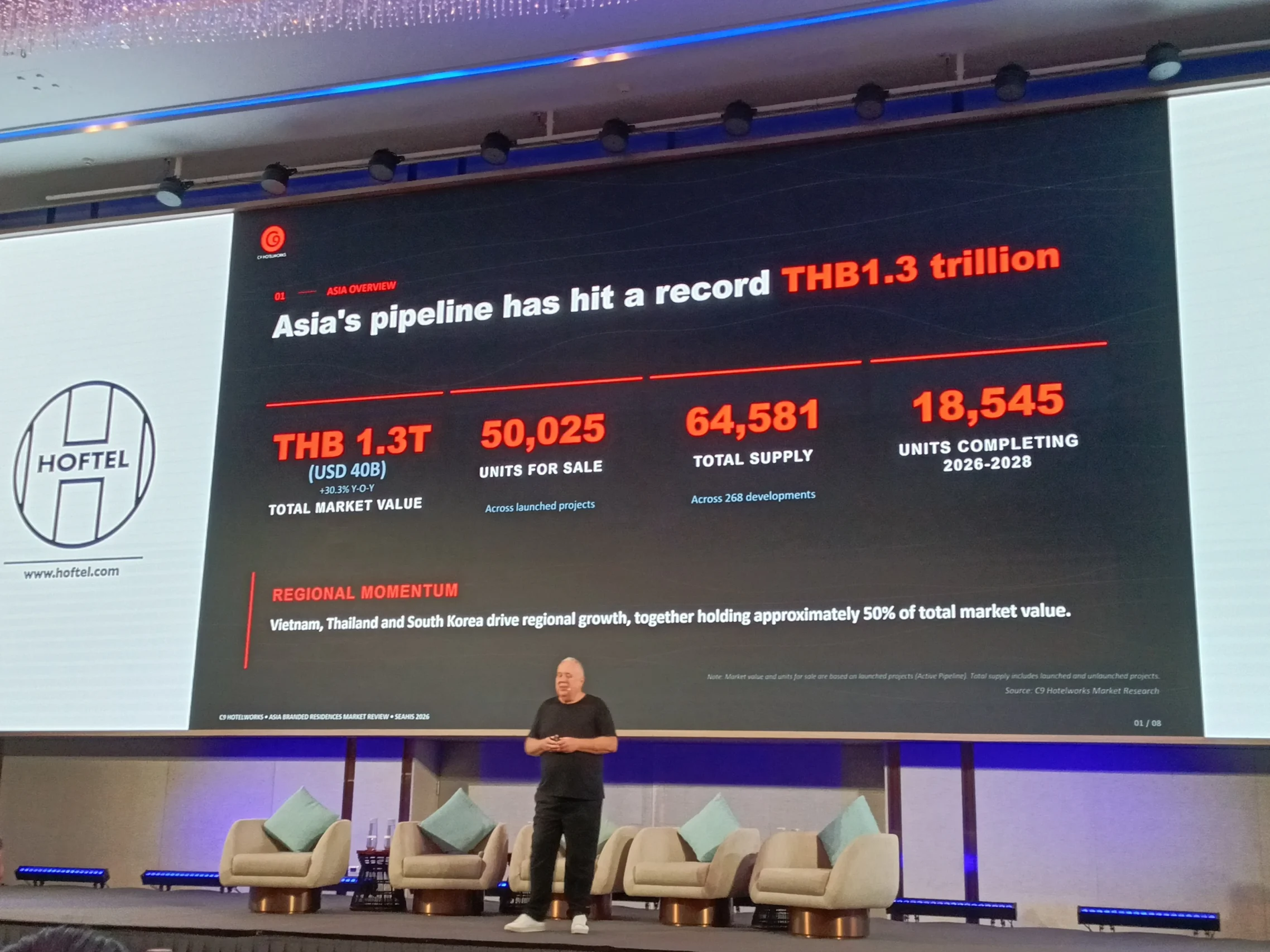
BANGKOK — The branded residences sector in Asia, valued at US$40 billion in units currently under development, is undergoing a structural transformation, according to Bill Barnett, founder and managing director of C9 Hotelworks. Speaking on Day 2 of the 2026 South East Asia Hotel Investors’ Summit (SEAHIS), Barnett outlined how post-pandemic demand, rising land costs, and tighter financial regulations are reshaping the landscape for hotel chains, developers, and investors.
Vietnam, Thailand, and South Korea Lead, but Paths Diverge
Vietnam has emerged as the region’s top market for hospitality-linked investment-grade properties, driven by an early-cycle development boom that began in 2022. Thailand, now entering a mature phase, is transitioning from a resort-centric model to a mixed-market approach, attracting buyers seeking long-term residences paired with luxury hotel services. South Korea, the third major player, is growing rapidly but operates primarily on fractional or membership ownership rather than full freehold title.
Barnett emphasized that the one-size-fits-all development paradigm of past decades is giving way to nuanced, country-specific ecosystems. “The Asian branded residences industry is a US$40 billion market — that’s the value of units currently for sale, not existing stock,” he said. “It’s a good market size, but it’s fragmenting.”
Urban Shift Reshapes Development
Soaring land values and evolving buyer preferences are driving a pivot from beachfront, hilltop, and mountainside projects toward high-rise urban condominiums and standalone developments not co-located with hotels. “We are seeing more condominium projects — that’s simply an indication of land value,” Barnett noted. “As land prices push up, it’s very expensive to find the right locations. For ultra-luxury projects, if you’re going to the beach, you get the first row of branded villas. But what about the second or third row? Who wants to be back there, peeking over your neighbor’s fence?”
This spatial reality has ignited growth in primary urban hubs like Bangkok, where premium penetration from brands such as SLS, InterContinental, and various upper-house concepts is accelerating. The trend mirrors broader shifts in Southeast Asian hospitality growth, where luxury, wellness, and business travel converge.
Standalone Models Gain Traction
Standalone branded residences — those not physically attached to a hotel or resort — are becoming a key growth vector. Global chains are leveraging these projects to boost earnings and expand their footprint without the constraints of Areas of Protection (AOPs) that often limit hotel brand placement in dense cities.
Barnett cited Four Seasons as an example: approximately 65 percent of its global pipeline now consists of mixed-use or residential projects. “Standalone is interesting because hotel brands all want to grow their earnings,” he said. “We’ll see that segment grow, and it could probably double in the next two to three years.”
Operators can also double their presence in a single market by using existing local hotel assets as a platform to dispatch specialized services or mobile concierge teams to standalone developments, effectively creating a secondary entry point.
Rental Pool Model Fades
The guaranteed rental pool — once a primary marketing hook — is becoming obsolete. Under the old model, total residential rental revenue was pooled and distributed purely by square meterage. Modern property technology and strict financial regulations, particularly in North America and Europe, have killed this approach.
“Most North American or listed hotel groups will not do rental pooling because of liability — they’re deemed to be selling a security,” Barnett explained. “Virtually none of the major hotel chains will do rental pools anymore.” Instead, the market is pivoting toward clean, top-line revenue-sharing models based on individual unit performance.
This regulatory shift aligns with broader trends in global travel market dynamics, where compliance and transparency are increasingly critical.
For travel professionals — from airline executives to hoteliers and tour operators — the message is clear: Asia’s branded residences sector is no longer a simple resort play. Urbanization, regulatory evolution, and brand strategy are rewriting the rules, creating both opportunities and challenges for those who adapt.