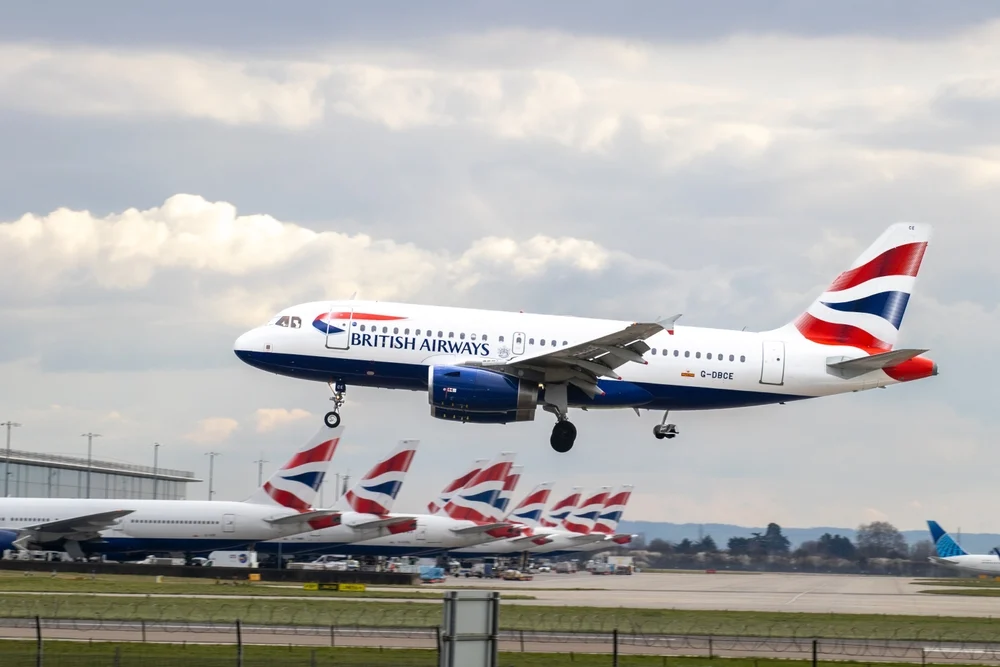
British Airways has emerged as the most expensive major airline in Europe on a per-seat basis, according to a new analysis by AirAdvisor. The study, which examined 23 European carriers, found that the IAG-owned flag carrier recorded a revenue per available seat kilometre (RASK) of 8.88 euro cents in fiscal 2025, up from 8.50 cents the previous year.
This places British Airways ahead of Air France (8.50 cents) and Lufthansa (8.45 cents), while easyJet, the UK's largest low-cost carrier, came in at 5.21 cents — the second-cheapest among the airlines studied. Wizz Air, the Hungarian ultra-low-cost carrier, posted the lowest RASK at 4.33 cents, creating a spread of 27.67 euro cents between the most and least expensive carriers.
Revenue trends diverge across Europe
AirAdvisor's analysis of publicly reported financial results for fiscal 2025 shows that eight of the 13 major airlines studied reduced their RASK year-on-year. British Airways, however, bucked the trend with a 4.5% increase, signalling a strategic push toward higher-yield traffic on long-haul routes from London Heathrow and other hubs.
Anton Radchenko, CEO of AirAdvisor, highlighted the practical implications for travellers. "If you're choosing between two airlines on the same route, what you pay per kilometre now depends heavily on which one you pick," he said. The findings underscore a widening cost disparity between full-service carriers and budget operators, a factor that travel buyers and corporate travel managers are increasingly weighing when negotiating contracts.
For travel professionals, the data offers a clear benchmark. British Airways' premium positioning — bolstered by its Club World business class and extensive network from London — commands a significant premium over low-cost rivals. Meanwhile, easyJet's competitive RASK reflects its efficient point-to-point model, which continues to attract price-sensitive leisure and business travellers across Europe.
The report comes as European airlines grapple with rising fuel costs, capacity constraints at major airports, and shifting demand patterns. Europe's leisure travel market remains a key driver, with WTTC data showing the region accounts for a third of global spend.
For travel agents and tour operators, the RASK gap between carriers can influence packaging decisions, particularly on popular routes where both full-service and low-cost options exist. The analysis also highlights the importance of ancillary revenue, which is not fully captured in RASK but contributes significantly to carriers like Wizz Air and easyJet.
AirAdvisor, known for its passenger rights advocacy, compiled the rankings using official financial disclosures. The firm's methodology focuses on RASK as a proxy for average fare levels, though it does not account for ancillary fees or baggage charges, which can narrow the effective price gap.
As the industry heads into 2026, the competitive landscape remains fluid. British Airways' continued investment in premium cabins and route expansion — including recent additions to its long-haul network — suggests the carrier is betting on sustained demand for high-end travel. Budget carriers, meanwhile, are likely to defend their cost advantage, keeping pressure on legacy airlines to justify their premium pricing.
For travel buyers, the takeaway is clear: carrier choice now has a measurable impact on per-kilometre costs, and understanding these dynamics is essential for managing travel budgets effectively.