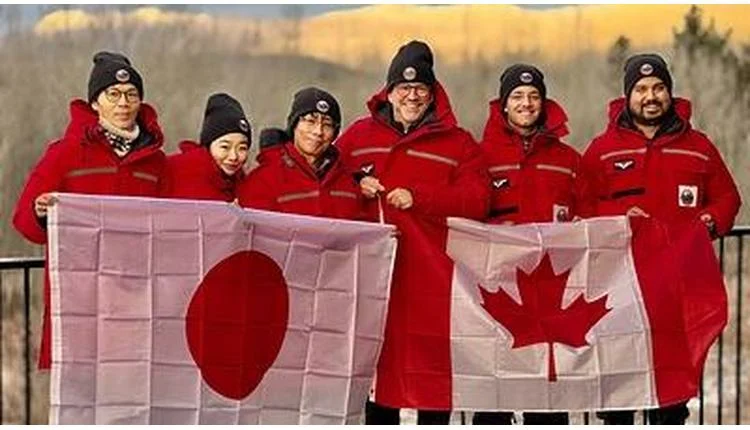
Landing Zones Canada Inc (LZC) and Meisei Electric Co Ltd have kicked off their first joint stratospheric flight campaign in Whitehorse, Yukon, running from 23 to 27 November 2026. Dubbed HoverEX1, the initiative is the first concrete activity under the International Project Consortium Agreement the two companies signed on 1 October 2026.
The campaign is testing the HoverloonEagle system, which pairs Meisei's Hoverloon stratospheric balloon with LZC's situational awareness communications payload. The goal is to validate long-range endurance operations at altitudes above 70,000 feet (20 kilometres), in temperatures that plunge to minus 70 degrees Celsius — a harsh proving ground for any airborne platform.
Strategic partnership in action
The collaboration falls under the Canada-Japan Comprehensive Strategic Partnership, announced by Prime Ministers Mark Carney and Sanae Takaichi, with a focus on defence, security, technology, and innovation. Spencer Fraser, CEO of LZC, said the rapid move from agreement to execution reflects strong support from Transport Canada and NAVCANADA. "We are grateful for the swift transition from agreement to execution," Fraser noted, "and for the support of Transport Canada and NAVCANADA in enabling this campaign."
Masanobu Natsuake, President of Meisei Electric, highlighted the broader significance of the work. "This campaign is a major step for stratospheric operations globally," he said, "and it strengthens our partnership with Canada."
The initiative addresses Canada's need for High-Altitude Platform Systems (HAPS) to deliver connectivity in remote regions, particularly for defence and emergency response. Flights are conducted under Transport Canada regulations, coordinated with NAVCANADA, and supported by the Arctic Training Centre.
For travel and tourism stakeholders, the implications extend beyond defence. Reliable high-altitude connectivity could eventually support aviation communications, remote tourism operations, and emergency services in Canada's vast northern territories — areas where traditional infrastructure is limited. The data gathered during HoverEX1 will inform future high-altitude connectivity solutions in challenging environments.
This test campaign comes as Japan continues to see strong travel demand, with record October arrivals despite a drop from China. Meanwhile, Canada's Arctic regions are increasingly on the radar for adventure tourism, though operators face logistical hurdles that improved connectivity could help address.
LZC and Meisei plan to analyse the flight data in the coming months, with an eye toward commercialising the HoverloonEagle system for both government and civilian applications. The partnership is expected to expand under the bilateral framework, potentially opening new opportunities for cross-border technology development.