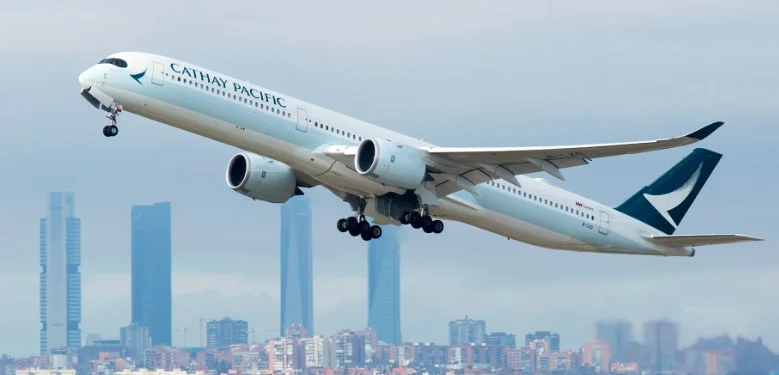
Cathay Pacific is set to resume passenger flights from Hong Kong to Dubai and Riyadh on September 1, marking a strategic move as the first Chinese airline to restart services to the Middle East. The Hong Kong-based carrier will operate daily flights to Dubai using Boeing 777-300ER aircraft, while the Riyadh route will run four times weekly with Airbus A350 jets. Cathay Cargo will also restart freight services to Riyadh from August 1, signaling a broader commitment to the region.
The resumption positions Cathay Pacific ahead of mainland Chinese carriers, which have yet to restore services from Beijing, Shanghai, Guangzhou, and Shenzhen to key Middle Eastern hubs such as Dubai, Abu Dhabi, Doha, and Tehran. In contrast, foreign carriers including Emirates, Etihad Airways, and Qatar Airways have already fully restored their China networks. Emirates currently operates 49 weekly round trips to mainland China, with double-daily services to Beijing and Shanghai, plus daily flights to Guangzhou, Shenzhen, and Hangzhou. Qatar Airways runs 56 weekly flights to and from Beijing, Shanghai, Guangzhou, Hong Kong, Chengdu, Chongqing, and Hangzhou, including double-daily service to Shanghai.
Strategic Implications for Travel Industry
This development underscores a shifting dynamic in the competitive landscape of China-Middle East air travel. For travel professionals—airline executives, hoteliers, tour operators, and agents—the return of a major Chinese carrier to these routes opens new opportunities for business and leisure travel. The Hong Kong-Dubai and Hong Kong-Riyadh connections are particularly significant for MICE and luxury travel segments, given Dubai's status as a global business hub and Riyadh's growing importance under Saudi Arabia's Vision 2030 tourism push.
The move also aligns with broader trends in the region. As noted in a recent Wego report, Middle East travelers increasingly demand personalization and flexibility, a factor that airlines and travel-tech vendors must consider when designing services. Cathay Pacific's resumption could spur mainland Chinese carriers to accelerate their own plans, potentially reshaping route networks and pricing dynamics.
For Hong Kong, the resumption bolsters its role as a key aviation hub, especially as the city continues to recover its MICE sector. The Lions International Convention returning to Hong Kong for a third time underscores the city's appeal for large-scale events, which will benefit from enhanced connectivity to the Middle East.
Cathay Pacific's move also has implications for the cargo sector. With freight services to Riyadh restarting in August, the airline is tapping into demand for logistics between Hong Kong and Saudi Arabia, a market that has grown with e-commerce and infrastructure projects. This complements the passenger services and provides a comprehensive offering for travel agents and corporate clients.
As the first Chinese carrier to resume Middle East flights, Cathay Pacific sets a precedent. Travel industry stakeholders should monitor whether mainland airlines like Air China, China Southern, and China Eastern will follow suit, potentially intensifying competition on routes that have been dominated by Gulf carriers. For now, Cathay Pacific's early move gives it a first-mover advantage in capturing demand from both Hong Kong and connecting markets across Asia.