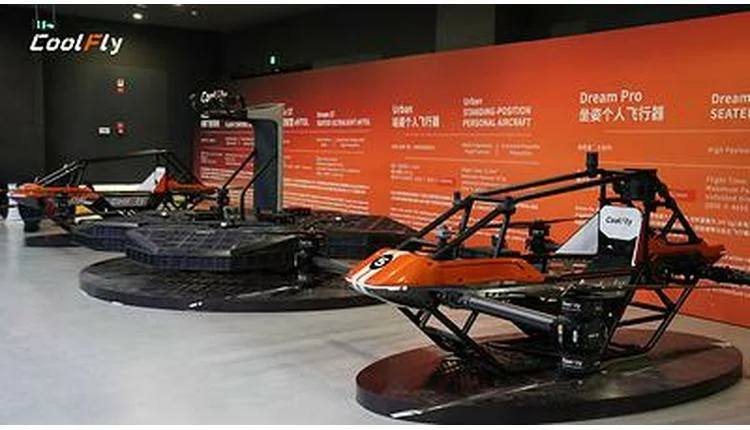
Chinese personal eVTOL developer CoolFly has taken the wraps off its latest innovation, the Urban, described as the world's first standing-position personal aircraft. The global product launch, held in Hangzhou on 13 August, also showcased the Dream series of seated models, the NA80 flight control system, and a series of strategic partnerships aimed at scaling the company's commercial footprint.
The Urban is positioned as a compact, intuitive aircraft designed for short urban hops. Its enclosed-propeller propulsion system and dual-redundant flight control architecture—developed in-house—are intended to lower the barrier to entry for personal flight. CoolFly's stated vision is to make personal aircraft more accessible and versatile, and the Urban's standing configuration is a deliberate departure from conventional seated designs, offering a smaller footprint and a more direct pilot experience.
Dream series expands the lineup
Alongside the Urban, CoolFly introduced two new seated models under the Dream banner. The Dream ST is tailored to ultralight aircraft regulations in both China and the United States, making it a candidate for early certification and delivery in those markets. The Dream Pro, meanwhile, ups the ante with greater payload capacity and extended flight endurance, targeting customers who need more range and carrying capability.
Both Dream variants come equipped with obstacle-detection radar and a whole-aircraft parachute system—features that are becoming standard in the emerging personal eVTOL segment. These additions reflect a broader industry push toward safety and redundancy, as regulators and consumers alike demand more than just novelty.
NA80 flight control system: a common brain
A key technical highlight of the event was the NA80 flight control system, which CoolFly says will serve as a unified platform across its entire aircraft lineup. The system is built on a dual-redundant architecture, with each control unit integrating three inertial measurement units (IMUs). This triple-redundant sensing approach is designed to provide fault tolerance and consistent handling characteristics across different airframes.
By standardizing on a single flight control platform, CoolFly aims to simplify certification, training, and maintenance—an approach that could resonate with fleet operators and training organizations eyeing the personal mobility market.
Partnerships and insurance coverage
CoolFly also used the launch to announce a partnership with the Zhejiang Institute of Security Technology, focused on industry-education collaboration. The move is part of a broader effort to build a talent pipeline for the personal aviation sector, which is expected to face a skills shortage as the industry scales.
On the insurance front, the company has secured agreements with PICC Property and Casualty and China Pacific Property Insurance, ensuring comprehensive coverage for its aircraft. These deals are critical for customer confidence, particularly in a nascent market where risk perception remains a hurdle.
CoolFly continues to expand its global dealer network, with a focus on product delivery, customer support, and market development. The company's strategy appears to be moving from concept to commercialization, with a clear eye on international markets—particularly the US, where the Dream ST's regulatory alignment could open doors.
The personal eVTOL sector is heating up, with players like Emirates and Arsenal exploring aviation-themed partnerships, but CoolFly's standing-position design is a distinctive bet. Whether the Urban's ergonomics and safety case will convince regulators and early adopters remains to be seen, but the company's integrated approach—aircraft, avionics, and insurance—suggests a serious bid for market leadership.
For travel professionals, the development of personal eVTOLs could eventually reshape short-haul urban mobility, complementing existing MICE travel and business travel ecosystems. While the technology is still in its infancy, CoolFly's launch marks a notable step toward making personal flight a practical option for the industry's future.