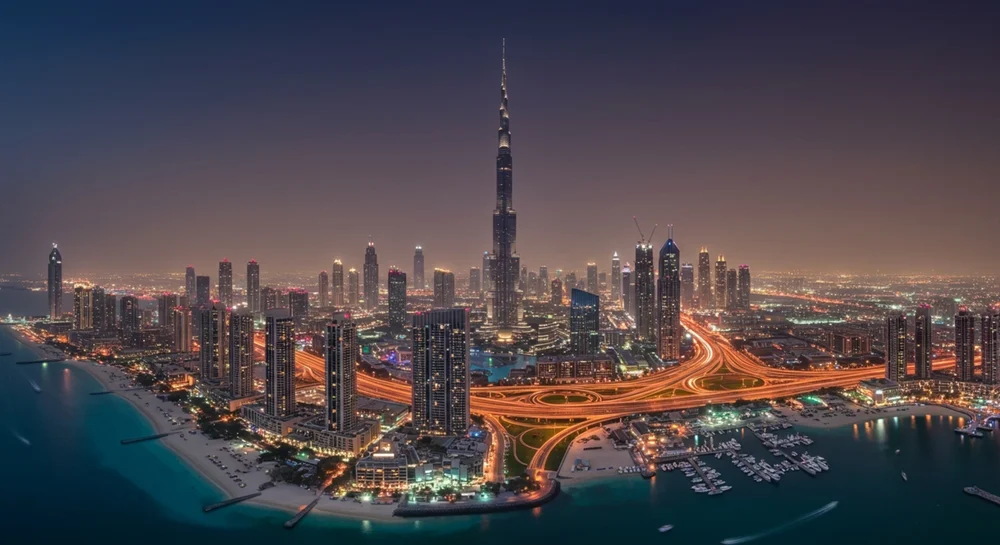
Dubai’s hospitality sector is navigating a recovery path after a turbulent first half of 2026, with restored long-haul capacity from Gulf carriers beginning to translate into stronger hotel bookings for the crucial winter season. The city’s tourism economy, heavily reliant on international air connectivity, faced a severe shock earlier this year when regional conflict forced airlines to cancel and reroute flights, disrupting the flow of visitors that feeds hotels, attractions, and retail.
H1 performance: a sharp reversal
According to the Dubai Hospitality Market Performance H1 2026 report from Cavendish Maxwell, which draws on STR and Data.Dubai figures, average hotel occupancy in the first half stood at 56.4%, while average daily rate (ADR) fell 7% to AED701. This marks a stark contrast to 2025, when Dubai welcomed a record 19.59 million international overnight visitors, up 5%, and average hotel occupancy reached 80.7%. Occupied room nights rose 4% to 44.85 million, as reported by the Dubai Department of Economy and Tourism.
The downturn was not a typical tourism slowdown. Regional conflict closed airspace, forced cancellations, and weakened the connectivity that underpins Dubai’s visitor economy. Demand itself did not evaporate; rather, access became the bottleneck. Restoring that access is now the primary driver of recovery.
Gulf carriers lead the rebuild
Gulf carriers have moved quickly to restore networks as operating conditions stabilise. Emirates and flydubai are adding substantial capacity, but the city’s tourism economy also depends on foreign airlines feeding travellers from Europe, Asia, Africa, and the Americas. Cavendish Maxwell estimates Emirates has restored about 85% of its pre-conflict capacity, with further additions expected.
By July, confidence among Dubai’s aviation leadership had strengthened. Emirates President Tim Clark said the airline was operating close to full capacity, while Dubai Airports chief executive Paul Griffiths pointed to improving conditions at the hub. Every restored long-haul frequency puts potential guests back into Dubai’s hotel pipeline, supporting tour operators, destination management companies, airport retailers, and the city’s meetings and events business.
Demand signals improve, but booking windows shorten
August brought more encouraging signs. UAE hotels have reported an improvement in reservations ahead of the peak winter period, and operators are recruiting again across front office, housekeeping, food and beverage, guest relations, and commercial functions. Hiring is a meaningful indicator: hotels do not add staff on sentiment alone; decisions are tied to expected occupancy and forward business.
However, booking windows have shortened. TUI, Europe’s largest tour operator, reported on 12 August that booked revenue had risen 7% over the previous four weeks, despite geopolitical uncertainty. Chief executive Sebastian Ebel noted that customers are still travelling but increasingly booking closer to departure. This trend complicates forecasting for Dubai hotels. Forward bookings may look softer in August and September, only for demand to surge closer to the travel date. Revenue managers face a dilemma: discounting too early could prove costly if late demand materialises.
Diversified source markets provide resilience
Dubai enters this recovery with a more diversified visitor economy than in earlier regional crises. Western Europe accounted for about 21% of visitors entering 2026, while the CIS and Eastern Europe, GCC, and South Asia each contributed around 15%, according to CBRE’s UAE Real Estate Market Review. This spread gives tourism authorities, airlines, and hotel groups flexibility to shift capacity and marketing as confidence recovers at different speeds across markets.
The UK remains vital for winter leisure demand, while India supports a mix of leisure, business, and visiting-friends-and-relatives traffic. Russia and the wider CIS are valuable to the luxury segment, and GCC visitors provide shorter-haul regional demand. Asian markets continue to be central to Dubai’s long-term growth strategy. Hotels have reported improving booking trends from the UK, Russia, and CIS, with demand expected to strengthen as the events and festive calendars gather pace.
The easing of travel warnings has helped, particularly for British travellers who faced concerns over security, insurance, and flight disruption. Removing these obstacles does not produce an overnight surge, but it allows the booking pipeline to reopen. Timing is on Dubai’s side: the city’s strongest international leisure period traditionally runs from October into the first quarter, giving the industry several months to rebuild connectivity before its most commercially important season.
Mid-market hotels offer a buffer
One of the more revealing findings in Cavendish Maxwell’s H1 data is the relative resilience of Dubai’s mid-market hotels. That matters because Dubai’s accommodation market has been expanding rapidly, with new supply entering the pipeline. Mid-market properties, which cater to a broader range of travellers, have shown greater stability during the disruption, providing a buffer for the overall market.
As the recovery gains traction, hoteliers are also watching developments such as Anantara The Palm’s new adults-only rooms, which respond to growing demand for privacy in Dubai. Meanwhile, the return of long-haul flights is not just a Dubai story; it also supports broader travel trends, such as Emirates’ recent fam trip for Singapore agents, which aims to boost inbound travel from Asia.
For travel professionals, the key takeaway is that Dubai’s recovery is underway, but it will be uneven and late-booking. Hoteliers should resist aggressive discounting and instead focus on flexible pricing strategies that capture last-minute demand. The winter season will be a test of how quickly the city can bounce back, and the signs are cautiously optimistic.