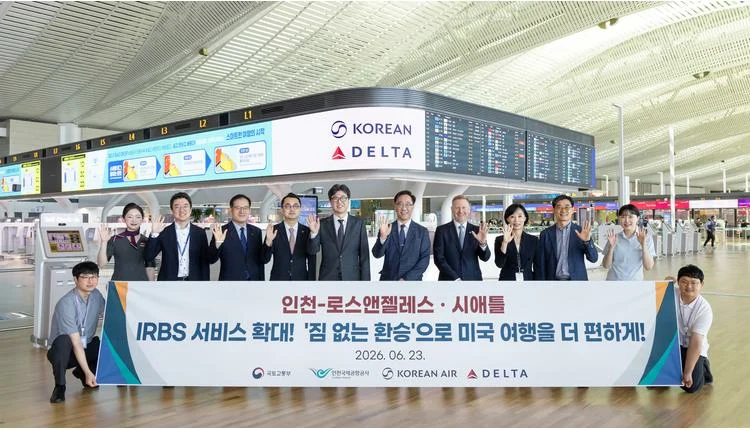
Korean Air and Delta Air Lines have extended their Seamless Baggage Transfer service to two additional US gateways: Seattle-Tacoma International Airport (SEA) and Los Angeles International Airport (LAX). The move, effective June 23, 2026, allows passengers originating from Incheon International Airport (ICN) to avoid the traditional process of collecting and rechecking luggage during US connections, saving an estimated 20 minutes per transfer.
The service relies on International Remote Baggage Screening (IRBS) technology, which screens checked baggage before it arrives in the United States. This pre-clearance enables travelers to proceed directly to their connecting gates upon landing, bypassing customs baggage recheck areas. The expansion brings the total number of US airports offering the service to five, joining Atlanta (ATL), Minneapolis-St. Paul (MSP), and Detroit (DTW).
Operational Impact and Passenger Benefits
Since its debut on the Incheon–Atlanta route in August 2025, the Seamless Baggage Transfer has delivered measurable improvements in passenger flow. According to data shared by the carriers, customs interactions have dropped by over 65% for eligible passengers, reducing congestion at baggage claim and recheck counters. The service is particularly valuable for business travelers and those with tight connections, as it eliminates a major friction point in the international-to-domestic transfer process.
Kwangho Ko, Senior Vice President at Korean Air, commented: “Our joint venture with Delta continues to strengthen connections between Korea and the United States. This expansion reflects our commitment to making the travel experience smoother for our customers.” Jeff Moomaw, Vice President – Asia Pacific at Delta Air Lines, added: “By expanding this service to Seattle and Los Angeles, we enable customers to move through US airports more efficiently, which is especially important as travel demand between Asia and the Americas continues to grow.”
The joint venture between Korean Air and Delta, now in its eighth year, has been a cornerstone of transpacific connectivity. The airlines coordinate schedules, share revenue, and offer reciprocal lounge access and frequent flyer benefits across their combined network. The Seamless Baggage Transfer is one of several initiatives aimed at enhancing the customer journey, alongside investments in lounge upgrades and digital tools. Korean Air recently won six Cellars in the Sky Awards for its 2026 wine program, underscoring its focus on premium onboard experiences.
Industry observers note that the expansion to Seattle and Los Angeles is strategically significant. Seattle serves as a key Delta hub for Pacific Northwest routes, while Los Angeles is a major gateway for both airlines, offering connections to destinations across the US, Latin America, and Asia. The service is expected to appeal to both leisure and business travelers, particularly those connecting to Delta’s extensive domestic network from Korean Air’s long-haul flights.
Looking ahead, the carriers have indicated plans to extend the Seamless Baggage Transfer to additional US markets. While no specific airports or timelines have been announced, the technology’s success on the initial routes suggests further expansion is likely. For travel professionals, the service represents a tangible improvement in operational efficiency and customer satisfaction, potentially influencing booking decisions for transpacific itineraries.
In related developments, Delta has been retrofitting its Boeing 737 fleet with VCT finlets for fuel savings, while Korean Air continues to modernize its widebody fleet. The joint venture’s focus on seamless connectivity aligns with broader industry trends toward reducing friction in international travel, a priority for airlines, airports, and technology providers alike.