For decades, the divide between full-service and low-cost carriers was clear: one bundled everything, the other charged for every extra. That line is blurring fast. In 2027, legacy airlines are borrowing the LCC playbook, monetising comfort in economy cabins while keeping baseline legroom tight. The result is a modular economy experience where passengers pay for what they value—sleep, space, or connectivity.
Sleep becomes a premium product
Carriers are rolling out novel ways to rest on long-haul flights without a business-class ticket. United Airlines will debut its Relax Row on select Boeing 777 and 787 aircraft, allowing passengers to book three economy seats that convert into a flat bed with a mattress pad and bedding. Air New Zealand is preparing to launch Skynest, a bank of six stacked bunk pods in the economy cabin, available for four-hour nap sessions at roughly US$495. These products target the growing demand for rest on ultra-long-haul sectors, especially as airlines like Qantas prepare to launch non-stop Sydney–London flights in October 2027.
For passengers seeking guaranteed elbow room, United's incoming Airbus A321XLR fleet will feature a dedicated Economy Plus row where the middle seat is permanently replaced by an armrest-to-armrest table. This modular approach to seating is a direct response to the rise of ultra-long-haul narrowbody networks, which are opening new city pairs and changing how airlines configure their cabins.
Cabin hardware gets a major upgrade
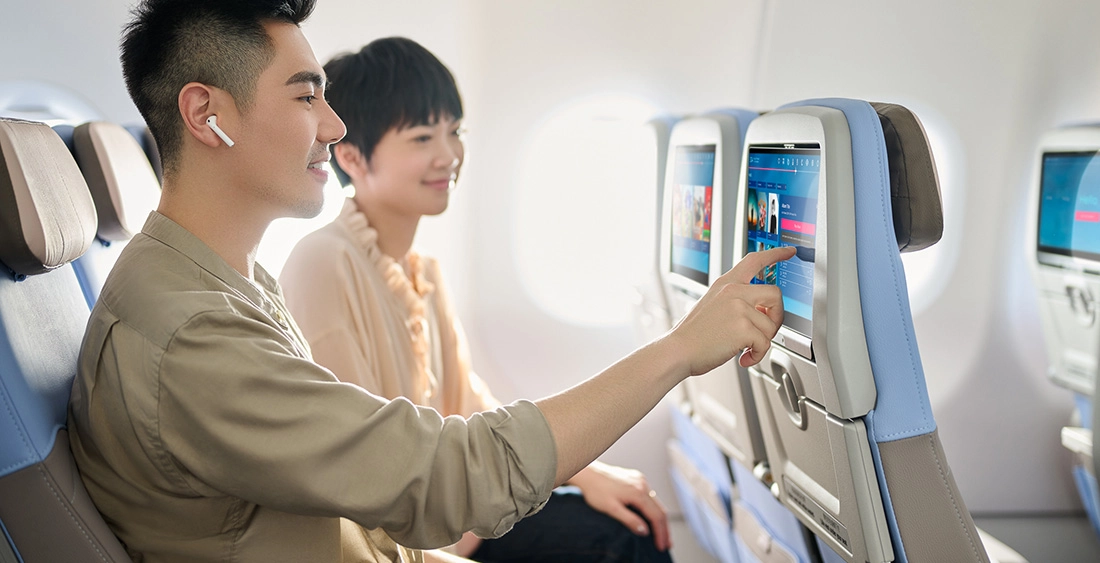
Cabin hardware is also undergoing a substantial overhaul, with several global airlines announcing retrofits scheduled for mid-to-late 2027. These renovations focus on personal connectivity and self-service convenience. Singapore Airlines, across its refurbished Airbus A350-900s and incoming Boeing 777-9s, alongside Aer Lingus on its retrofitted A330s, will roll out 4K seatback touchscreens equipped with USB-C charging and direct Bluetooth audio pairing. High-speed connectivity is rapidly transitioning from a paid luxury to a baseline expectation, led by carriers such as Aer Lingus offering complimentary gate-to-gate Starlink Wi-Fi.
Onboard service flows are evolving alongside hardware. To streamline cabin movement, airlines including United and Aer Lingus are replacing traditional mid-flight trolley runs with walk-up refreshment stations. This shift reduces congestion in the aisle and allows cabin crew to focus on more personalised service. Qantas will introduce a dedicated well-being zone for stretching and movement on its Project Sunrise flights, recognising the physical demands of 20-hour journeys.
A new sales model for economy seats
Behind the scenes, fleet economics and pricing models are reshaping how economy seats are sold. Accelerated deliveries of the Airbus A321XLR will place more economy flyers onto single-aisle jets for eight- to 11-hour intercontinental journeys, unlocking direct links between secondary cities. This trend is evident in recent route expansions, such as British Airways' Gatwick–Colombo service, which is opening new markets for both leisure and business travel.
Despite persistent fuel and supply chain pressures, American Express Global Business Travel forecasts modest growth in the economy fare segment in 2027, projecting increases of 2.1 percent to 2.6 percent within Asia. On the other hand, growth of around 0.3 percent to 0.8 percent could be seen across European and transatlantic routes. This divergence reflects the varying recovery trajectories and demand patterns across regions.
Fare segmentation continues to sharpen. Legacy airlines rely heavily on stripped-back Basic Economy tiers, while ultra-low-cost carriers like Frontier will introduce front-of-cabin first-class seating in March 2027 to capture yield from price-sensitive flyers willing to pay selectively for comfort. This convergence of business models is a defining feature of the 2027 aviation landscape.
As the industry adapts, travel management companies and corporate buyers are watching closely. The modular economy cabin means more ancillary revenue opportunities for airlines, but also more complexity for travellers. Travel technology platforms are evolving to display these options transparently, helping agents and corporate bookers compare total costs. The days of a single economy fare are numbered; the future is a menu of choices.