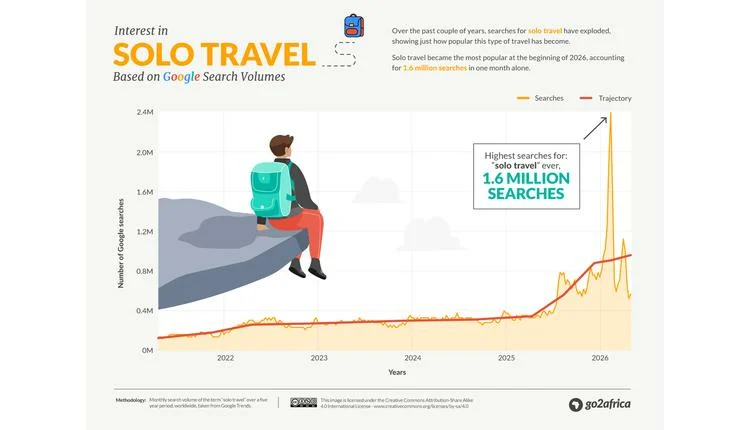
The solo travel segment has seen a dramatic 230% increase in search interest over the past decade, according to the Luxury Solo Travel Report from Go2Africa. The report, which draws on search data and internal booking trends, recorded 1.6 million global searches for "solo travel" in January 2026 alone, underscoring a structural shift in traveller behaviour.
Go2Africa's analysis shows that solo travellers are increasingly intentional and research-driven. Some 81.18% of solo travellers now have a clear destination in mind before booking, up from 72.83% in 2024. The proportion who conduct pre-trip research has more than doubled, rising from 7.16% in 2024 to 17.20% in 2025. This suggests that tour operators and travel agents need to invest in detailed, destination-specific content and personalised trip planning tools to capture this audience.
Luxury Safari and High-Value Solo Travellers
Within Go2Africa's own luxury safari business, solo travellers have become the fastest-growing segment. Enquiries from solo travellers rose from 13.07% of total in 2024 to 15.42% in 2025. The United States remains the dominant source market, contributing over 50% of solo traveller enquiries and posting a 26.26% year-on-year increase. This aligns with broader trends in customised travel demand seen in other markets.
Critically, solo travellers exhibit higher spending power. The report finds that solo travellers spend 42.8% more per person than couples, reflecting a willingness to invest in premium experiences such as private guides, upgraded accommodation, and exclusive safari camps. However, they tend to book shorter trips: 30.1% prefer itineraries of around 10 days, compared to longer durations typical of group or couple travel.
This high-value profile makes solo travellers an attractive target for luxury hotel groups like Aman, Belmond, and Singita, as well as for tour operators specialising in curated experiences. Airlines such as Emirates and Singapore Airlines, which offer premium economy and business-class solo traveller fares, could also benefit from targeted marketing campaigns.
The rise of solo travel also intersects with broader shifts in travel distribution. As noted in recent analysis of social commerce and AI, younger travellers increasingly book based on influencer recommendations and digital content. Solo travellers, who are often more research-driven, may be particularly receptive to AI-powered trip planning tools and personalised social media campaigns.
For travel agents and online travel agencies, the data underscores the need to segment solo travellers separately from couples and groups. GDS systems like Amadeus and Sabre could enhance their offerings by enabling filters for solo-friendly inventory, such as single-occupancy rooms with no supplement, or small-group tours designed for solo participants.
Go2Africa's report also highlights that solo travellers value flexibility and freedom over rigid itineraries. This aligns with the growing demand for modular, bookable components — a trend that companies like Trip.com Group and Expedia are already capitalising on. The expansion of ITB China to address personalised travel demand further signals the industry's recognition of this shift.
As the solo travel segment continues to expand, travel industry stakeholders — from airlines and hotel chains to destination marketing organisations and tour operators — should reassess their product offerings and marketing strategies. The data from Go2Africa makes clear that solo travellers are not a niche but a growing, high-spending demographic that rewards targeted attention.