European airport operators entered the summer anticipating another season of steady growth, but the escalation of the US-Iran conflict has redrawn parts of the continent's aviation map. Passenger flows have shifted, long-haul networks have been disrupted, and the response to geopolitical shocks varies sharply among airports.
Holiday-focused airports have attracted travelers avoiding the Middle East, while major connecting hubs face weaker Gulf traffic, longer flight routings, and higher operational costs. The result is a split market where some operators revise forecasts upward even as others navigate growing uncertainty.
Spain emerges as the biggest winner
No European airport operator has capitalized on the changing travel landscape more than Aena. The Spanish airport group reported a 12% rise in first-half net profit to €1 billion after handling 156.2 million passengers, prompting it to lift its full-year passenger growth forecast from 1.3% to 3%. The stronger outlook reflects robust international demand as Spain continues to attract travelers looking for Mediterranean holidays away from regions affected by geopolitical tensions.
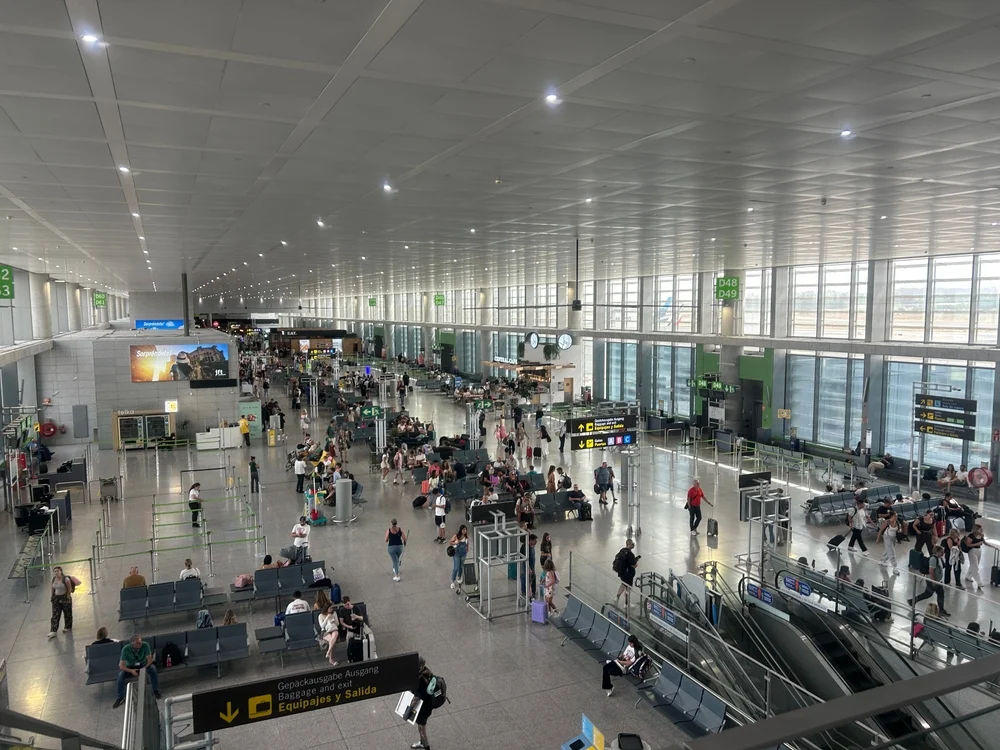
The trend extends well beyond Madrid-Barajas and Barcelona-El Prat. Airports serving Spain's leisure markets—including Palma de Mallorca, Málaga-Costa del Sol, Alicante-Elche, and the Canary Islands—have all benefited from another exceptionally strong summer, reinforcing Spain's position as one of Europe's safest bets for international tourism. The timing is notable: Europe had already been experiencing a broad recovery in leisure travel, but renewed instability in the Middle East appears to have accelerated booking shifts rather than creating entirely new demand. For Aena, that has translated into fuller terminals, stronger commercial revenues, and confidence to upgrade traffic expectations while many of its European counterparts remain more cautious. The operator has nevertheless warned that geopolitical uncertainty continues to cloud the outlook for the remainder of the year, a reminder that today's gains remain closely tied to an unpredictable global environment.
Heathrow finds resilience in disruption
If Spain illustrates the upside of shifting traveler preferences, London Heathrow tells a more complicated story. The UK's busiest airport has felt the immediate impact of weaker demand on Middle East routes. Heathrow's first-half earnings came under pressure as conflict-related disruption reduced traffic to the region and contributed to a softer financial performance. Yet Heathrow's role as one of Europe's largest intercontinental hubs also helped cushion the blow. As airlines rerouted services around restricted Middle Eastern airspace, transfer traffic through London increased, offsetting part of the decline in direct Gulf-bound passengers. During the height of the disruption, connecting passenger volumes rose while airlines adjusted schedules to bypass conflict zones. The experience highlights an important distinction between network hubs and destination airports. While Heathrow remains exposed to global geopolitical events, the breadth of its airline network allows it to absorb changing traffic flows more effectively than airports dependent on a narrower range of international markets.
Europe's hubs face a tougher operating environment
The wider picture across Europe has been less encouraging. Figures published by ACI Europe showed that April marked the first year-on-year decline in passenger traffic since the industry's post-pandemic recovery began in 2021. Passenger volumes across European airports slipped by 0.7%, with the airport association pointing to geopolitical instability, rising operating costs, and softer consumer demand as key factors behind the slowdown. ACI Europe Director General Olivier Jankovec described the Middle East conflict as one of several developments weighing on the market just as the pace of aviation's recovery had begun to moderate. Large international hubs have carried much of that burden. Airport operators including Groupe ADP (Paris), Fraport (Frankfurt), Flughafen Zürich, and Heathrow depend heavily on long-haul connectivity and premium international traffic. That exposure has made them more vulnerable to route suspensions, changing airline schedules, and weaker demand on services linking Europe with the Gulf. Regional leisure airports, by contrast, have generally proved more resilient, supported by strong intra-European holiday demand and travelers choosing destinations perceived to be lower risk. ACI Europe's May traffic figures suggested conditions had begun to stabilise, with passenger numbers returning to growth. Even so, the association noted that performance across the continent remained uneven, reflecting the differing exposure of airports to international geopolitical events.
Airspace closures continue to reshape airline networks
For airlines and airports alike, the operational consequences of the conflict have extended far beyond cancelled routes. According to EUROCONTROL's European Aviation Overview, flights between Europe and the Middle East have remained volatile throughout the summer. Traffic recovered briefly after diplomatic efforts eased tensions in June before weakening again following renewed instability in July. By late July, flight volumes between Europe and the Middle East remained below last year's levels. Those changes have forced airlines onto longer routings that avoid restricted airspace, increasing flight times, fuel consumption, and crew costs. For airport operators, that translates into more complex stand planning, greater pressure on ground handling operations, and less predictable aircraft scheduling during one of the busiest periods of the year. The operational disruption is also placing greater emphasis on flexibility. Airports capable of accommodating irregular operations—such as those with ample gate capacity and robust ground handling resources—are better positioned to manage the ripple effects. Meanwhile, the broader industry continues to monitor how shifting demand patterns might influence future network planning, particularly on routes connecting Europe with Asia via the Gulf. As the situation evolves, airport operators across the continent are recalibrating their expectations, with some raising forecasts and others bracing for further uncertainty.