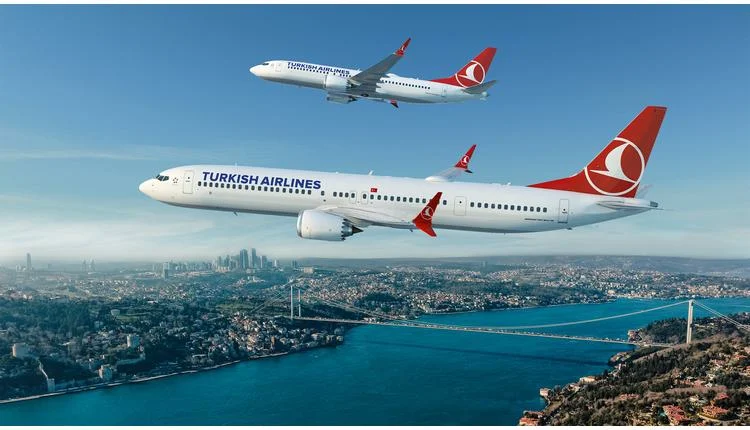
Turkish Airlines has cemented its growth strategy with a landmark order for up to 150 Boeing 737 MAX aircraft, marking the carrier's largest-ever single-aisle purchase. The deal, finalized in the presence of Turkish President Recep Tayyip Erdoğan, comprises 100 firm orders for the Boeing 737-8 and options for an additional 50 aircraft, with substitution rights for the larger 737-10.
The agreement, which had been under discussion since 2025, is designed to bolster Turkish Airlines' short- and medium-haul network, particularly on high-demand routes across Europe, the Middle East, and Africa. The 737-8 offers a 20% reduction in fuel consumption and emissions compared to its predecessor, aligning with the airline's sustainability targets.
Fleet expansion and flexibility
Murat Şeker, Chairman of the Board and the Executive Committee at Turkish Airlines, emphasized the strategic importance of the deal. "This agreement marks another significant step in the continued expansion of our fleet," he said. "The new Boeing 737 MAX aircraft will bring greater efficiency and flexibility to our operations."
Stephanie Pope, CEO of Boeing Commercial Airplanes, echoed that sentiment, noting, "This order reflects the trust and shared vision that have defined our long-standing partnership with Turkish Airlines." The carrier already operates more than 200 Boeing aircraft, including the 737 MAX and the 787 Dreamliner.
The flexibility embedded in the order—particularly the option to switch to the 737-10—allows Turkish Airlines to adapt to shifting passenger demand and route dynamics. This is a critical capability for a carrier that has aggressively expanded its network, now serving more countries than any other airline.
Industrial participation and local ecosystem
Beyond the aircraft purchase, Turkish Airlines and Boeing signed a strategic Memorandum of Understanding on Industrial Participation. This agreement focuses on skill development, value creation, and business awards, aiming to strengthen Türkiye's aviation ecosystem. It underscores a deepening partnership that extends beyond fleet transactions into broader economic collaboration.
The order also signals confidence in the single-aisle market, which has seen robust recovery in regional travel. For travel professionals, this move positions Turkish Airlines to capture more connecting traffic through its Istanbul hub, a key gateway between Europe and Asia. The efficiency gains from the 737 MAX will likely translate into more competitive fares on short-haul routes, benefiting both leisure and corporate travelers.
Industry observers note that the deal could pressure rival carriers in the region to accelerate their own fleet renewal plans. Turkish Airlines' commitment to the 737 MAX also reinforces Boeing's recovery in the narrowbody segment, following a period of production challenges.
For agents and tour operators, the expanded capacity and improved economics may open new opportunities for package deals and group bookings, particularly on routes to emerging destinations. The airline's continued investment in its fleet aligns with its strategy to maintain a young, fuel-efficient aircraft portfolio, a factor increasingly important to corporate clients with sustainability mandates.
As Turkish Airlines integrates the new aircraft, its operational flexibility will be tested. The substitution rights for the 737-10 provide a hedge against demand volatility, allowing the carrier to upsize capacity on routes that outperform expectations. This adaptability is a hallmark of modern fleet planning, and Turkish Airlines is positioning itself to remain a dominant player in global aviation.
The deal also has implications for the broader travel industry, as fleet expansions often lead to new route announcements and increased frequencies. Turkish Airlines has been a pioneer in connecting secondary cities, and the 737 MAX's range and efficiency could enable even more point-to-point services, bypassing traditional hubs.
In related news, Finnair's expansion of its Tokyo network highlights the competitive dynamics in long-haul travel, while Vietjet's Starlink rollout underscores the growing importance of in-flight connectivity. Turkish Airlines' order, however, is a clear statement of intent in the single-aisle segment.
With delivery slots secured, Turkish Airlines is expected to receive the first of the new 737 MAX aircraft within the next few years. The airline's engineering and training divisions are already preparing for the integration, ensuring a smooth transition into its existing fleet.
For travel professionals, the message is clear: Turkish Airlines is doubling down on efficiency and network growth. The order is not just a fleet update—it is a strategic lever to enhance competitiveness, reduce operating costs, and expand its global footprint.