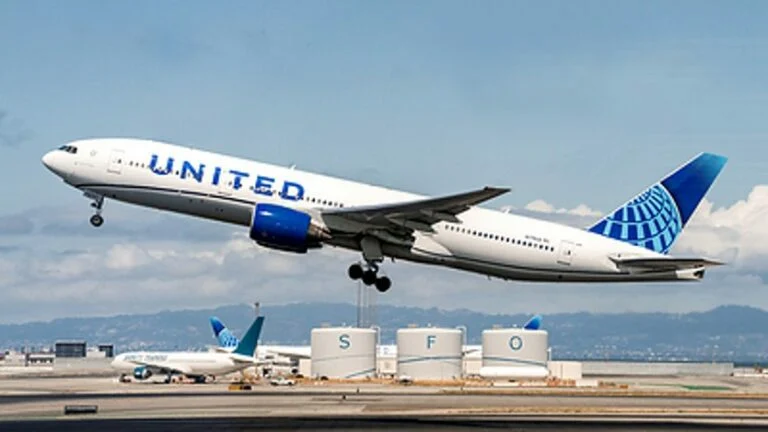
United Airlines has taken a significant step in its inflight connectivity strategy by launching the first Starlink-equipped widebody passenger flight. United Flight 14, operating a Boeing 777-200 from Newark/New York to London Heathrow, now offers SpaceX’s low-earth-orbit satellite internet to passengers. This marks the beginning of a rapid deployment that will see nearly 60 widebody aircraft fitted with Starlink by the end of 2025, with the airline targeting full widebody fleet connectivity by summer 2026.
Widebody Rollout and Fleet Scale
United already has Starlink installed on more than 400 aircraft, primarily narrowbodies, and expects to reach close to 1,000 Starlink-equipped planes before year-end. The widebody expansion is critical for long-haul routes where connectivity has historically been unreliable over oceans and polar regions. The carrier’s Boeing 777-200, 787 Dreamliner, and Airbus A350 fleets are all slated for installation.
“This is a meaningful milestone, not just for United, but for anyone who has ever stared at a spinning Wi-Fi icon somewhere over the Atlantic,” said a United spokesperson. The airline is betting that consistent, high-speed internet will become a core differentiator in the premium transatlantic market, where competitors like Delta Air Lines and American Airlines are also investing in satellite-based connectivity through partners such as Viasat and Intelsat.
Impact on Long-Haul Travel Experience
Starlink’s low-earth-orbit constellation promises latency as low as 20 milliseconds and download speeds exceeding 200 Mbps, enabling activities that were previously impractical at 35,000 feet. Passengers can stream 4K video, participate in video conferences, play online games, and collaborate on shared documents without the buffering and dropouts typical of air-to-ground or geostationary satellite systems.
United is offering the service free to MileagePlus members, a move that strengthens loyalty program value on routes to London, Tokyo, Paris, Buenos Aires, and other long-haul destinations. For corporate travellers and business-class passengers, the ability to remain productive across the Atlantic could influence carrier choice, particularly on competitive city pairs like Newark-London and Chicago-Frankfurt.
The broader industry shift toward connectivity as a competitive lever is evident. Airlines are no longer treating Wi-Fi as a paid add-on but as an essential component of the cabin experience. United’s combination of Starlink and its growing seatback screen network positions it to offer a seamless digital environment that rivals the connectivity expectations of modern offices and homes.
Broader Industry Context
This rollout comes as global tourism continues to rebound, with transatlantic travel seeing strong demand. United’s investment in Starlink aligns with trends highlighted in recent industry reports, such as the record $11.6 trillion global tourism contribution, though climate risks remain a concern. For travel agents and corporate booking platforms, the availability of reliable inflight connectivity is increasingly a selling point for premium itineraries.
The technology also has implications for MICE travel, where delegates expect to stay connected during long-haul flights to finalize presentations or join virtual meetings. United’s Starlink deployment could make its widebody fleet more attractive for group bookings and incentive travel.
For more details, visit the official United Starlink page.