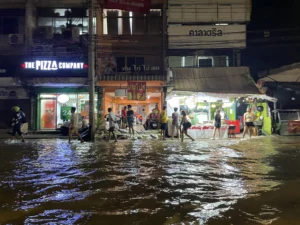
For travel professionals, the true test of a destination's resilience often comes not in the boardroom but on the ground when systems are stretched. A recent journey from New York to Bangkok during the September 2026 floods offered a stark reminder that while airlines and airports have crisis plans, the decisive factor is often the willingness of ordinary people to step in.
The traveler, a veteran of Thailand's tourism and hospitality sector, departed JFK on September 27 as a nor'easter battered the East Coast. The first leg, operated by EVA Air as part of a Thai Airways itinerary, landed in Taipei after a long trans-Pacific crossing. The final leg, Thai Airways flight TG637 to Bangkok, was delayed over five hours, pushing departure from 7:55 a.m. to 1 p.m.
While waiting, the traveler knew his Bang Kapi neighborhood was flooded but had no word on his home's condition. He had long believed that effective crisis management hinges on two pillars: solving the problem and communicating clearly while doing so. That belief was about to be tested.
Arrival at Suvarnabhumi: A test of patience
Landing at Suvarnabhumi Airport late on September 28, immigration was surprisingly efficient—cleared in under 20 minutes. But the baggage hall told a different story. Bags were piled everywhere, passengers milled about with no seating, and no airline representatives were visible. The traveler received no text, email, or app notification about the delay. The carousel display simply read "BAG DELAY" at 6:17 p.m. After two hours, his bags arrived intact.
This experience underscores a broader industry challenge: when disruptions occur, proactive communication is often the first casualty. For airlines like Thai Airways, the lesson is clear—even a simple update can transform passenger anxiety into a manageable wait.
The last mile: A community response
Leaving the airport past 8 p.m., the real journey began. Taxis were scarce, and drivers were reluctant to enter flooded areas. One driver eventually attempted the trip but turned back when streets became impassable, dropping the traveler at a petrol station. There, a second driver—an SUV owner whose own home had been flooded for days and who had been sleeping in his vehicle—offered to try. They navigated flooded roads until reaching ABAC Hua Mak Campus, where water depths exceeded 20 centimeters.
With 300 meters still to go, the traveler decided to walk, lifting his luggage into water that rose from ankle to knee, and in places nearly a meter deep. Halfway, an Assumption University student appeared and helped carry the bags. Then a pickup truck—the community's improvised transport—stopped and carried him the rest of the way.
This last-mile assistance, provided by locals and students, proved more effective than any official response. It echoes the resilience seen across Bang Kapi and Ramkhamhaeng, where residents have adapted with informal networks of trucks and volunteers.
For travel industry stakeholders, the episode offers actionable insights. Airlines must invest in real-time disruption communication, as Bangkok floods strain travel infrastructure at the start of peak season. Hotels and local tourism boards could formalize community-based transport options, as seen in the pickup truck networks. The Moxy Bangkok Ratchaprasong's sustainability certification shows how properties can lead in resilience, while upcoming openings like Langham's Bangkok Custom House will need to factor such risks into their operations.
The traveler reached home wet and exhausted, but grateful. The floodwater had receded enough to enter, and he began cleanup. His story is not unique—it is a microcosm of how Bangkok's residents and frontline workers, from immigration officers to taxi drivers, become the true crisis managers when systems fail.
As the industry looks to new air links like Air Astana's Astana-Bangkok route, the lesson is universal: resilience is built not just in control centers, but in the kindness of strangers who decide to help.