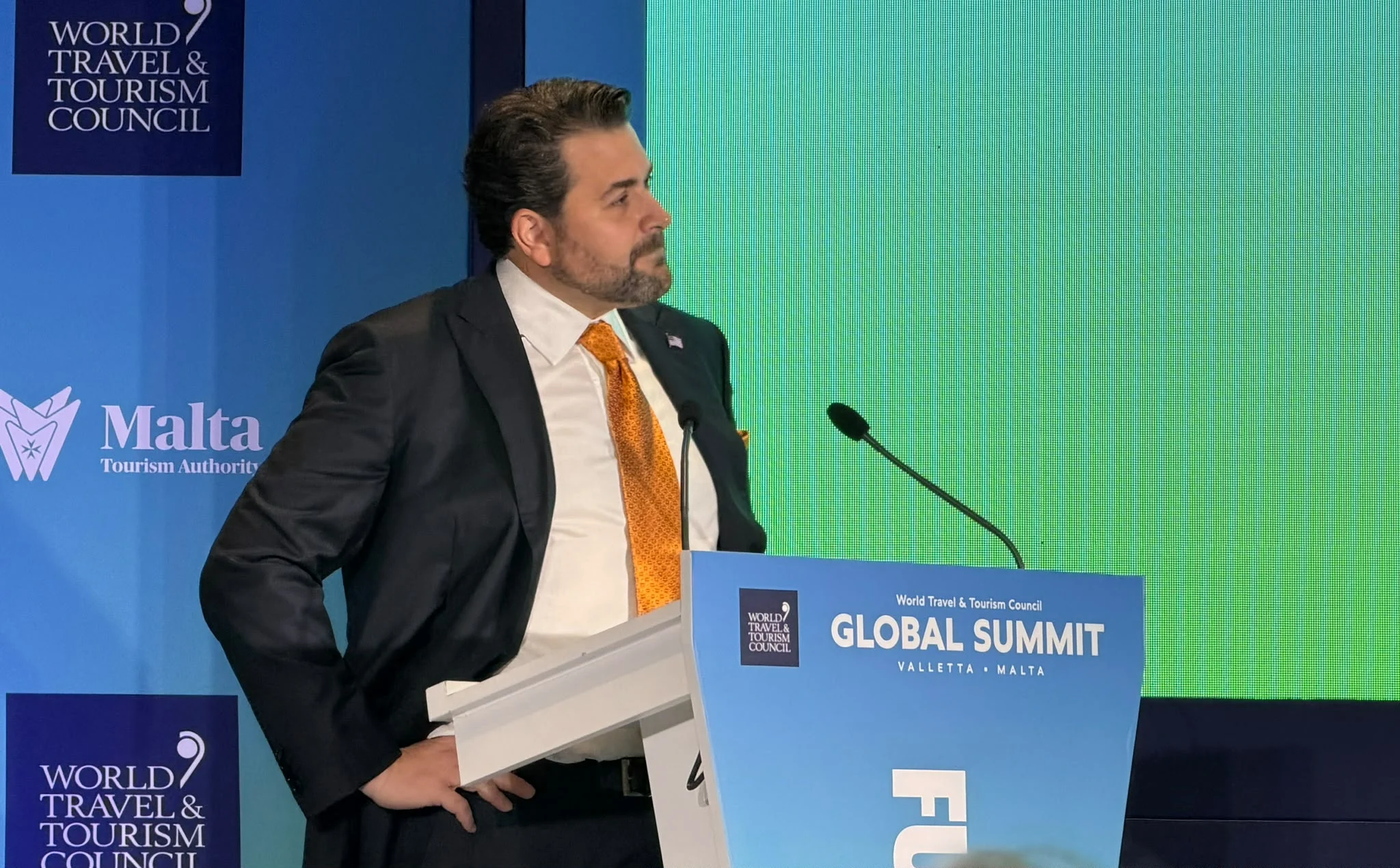
At the 2026 WTTC Global Summit in Malta, U.S. Special Presidential Envoy for Tourism Nick Adams delivered a clear message to the assembled global hospitality executives, destination marketers, and travel advisors: prioritize traveler happiness over political noise. Accepting the Global Leadership Pioneer award, Adams fielded pointed questions from a press corps of 30, including Christopher Head, GM and Managing Editor of TDM.
Adams addressed the friction points that have been dampening international travel demand: tariff disputes, passport control bottlenecks, and a noticeable dip in Canadian border crossings. His counsel was direct: keep doors open, eliminate friction, and shield consumer travel from geopolitical turbulence.
“We are in the business of happiness, and a tourism boycott is misery... As leaders in the tourism space, we should be pro-tourism, not anti-tourism.”
The stakes are high. Washington has set an ambitious target of 100 million international visitors annually by 2030. Achieving that will require more than polished ad campaigns; it demands a fundamental rethinking of how the U.S. welcomes the world.
The Decade of the Mega-Event
Adams pointed to an unprecedented run of global events as a key driver. Following the FIFA World Cup, the U.S. will host the 2028 Los Angeles Olympic and Paralympic Games, both Men’s and Women’s Rugby World Cups, the FIFA Women’s World Cup, and is backing Miami’s bid for World Expo 2035. This ten-year calendar offers a unique opportunity to channel international visitors beyond host cities into secondary markets, rural scenic routes, and smaller regional towns.
For destination marketing organizations, the strategy is to build itineraries that plug into these mega-event corridors. Instead of selling static landmarks, the focus should be on authentic, daily local experiences—regional food halls, quirky main streets, and genuine hospitality. This approach aligns with the WTTC's latest growth forecasts, which show travel demand outpacing earlier projections.
Trade Friction vs. Peer Trust
Adams acknowledged that big events cannot fully mask political headlines. When trade talks sour or regulatory friction hits the news, potential visitors hesitate. For travel advisors and intermediaries, the antidote lies in authentic peer-to-peer proof. Traditional destination marketing videos are losing ground to unscripted, user-generated content from real travelers. Younger demographics are not seeking manufactured tourist traps; they want everyday lifestyle tourism.
“When policy debates create noise, authentic stories from returning travelers do far more heavy lifting than expensive ad spots,” Adams said. For trade partners across Canada, Europe, and Latin America, sharing real traveler experiences is proving the most effective way to reassure hesitant clients.
Five-Star Service at Passport Control
Perhaps the most surprising revelation was Adams’ plan to overhaul border customs. Recognizing that a two-hour queue and a cold reception can ruin a trip, his office is bringing in five-star hospitality experts—the same firms that train luxury hotel staff—to retrain airport immigration and border control personnel. The goal is not to compromise security but to infuse guest-first principles into the process. If America wants to welcome 100 million people, the welcome needs to feel warm from minute one.
This focus on seamless arrival experiences resonates with broader industry trends. For instance, luxury properties like Copacabana Palace are investing in high-end amenities to enhance the guest journey, while cruise lines like Holland America are revamping ships to meet evolving expectations.
Key Takeaways for the Industry
- For DMOs & Regional Boards: Build itineraries that plug directly into nearby mega-event corridors. Don't sell static landmarks; sell authentic, daily local experiences.
- For Travel Advisors: Leverage real, peer-to-peer visitor testimonials to overcome geopolitical hesitation in core source markets.
- For Hospitality Operators: Anticipate a shift toward experience-driven international travelers who value seamless service from the moment they step off the plane.
Adams’ message is a call to action for the entire industry: focus on the traveler, not the politics. As the U.S. gears up for a decade of mega-events, the opportunity is immense—but only if the welcome mat is truly out.