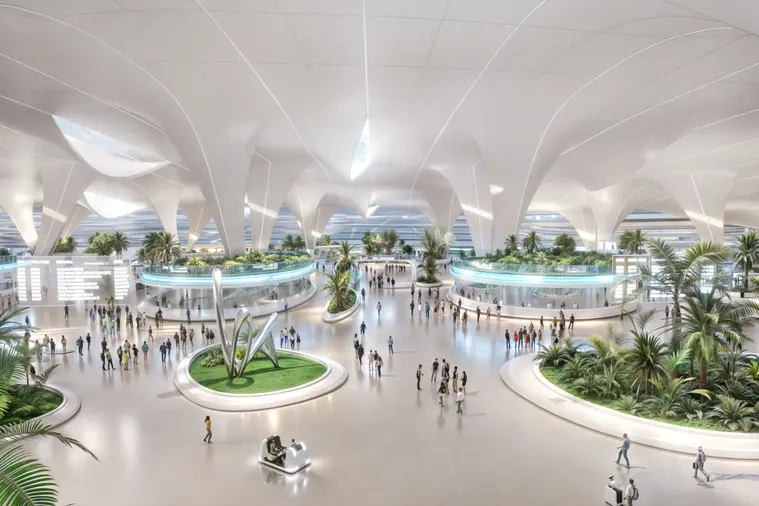
Dubai is accelerating its long-term aviation strategy as Dubai International Airport (DXB) approaches maximum capacity. The emirate's AED128 billion (US$35 billion) expansion of Al Maktoum International Airport (DWC) will transform the facility into the world's largest airport by passenger capacity, with five parallel runways and 400 aircraft gates capable of handling 260 million travellers annually.
A Strategic Pivot from DXB to DWC
DXB, one of the busiest international airports globally, processed over 92 million passengers last year, connecting travellers to hundreds of destinations across six continents. However, its urban location leaves no room for further expansion. In contrast, Al Maktoum International Airport, situated within the Dubai South development zone, offers ample space for growth and is designed to accommodate future aviation trends.
Dubai's leadership has confirmed that airline operations, including those of Emirates and flydubai, will eventually transition to DWC. This consolidation will create a single, unified aviation hub capable of supporting the emirate's growth ambitions for decades. The first operational phase is targeted for 2032, with major construction contracts already awarded and billions of dirhams under execution.
More Than an Airport: An Aerotropolis
Al Maktoum International Airport is being designed as the centrepiece of a fully integrated aerotropolis, combining passenger transport, cargo operations, logistics, commercial districts and residential developments. The project aligns with Dubai's Economic Agenda D33, which aims to double the size of the emirate's economy and strengthen its position as a global hub for trade, tourism and logistics.
Industry experts expect the airport to reshape Dubai's growth geography. Areas such as Dubai South and Expo City are emerging as major beneficiaries, with developers, investors and businesses positioning themselves to capitalise on anticipated demand. Property analysts predict the airport's influence will extend well beyond its immediate vicinity, creating new commercial corridors and logistics clusters across southern Dubai.
For aviation stakeholders, the scale is significant. The airport is designed to process up to 12 million tonnes of cargo annually alongside its passenger operations, reinforcing Dubai's role as a critical node in global supply chains. This convergence of passenger and cargo operations is increasingly important as airlines seek diversified revenue streams and destinations pursue integrated tourism and trade strategies.
AI at the Core of Operations
A defining feature of Al Maktoum International Airport will be its extensive use of artificial intelligence and next-generation digital technologies. According to project planners, AI will be integrated into multiple touchpoints across the passenger journey, from check-in and baggage handling to security screening and operational management. The objective is to create a highly automated airport ecosystem capable of managing unprecedented passenger volumes while maintaining efficiency and service quality.
AI-driven systems are expected to support predictive maintenance, real-time passenger flow management, automated border control, smart baggage tracking and advanced resource allocation. These technologies could significantly reduce operational bottlenecks while improving turnaround times for airlines. For travel companies, airlines and airport operators worldwide, Al Maktoum International Airport may serve as a blueprint for future airport design, demonstrating how technology can be leveraged to address capacity constraints without compromising customer experience.
Implications for Travel Industry Stakeholders
The new airport is expected to increase connectivity, create additional route opportunities and enhance Dubai's competitiveness as a global transit hub. Airlines will benefit from greater slot availability, while tourism stakeholders can anticipate stronger visitor flows as capacity constraints ease. The project is also likely to stimulate investment across hospitality, retail, MICE and logistics sectors. Hotels, convention centres, travel technology firms and destination management companies operating in and around Dubai South stand to benefit from the emergence of a new economic cluster centred on aviation.
As global aviation prepares for the next era of growth, Al Maktoum International Airport represents more than a record-breaking infrastructure project. It is a strategic statement about the future of air travel—one where scale, technology and connectivity converge to create a new benchmark for aviation hubs worldwide.