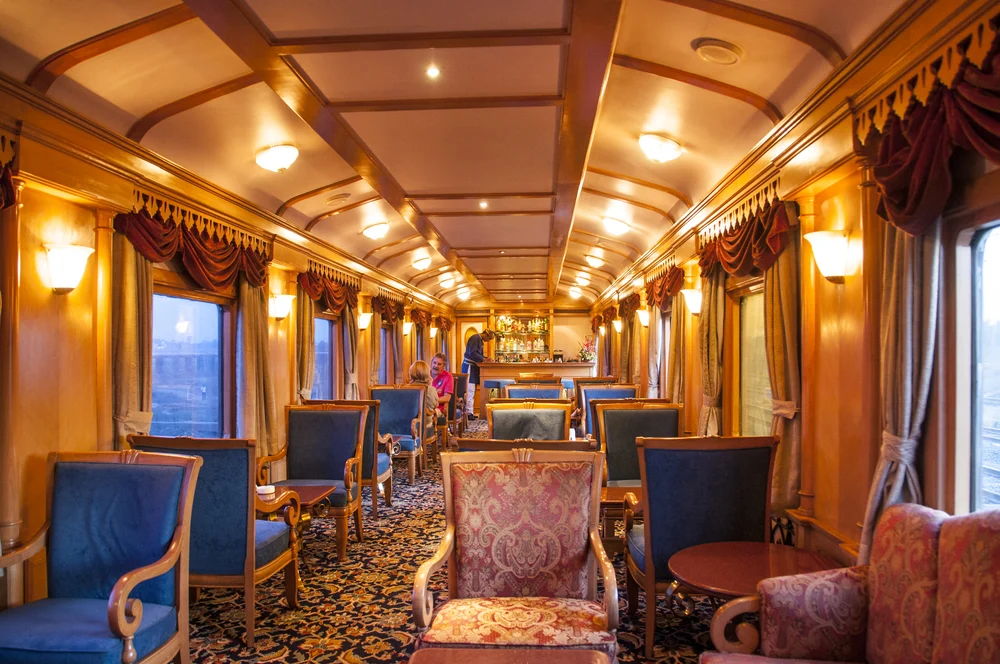
India's railway narrative has moved beyond new rolling stock and faster connections. At the premium end, rail is being recast as a destination in itself, with luxury trains stitching together heritage, wildlife, and cultural circuits. For travel professionals, these products offer a single package that bundles transport, lodging, dining, and excursions—appealing to affluent clients who want a slower, more immersive way to see the subcontinent.
The commercial case is clear: luxury rail lets operators replace multiple hotel changes and long road transfers with one seamless journey. It also lends itself to private charters, honeymoons, incentive groups, and high-value independent travellers. Five trains remain central to this offering, each with a distinct regional focus.
Rajasthan's royal anchor
The Palace on Wheels, launched in 1982 and inspired by the coaches of princely states, remains the sector's flagship. Its seven-night itinerary—Delhi, Jaipur, Ranthambore, Chittorgarh, Udaipur, Jaisalmer, Jodhpur, Bharatpur, and Agra—combines Rajasthan's forts and palaces with wildlife and the Taj Mahal. For overseas operators, especially those selling comprehensive India programmes, this single-rail solution simplifies logistics and has long been a key selling point.
At the ultra-luxury end, the Maharajas' Express operates at a higher price point, pushing Indian rail into the international luxury segment. Its itineraries cover Delhi, Agra, Ranthambore, Jaipur, Jodhpur, and Udaipur, with shorter options like the three-night Treasures of India linking Delhi, Agra, Ranthambore, and Jaipur. For advisors, the train functions less as transport and more as a premium accommodation and sightseeing product, fitting comfortably into high-end India programmes where clients pay for privacy and service.
Beyond the Golden Triangle
The Deccan Odyssey shifts the focus to Maharashtra, offering access to a region traditionally less dominated by luxury rail than Rajasthan. Its itineraries incorporate Mumbai and the state's heritage sites, with some journeys extending toward Rajasthan and the north. On board, guests find luxury cabins, dining, lounges, and wellness facilities. The commercial opportunity lies in diversification: for repeat visitors to India, a Maharashtra-led journey provides an alternative to the familiar Delhi-Agra-Rajasthan circuit, while combining urban gateways with cultural experiences.
South India enters the conversation with the Golden Chariot, which spans Karnataka, Goa, Tamil Nadu, and Kerala. Its routes feature Mysuru, Hampi, Mahabalipuram, Thanjavur, and Kerala, connecting the region's architecture, temples, cuisine, and wildlife. This regional focus matters because South India's premium attractions are spread across several states, often requiring a mix of road and air travel. A luxury train offers a cohesive way to link them, complementing existing beach and wellness programmes in Kerala and Goa rather than competing with Rajasthan's circuit.
The Royal Rajasthan on Wheels offers another take on the classic northern circuit, with itineraries including Delhi, Jaipur, Jaisalmer, Jodhpur, Udaipur, Chittorgarh, Bharatpur, and Agra. Its positioning reflects Rajasthan's enduring strength as India's most established luxury tourism region, where palaces, forts, wildlife, and desert experiences provide a ready-made itinerary.
A niche with wider implications
Luxury trains remain a small slice of India's overall rail and tourism markets, but they allow the industry to package multiple high-value experiences into one product at a time when affluent travellers increasingly seek experiential and slower forms of travel. They also give operators another tool for selling India beyond conventional city-to-city routes. The business case extends to groups: private charters, incentives, and special-interest departures can turn a train into a destination itself, with pre- and post-tour extensions in gateways like Delhi, Mumbai, and Bengaluru.
India's broader rail modernisation is also reshaping the context. Faster conventional services and better connectivity make rail a more practical component of mainstream tourism, while luxury trains occupy a different end of the spectrum—one where time, service, and experience are the value proposition. As the segment evolves, it aligns with broader trends in premium travel, such as the rise of wellness and sustainability in luxury properties and the demand for meaningful, low-risk experiences.
For travel advisors and tour operators, the key is positioning these trains not as mere transport but as integral components of a curated itinerary. With the right marketing, luxury rail can tap into the growing appetite for authentic, unhurried journeys—an opportunity that extends beyond India's borders, as seen in other markets like Colombo's integrated resort and Norwegian Aura's debut.