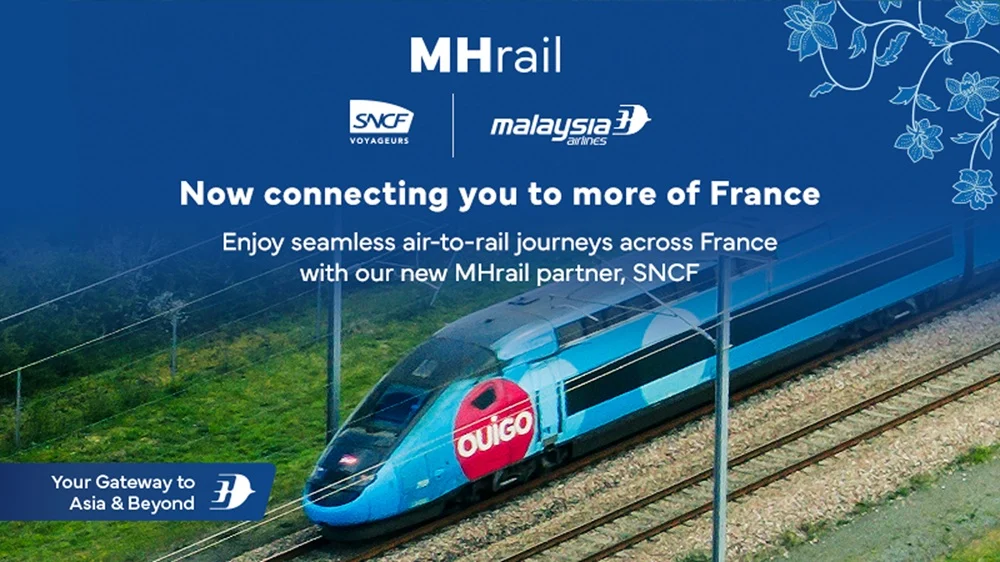
Malaysia Airlines has announced a strategic partnership with SNCF Voyageurs, France's national rail operator, to offer integrated air and rail travel between Paris Charles de Gaulle Airport and 28 destinations across France. The collaboration, effective 10 July 2026, allows passengers to book a single itinerary combining flights and high-speed rail journeys, enhancing convenience and connectivity for travellers heading to regional hubs such as Lyon, Strasbourg, and Marseille.
Single Itinerary, Seamless Connectivity
Under the SNCF TRAIN + AIR product, Malaysia Airlines will place its marketing code on SNCF-operated rail services, enabling customers to book rail segments via AccesRail’s IATA code “9B”. This integration is part of the carrier’s broader MHrail programme, which already connects air and rail at key global gateways including Seoul and London Heathrow. The move underscores Malaysia Airlines’ commitment to redefining connectivity through strategic partnerships, extending its network reach beyond traditional aviation routes.
Bryan Foong, CEO of Airline Business at Malaysia Aviation Group, stated: “This partnership with SNCF Voyageurs represents a key step in advancing our broader strategy to deliver truly seamless, end-to-end connectivity for our customers across Europe.” The executive’s comments highlight the airline’s focus on multimodal travel as a competitive differentiator in the long-haul market.
Expanding the MHrail Network
The MHrail programme is central to Malaysia Airlines’ efforts to offer seamless intermodal journeys at major European gateways. By integrating with SNCF’s high-speed TGV network, the airline can now provide onward connections from Paris to cities such as Bordeaux, Nantes, and Lille, as well as to secondary markets like Avignon and Montpellier. This is particularly relevant for business travellers and leisure tourists seeking to explore France’s regions without the hassle of separate bookings.
The partnership also aligns with broader industry trends toward air-rail codeshares, as seen with other carriers such as Lufthansa and Deutsche Bahn, and Air France-KLM and Thalys. For travel agents and tour operators, the single-ticket solution simplifies itinerary planning and reduces the risk of missed connections, a key selling point for corporate travel managers and MICE planners.
Implications for the Travel Industry
For airline executives, this deal demonstrates how carriers can leverage rail partnerships to expand their virtual network without adding aircraft. For hoteliers and destination management companies in France, the improved connectivity could boost arrivals from Southeast Asia, particularly from Malaysia, Singapore, and Indonesia, where Malaysia Airlines has a strong feeder network. The integration also supports France’s tourism push to disperse visitors beyond Paris, a priority for regional tourism boards.
Travel technology vendors should note the role of AccesRail’s IATA code in enabling seamless booking through global distribution systems such as Amadeus, Sabre, and Travelport. This technical integration is critical for ensuring that the rail segments appear in standard GDS displays, allowing agents to book them alongside flights.
Malaysia Airlines has been actively expanding its China network, recently adding Shenzhen and Changsha routes, as reported in Malaysia Airlines Adds Shenzhen and Changsha Routes, Boosting China Network to Nine Gateways. The SNCF partnership complements this growth by offering European connectivity for passengers originating from those Chinese gateways.
The move also comes amid a broader push by Malaysia to attract UK travellers, as highlighted in Citrawarna 2026 Targets UK Travelers for Malaysia's Cultural Tourism Push. While the SNCF deal focuses on France, it could serve as a template for similar partnerships in other European markets, such as Italy or Spain, where high-speed rail networks are well developed.
For travel agents, the single-ticket air-rail product simplifies commission structures and reduces administrative overhead. The ability to book rail segments through the GDS means agents can offer clients a unified invoice and baggage transfer, where applicable. This is particularly valuable for complex itineraries involving multiple European cities.
In summary, the Malaysia Airlines-SNCF partnership is a strategic move that enhances the carrier’s European network reach, supports France’s regional tourism goals, and provides travel professionals with a more efficient booking tool. As the travel industry continues to embrace multimodal solutions, this deal sets a benchmark for air-rail integration in the Asia-Europe corridor.