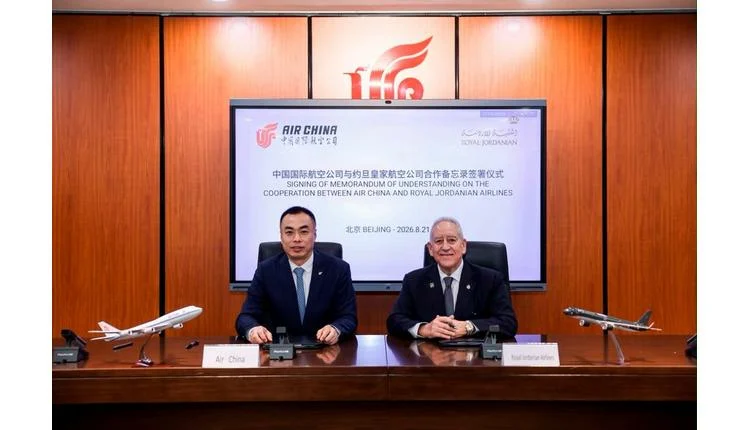
Royal Jordanian Airlines and Air China have formalised a Memorandum of Understanding (MoU) in Beijing, marking a strategic step to deepen air transport links between Jordan and China. The agreement, signed during King Abdullah II's official visit to the Chinese capital, is designed to broaden commercial and operational collaboration, potentially unlocking new routes and sharpening competitiveness across international markets.
Codeshare and hub-to-hub strategy
The MoU lays the groundwork for codeshare arrangements on key trunk routes, leveraging the carriers' respective hubs in Amman and Beijing to give passengers a wider choice of itineraries and smoother connections. Beyond codesharing, the two flag carriers will cooperate on interline agreements, joint product and service training, and brand promotion. Operational support—spanning ground handling, air cargo, and in-flight catering—will also be enhanced at both hubs, a move that could streamline transfer experiences for travellers transiting through Queen Alia International Airport and Beijing Capital International Airport.
Samer Majali, Vice Chairman and CEO of Royal Jordanian, underscored the MoU's role in the airline's broader push into the Chinese and Far Eastern markets. “Beijing represents a key gateway to China and the wider Asian markets, whilst Amman serves as a major hub for the Levant,” Majali said. He stressed the potential to extend Royal Jordanian's network reach and deliver more seamless connections for passengers, particularly those moving between the Middle East and East Asia.
Qu Guangji, President of China National Aviation Holding Corporation and Air China, voiced optimism about the partnership's prospects, citing the strong cooperative ties between the two national carriers. He confirmed Air China's backing for launching direct non-stop services between Amman and Beijing, a move aimed at stimulating tourism, business travel, and cultural exchange between the two countries.
Implications for the China-Jordan air market
The agreement arrives at a time when Chinese outbound travel is rebounding and Middle Eastern carriers are aggressively expanding their Asian networks. For Royal Jordanian, a deeper foothold in China could help diversify its route portfolio beyond its traditional European and Gulf strengths. For Air China, Amman offers a gateway to the Levant, a region with growing commercial and diplomatic ties to Beijing.
Industry observers note that the MoU stops short of a full joint venture, but the scope of cooperation—spanning commercial, operational, and potentially schedule coordination—suggests a long-term strategic alignment. The airlines have not yet announced specific launch dates for new services, but the commitment to explore direct flights is a clear signal of intent.
The move also aligns with broader trends in the region. Turkish Airlines, for instance, has been steadily expanding its China network, adding Chengdu to its roster from November 2026. Similarly, low-cost carrier Scoot is boosting its China presence with new Guiyang flights for winter 2026, reflecting the competitive intensity in the Asia-Middle East corridor.
For travel professionals, the MoU could translate into new ticketing and interline opportunities, particularly for agents and tour operators serving the Jordan-China market. Enhanced ground handling and catering at both hubs may also improve the premium travel experience, a factor that could appeal to luxury and MICE segments.
Royal Jordanian has been modernising its operations, including a recent MRO and supply chain overhaul with Ramco, which could support the operational demands of expanded Asian services. The airline's focus on efficiency and technology is likely to underpin any new long-haul routes.
The MoU marks a significant milestone in aviation cooperation between Jordan and China, providing momentum for developing the air transport market in both nations. The airlines plan to continue expanding their partnership, contributing to a more accessible and efficient “air bridge” that supports travel, economic relations, and cultural exchange.