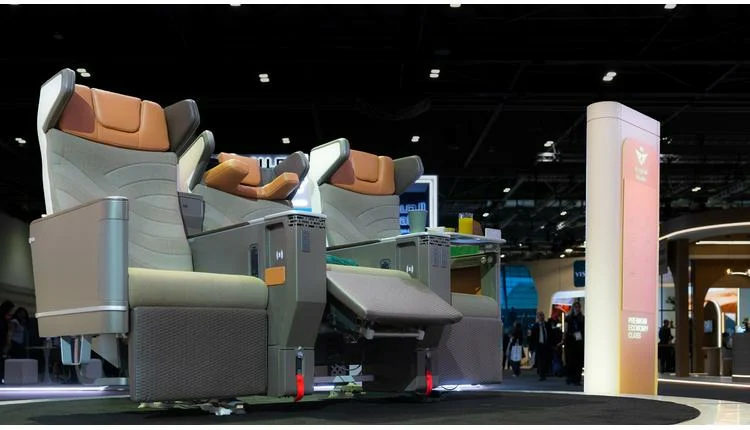
Saudia used this year's World Travel Market in London to unveil its long-anticipated premium economy cabin, a key element of the carrier's broader 'New Saudia Experience' fleet modernisation programme. The product, positioned between economy and business, is designed to capture demand from both leisure and corporate travellers seeking a middle ground on long-haul routes.
The new seat offers a pitch of up to 43 inches, a 15.5-inch high-definition entertainment screen, an extendable calf rest, and additional personal storage. Saudia says the configuration gives passengers more space and privacy, addressing a common complaint about standard economy on ultra-long sectors.
First deployment will be on the airline's Boeing 787 Dreamliner fleet, with the cabin entering service in 2027. Saudia also plans to retrofit selected Airbus A330, Boeing 777, and additional 787 aircraft, signalling a fleet-wide rollout rather than a limited trial.
“The introduction of Premium Economy marks another step in enhancing the choices and comfort available to our guests,” said Arved von zur Muehlen, Chief Commercial Officer at Saudia. The executive, who has led the airline's commercial strategy since 2023, emphasised that the new cabin is part of a wider effort to compete with Gulf rivals on service quality.
Business class on the A321XLR
Alongside the premium economy reveal, Saudia showcased its latest business class product on the Airbus A321XLR. The aircraft features 24 suites, each with a fully flat bed and direct aisle access—a configuration that mirrors long-haul standards on a narrowbody, enabling the airline to deploy premium-heavy capacity on medium-haul routes to Europe and Asia.
The A321XLR is expected to play a central role in Saudia's network strategy, allowing the carrier to open thinner routes that would not justify a widebody. The business class suite, developed with a focus on privacy, includes sliding doors and ample storage, details that were highlighted at the WTM stand.
Saudia also used the event to promote its onboard amenities and hospitality services, which have earned recognition in industry awards. The airline recently took home 'Best Airline Staff Service in the Middle East' at the 2026 Skytrax World Airline Awards, a distinction that underscores its investment in cabin crew training.
Fleet and network context
Founded in 1945, Saudia operates a fleet of 156 aircraft and serves around 100 destinations worldwide. The carrier is in the midst of a significant expansion under Saudi Arabia's Vision 2030, which aims to triple annual passenger traffic to 330 million by the end of the decade. New cabins like premium economy are central to that growth, as the airline seeks to attract more transit traffic through its Jeddah and Riyadh hubs.
The premium economy launch comes at a time when Saudia's 787 deployment plans are closely watched by industry analysts. The Dreamliner is the backbone of the carrier's long-haul fleet, and the addition of a fourth cabin class will require careful configuration changes.
For travel agents and corporate buyers, the new cabin offers a compelling option for clients who want more comfort than economy but do not require a full business class fare. Saudia's pricing strategy for premium economy has not been disclosed, but industry benchmarks suggest a fare premium of 30-50% over economy on comparable routes.
The WTM London event, which this year focused on experience-led travel and AI, provided a fitting backdrop for Saudia's announcement. The airline's investment in seat comfort and digital services aligns with broader trends in the industry, where carriers are differentiating through onboard experience rather than just price.
As Saudia prepares to take delivery of additional 787s and A321XLRs, the premium economy rollout will be phased to minimise disruption. The airline has not yet confirmed which specific routes will see the new cabin first, but long-haul services to North America and Asia are likely candidates given the demand for premium leisure travel.
With the 2027 launch date set, Saudia is giving itself ample time to fine-tune the product and train crew. The airline's move mirrors similar initiatives by Singapore Airlines, which recently refreshed its own premium cabins, underscoring the competitive pressure in the premium segment.
For now, the industry will watch how Saudia integrates the new cabin into its existing fleet and whether it can maintain the service standards that have earned it recent accolades. The premium economy launch is a clear signal that the carrier is serious about competing on quality, not just capacity.