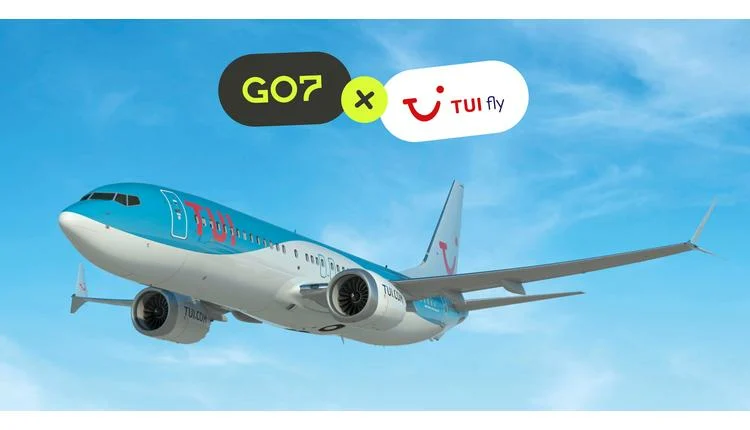
TUI Airline has become the launch customer for GO7's Orchestrated Virtual Interlining (OVI), a new airline-controlled connection model that lets passengers book two separate flights as a single itinerary with through-checked baggage. The partnership, announced on 17 September, aims to remove the friction traditionally associated with self-connections, such as baggage re-checks and complex system integrations.
By integrating TUI Airline's existing New Skies passenger service system (PSS) with GO7's connection environment, the solution operates without altering the carrier's current operational infrastructure. This PSS-agnostic approach is designed to be flexible and scalable, allowing airlines to adopt it without significant IT investment.
How OVI works
OVI enables airlines to offer virtual interlining—combining flights from different carriers or even their own network—while maintaining full control over pricing, settlement, and customer relationships. The model includes two key components: ThruBag©, a patent-protected baggage transfer solution, and ConnectProtect™, which provides parametric cash payouts to passengers if they miss a connection.
For TUI Airline, this means passengers can now book a journey that includes, for example, a TUI flight from London Gatwick to Orlando and a connecting flight on a partner airline, all under one ticket with baggage checked through to the final destination. This eliminates the need for passengers to collect and recheck their luggage, a common pain point in self-connections.
Peter Glade, Chief Commercial Officer of TUI Airline, expressed confidence in the new model: “Our customers expect seamless, connected journeys, and we expect to stay in control of every experience we put our name to.”
Adam Weiss, CEO of GO7, highlighted the significance of the partnership: “This is not a marginal improvement; it marks a shift to connectivity that is led by airlines, built around their customers, and fully under their control.”
Industry implications
The move positions TUI Airline as a pioneer in airline-led connectivity, a space traditionally dominated by global distribution systems (GDSs) and online travel agencies. By using OVI, airlines can offer more comprehensive networks without the need for bilateral interline agreements or costly IT overhauls.
This development is particularly relevant for leisure carriers like TUI, which often operate point-to-point routes and rely on partnerships to expand their reach. The ability to offer seamless connections could enhance TUI's appeal to travelers who value convenience, especially on long-haul routes to destinations such as the Caribbean, Africa, and Asia.
GO7's solution is designed to be PSS-agnostic, meaning it can work with any airline's reservation system. This could open the door for other carriers to adopt similar models, potentially reshaping how airlines approach interlining and virtual connections.
The partnership also aligns with broader industry trends toward AI-driven travel management and expanded distribution networks, as airlines seek to offer more personalized and efficient travel experiences.
As TUI Airline and GO7 plan to expand their collaboration, the initiative is poised to redefine airline connectivity and passenger experience, setting a new benchmark for the industry.