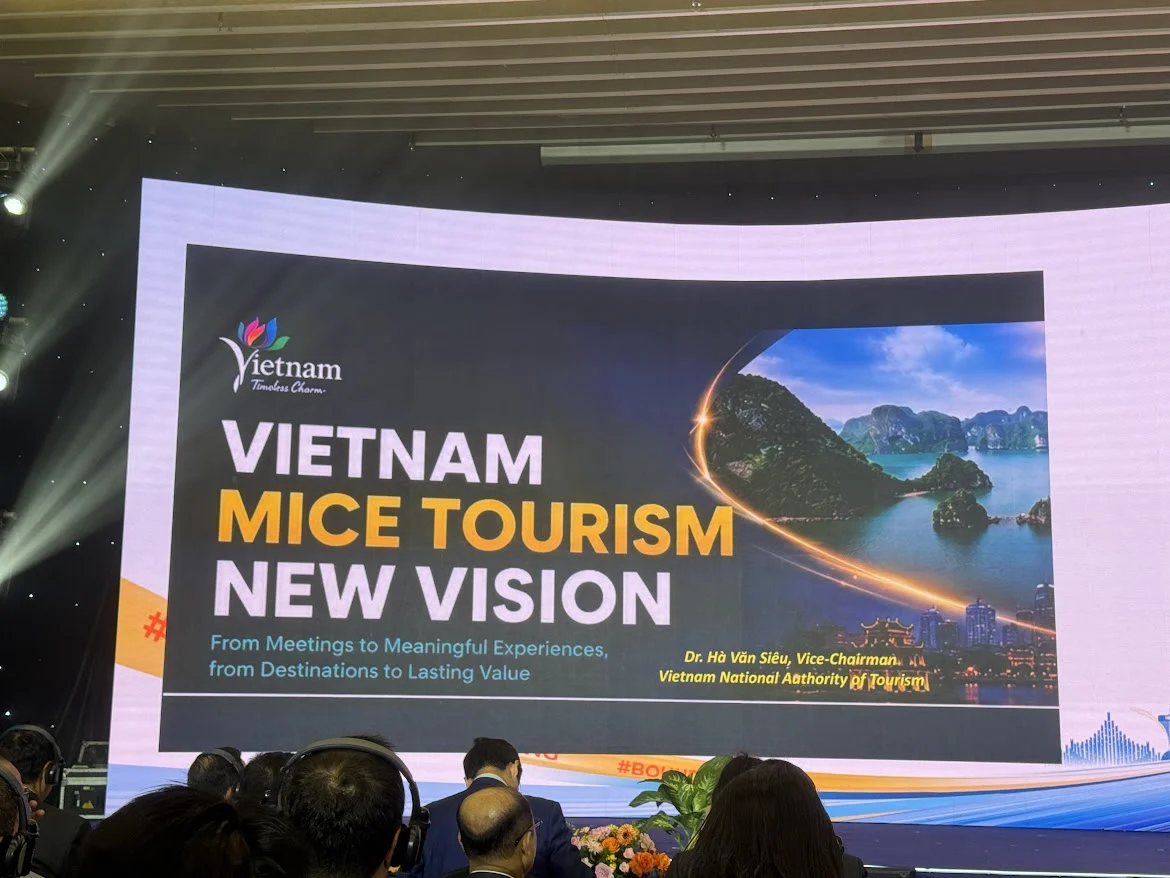
Vietnam has unveiled a comprehensive MICE tourism strategy aimed at strengthening its position in the increasingly competitive global business travel market. The announcement was made on 7th August during the High-Level Tourism Forum of the twentieth ITE-HCMC at the Saigon Expo and Convention Centre (SECC) in Ho Chi Minh City.
Ho Van Sieu, vice-chair of the Vietnam National Authority of Tourism, presented the blueprint, which shifts focus from merely hosting meetings to delivering meaningful experiences and long-term value for corporate clients. He highlighted five key advantages for Vietnam: its strategic location in Southeast Asia, growing international connectivity, diverse cultural and ecological offerings, competitive pricing compared to regional peers, and a strong tradition of hospitality.
Market growth and regional competition
The Vietnamese MICE market, valued at nearly US$6 billion, is projected to grow from $7.3 billion in 2025 to $7.7 billion in 2026, reaching $10.3 billion by 2031. However, Vietnam faces mature competition from established hubs like Singapore and Thailand. To counter this, the strategy promotes a shared regional MICE space with Indochinese neighbours, encouraging collaborative cross-border packages that combine conferences in Ho Chi Minh City with incentives in Cambodia or the broader Mekong subregion.
Domestically, major economic gateways are absorbing nearby provincial assets to expand capacity. Ho Chi Minh City, for instance, is leveraging infrastructure from Ba Ria-Vung Tau and Binh Duong provinces to transform from a transit point into a long-stay experience hub.
Government backing and incentives
The strategy is reinforced by legislative support. National Assembly Resolution No. 28/2026/QH16 formalises MICE as a high-priority sector. Ho Chi Minh City now mandates financial support for large delegations, including up to 25% discounts on entrance fees and subsidies covering 30% of venue rental costs. VAT on events has been cut to five percent, and simplified visa processes have been introduced, alongside 100% visa-free zones like Phu Quoc.
Sustainability as a core pillar
Recognising that 85% of international event planners prioritise sustainability, Vietnam’s 2030 Sustainable Tourism Strategy includes zero-plastic meeting environments at coastal hubs and major properties such as Radisson Blu Resort Cam Ranh. Da Nang and Hoi An are formalising Green Event City frameworks with low-emission and electric transportation grids to meet corporate environmental mandates.
Technology and infrastructure investment
The strategy also embraces a “twin wings” approach, blending cultural heritage with modern technology. Venues like SECC and the National Convention Center (NCC) are being retrofitted for hybrid setups, AI-powered apps, and AR/VR integration. Corporate incentives are shifting from mass sightseeing to bespoke experiences, including Michelin-starred dining tours, luxury multi-sport modules, and mega-galas on private yachts or at World Heritage sites.
Infrastructure investment is addressing venue bottlenecks and appealing to high-yield industrial supply chains. The Vietnam Event Centre (VEC) is hosting specialised B2B exhibitions requiring heavy floor loads and machinery accommodations. With private sector backing, Vietnam is positioning itself as a reliable host for global geopolitical, technological, and medical gatherings.
Vietnam’s renewed focus on MICE comes as the region sees increased competition. For more on regional travel trends, see Vietnam's arrival surge and ITE HCMC's 20th edition.