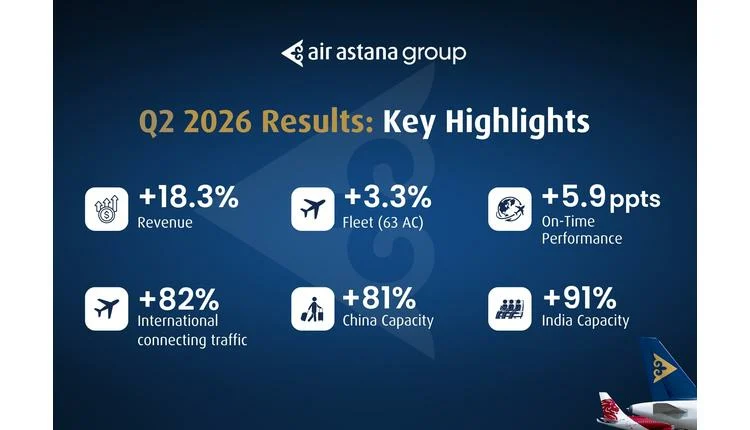
Air Astana Group has posted a robust 18.3% year-on-year increase in second-quarter revenue, reaching $433 million, even as capacity remained broadly flat. The growth was driven by a strategic pivot toward international markets, which lifted revenue per available seat kilometre (RASK) by 18.5%. The carrier's leadership attributes the performance to agile capacity allocation that allowed it to chase demand across its network.
International expansion fuels growth
CEO Ibrahim Canliel highlighted the group's dynamic approach to route planning as a key driver. "Our ability to shift capacity quickly to where demand is strongest has been instrumental," he said. The airline has been expanding its footprint in China, India, Europe, and Southeast Asia, reinforcing Kazakhstan's position as a regional aviation hub. New routes launched in the first half of 2026 have contributed to a 16.1% rise in total revenue and other income to $763.9 million.
The carrier's international focus is paying off despite a challenging operating environment. "We have seen volatile conditions in the Gulf, but our flexibility allowed us to redeploy aircraft to alternative markets with strong demand," Canliel added. This adaptability has been crucial in maintaining momentum as the group navigates higher fuel costs and supply-chain disruptions.
Cost pressures and engine challenges
Profitability, however, has come under pressure from a 22.2% increase in cost per available seat kilometre (CASK), outpacing RASK growth. Fuel prices and ongoing issues with Pratt & Whitney engines have been the primary culprits. The airline reported a 60% reduction in engine groundings compared with the previous year, with a target of zero groundings by summer 2027. This improvement is expected to ease operational strain and support future capacity growth.
Despite these headwinds, Air Astana remains optimistic about its long-term trajectory. The group plans to expand its fleet to 86 aircraft by 2030 and aims to lift its EBITDAR margin to the mid-to-high 20s. Management is focused on realigning capacity to protect margins amid inflationary pressures, a strategy that has already shown results in the second quarter.
The airline's performance mirrors broader trends in the industry, where carriers are increasingly prioritizing international routes to offset domestic softness. For context, Vietjet's H1 results also highlighted the benefits of international expansion, with a 44% revenue surge. Similarly, Frontier Airlines posted record Q2 revenue of $1.3 billion, underscoring the resilience of the aviation sector.
Looking ahead, Air Astana's ability to manage costs while pursuing growth will be closely watched by industry analysts. The carrier's focus on high-yield international markets, combined with its fleet modernization plans, positions it well for sustained profitability. As the group continues to adapt to shifting demand patterns, its performance will serve as a bellwether for other airlines in the region.
For travel professionals, Air Astana's results offer insights into the benefits of dynamic capacity management and the importance of diversifying route networks. The airline's experience with engine groundings also highlights the need for robust maintenance strategies in an era of supply-chain constraints.