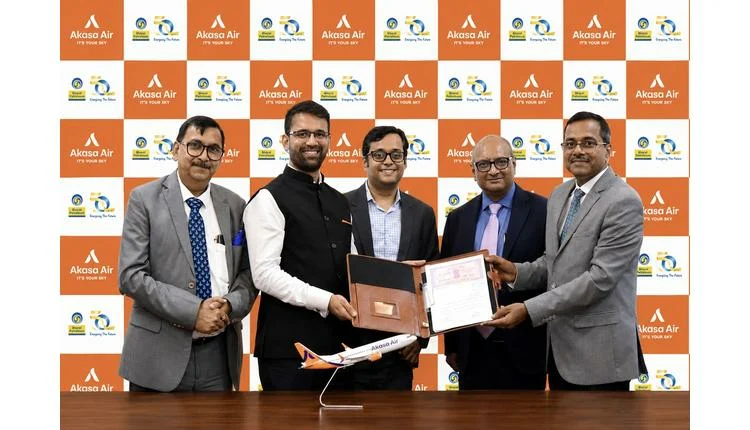
Akasa Air, one of India's fastest-growing carriers, has signed a Memorandum of Understanding (MoU) with Bharat Petroleum Corporation Limited (BPCL) to accelerate the adoption of Sustainable Aviation Fuel (SAF) across the country. The agreement, announced in early 2025, aims to strengthen India's SAF ecosystem and align with global decarbonisation frameworks, including ICAO's CORSIA mandate.
Scope of the Partnership
The MoU establishes a framework for the supply and offtake of SAF-blended Aviation Turbine Fuel (ATF) at select Indian airports. Both parties will share demand forecasts to support production planning and gradually increase SAF blending as the domestic supply chain matures. The collaboration also includes joint knowledge sharing, policy advocacy, and engagement with government and industry stakeholders to build a robust SAF infrastructure.
Ankur Goel, Chief Financial Officer of Akasa Air, stated: "At Akasa Air, sustainability is one of our core values, shaping decisions we make across our business." Subhankar Sen, Director of Marketing at BPCL, added: "BPCL is committed to supporting the aviation industry's decarbonisation journey through sustainable and innovative energy solutions."
Fleet and Operational Efficiency
Akasa Air operates an all-Boeing 737 MAX fleet powered by CFM International LEAP-1B engines, which already deliver 15-20% better fuel efficiency than older-generation aircraft. The airline has also partnered with OpenAirlines to implement SkyBreathe®, a fuel management solution that uses big data and AI to reduce carbon emissions and enhance operational efficiency. These initiatives complement the SAF partnership by minimising fuel burn across the network.
The carrier's focus on sustainability extends to its route planning and ground operations. Akasa Air currently serves domestic destinations including Mumbai, Delhi, Bengaluru, Chennai, Kolkata, and Ahmedabad, with plans to expand internationally. The SAF partnership with BPCL is expected to initially cover major hubs such as Mumbai and Delhi, where blending infrastructure is more developed.
Industry Context and Policy Support
India's aviation sector is under increasing pressure to reduce its carbon footprint, with the government targeting net-zero emissions by 2070. The SAF partnership between Akasa Air and BPCL aligns with the Ministry of Civil Aviation's Sustainable Aviation Fuel Roadmap, which aims to achieve 1% SAF blending by 2027 and 5% by 2030. Globally, airlines like Air India have also invested in digital tools to improve efficiency, while carriers such as Air New Zealand are boosting operational performance to reduce emissions.
The collaboration also reflects broader trends in the travel industry, where sustainability is becoming a key differentiator. A recent Agoda survey found that Gen Z travellers prioritise seamless, sustainable loyalty programmes, indicating that airlines must integrate environmental commitments into their customer experience.
Challenges and Outlook
Despite the MoU, scaling SAF in India faces hurdles, including high production costs, limited feedstock availability, and insufficient blending infrastructure. BPCL's expertise in refinery operations and fuel supply chains will be critical to overcoming these barriers. The partnership also involves policy advocacy to push for government incentives, such as tax breaks or mandates, which could accelerate SAF adoption.
Akasa Air's commitment to sustainability is part of a broader industry shift. Other Indian carriers, including IndiGo and SpiceJet, have also explored SAF trials, but Akasa Air's MoU with BPCL is one of the most comprehensive agreements to date. The airline's young fleet and data-driven fuel management give it a competitive edge in reducing lifecycle emissions.
For travel professionals, this partnership signals that Indian aviation is moving beyond pilot projects toward commercial-scale SAF deployment. Hoteliers, tour operators, and MICE planners may see indirect benefits as airlines lower their carbon footprints, potentially influencing corporate travel policies and destination choices. As the SAF ecosystem develops, stakeholders across the value chain—from fuel suppliers to travel agents—will need to adapt to evolving sustainability standards.