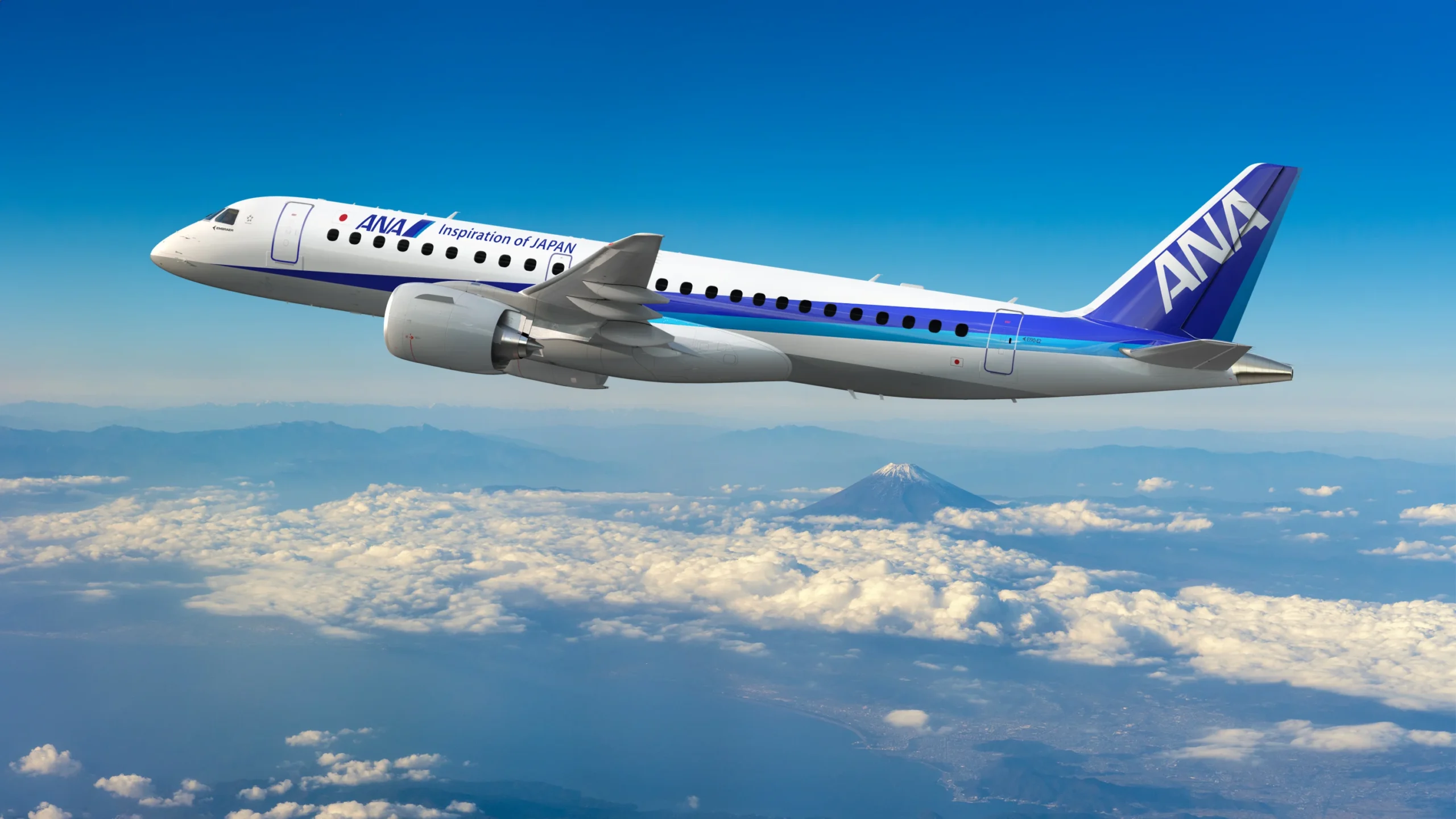
ANA Holdings has deepened its commitment to Embraer's E-Jets E2 family, signing a firm order for eight more E190-E2 aircraft. The deal, announced on 29 July 2026, brings ANA's total firm orders for the E2 series to 23, with options for five additional jets. The move underscores the Japanese carrier group's strategy to modernise and expand its domestic regional network.
Strategic fleet expansion for regional connectivity
The additional aircraft will be deployed across ANA's regional routes, which serve a mix of business and leisure destinations throughout Japan. The E190-E2's range and capacity make it well suited to thinner domestic sectors where larger narrowbodies would be inefficient. ANA's first E2 is scheduled for delivery in 2028, with the remainder following in a phased rollout.
Koji Shibata, President and CEO of ANA Holdings, framed the order as a step toward a more resilient and eco-conscious regional operation. “This additional E190-E2 order accelerates our efforts to build a sustainable regional aviation network in Japan,” he said. He pointed to the aircraft's lower emissions and operating costs, as well as improved passenger comfort, as key drivers behind the decision.
Arjan Meijer, President and CEO of Embraer Commercial Aviation, welcomed the continued partnership. “With its exceptional economics and fuel efficiency, the E2 will support expanded connectivity across Japan along with better comfort and space for passengers,” Meijer noted. He also highlighted the E2's role in helping airlines open new point-to-point routes without compromising on environmental performance.
E2 advantages for regional operators
The E190-E2 is the smallest member of Embraer's second-generation E-Jet family, which also includes the E195-E2. It features a new wing design, geared turbofan engines, and a full fly-by-wire flight control system, contributing to a double-digit reduction in fuel burn and CO2 emissions compared with previous-generation aircraft. For ANA, which operates a mixed fleet of domestic and international aircraft, the E2 offers flexibility to adjust capacity on regional routes while maintaining high frequency.
Embraer has been active in Japan since 2009, providing local support and maintenance infrastructure. The Brazilian manufacturer's presence in the region has grown alongside its order book, and this latest deal reinforces its foothold in one of Asia's most mature aviation markets. The announcement follows other recent E-Jet milestones, including Embraer's 2,000th E-Jet delivery to Azul, which highlighted the family's global acceptance.
For ANA, the E190-E2 order is part of a broader fleet renewal strategy. The group has also been evaluating narrowbody replacements for its domestic Boeing 737 and Airbus A320 fleets, and the E2 order signals a preference for right-sizing capacity on lower-demand routes. The carrier's regional subsidiary, ANA Wings, currently operates Bombardier Q400 turboprops, and the E2 could eventually replace some of those on longer thin routes.
The Japanese domestic market is highly competitive, with rivals such as Japan Airlines (JAL) and low-cost carriers like Peach and Jetstar Japan vying for passengers. ANA's investment in the E2 is aimed at maintaining a cost advantage while offering a superior cabin experience. The E190-E2 features a 2-2 seating layout in economy, eliminating middle seats, which is a selling point for both business and leisure travellers.
Industry analysts see the order as a positive signal for regional jet demand in Asia, where infrastructure constraints and environmental pressures are pushing carriers toward more efficient aircraft. The E2's performance on short runways and its lower noise footprint also make it suitable for secondary airports, potentially opening new city pairs that were previously uneconomical.
ANA's decision to expand its E2 fleet comes at a time when many global carriers are reassessing their regional strategies. The pandemic accelerated the retirement of older regional jets, and the recovery has highlighted the need for flexible, fuel-efficient aircraft. Embraer has positioned the E2 as a replacement for older 70- to 100-seat jets, and ANA's order adds to a growing list of operators that include KLM Cityhopper, Helvetic Airways, and Azul.
The financial details of the order were not disclosed, but list prices for the E190-E2 are around $60 million, though typical deals include significant discounts. ANA's firm order book now stands at 23 E2s, with options for five more, giving the group ample room to adjust its regional capacity over the next decade. The first delivery in 2028 will mark the entry of the E2 into Japan's major airline network, a milestone that both ANA and Embraer are likely to promote heavily.
For travel professionals, the expansion of ANA's regional fleet could translate into more seat availability on domestic routes, particularly those serving business hubs like Tokyo Haneda, Osaka Itami, and Fukuoka. The E2's range also allows for potential new international regional services to nearby Asian cities, though ANA has not yet specified deployment plans beyond domestic use.
Embraer's relationship with ANA is part of a broader push into the Asia-Pacific market, where the company sees significant growth potential for regional jets. With Japan's aging population and labour shortages, airlines are under pressure to operate efficiently, and the E2's lower maintenance costs and fuel burn are attractive. The order also bolsters Embraer's aftermarket business, as ANA will require training, parts, and support services.
As the aviation industry continues to focus on sustainability, the E2's environmental credentials are a key selling point. The aircraft emits about 25% less CO2 per seat than previous-generation regional jets, and its noise footprint is significantly lower, which is important for airports with strict curfews. ANA has set ambitious carbon neutrality targets, and the E2 order aligns with those goals.
The announcement was made via a press release, and no further details were provided on delivery slots or financing. ANA's existing E2 orders were placed in 2023 and 2024, and the new aircraft will likely be delivered in a similar timeframe. The carrier's decision to exercise options early suggests confidence in its regional network's growth prospects.
For more on how airlines are optimising regional fleets, see our analysis of cost-saving tactics for travel professionals. And for other recent fleet news, check out Philippine Airlines' widebody order.