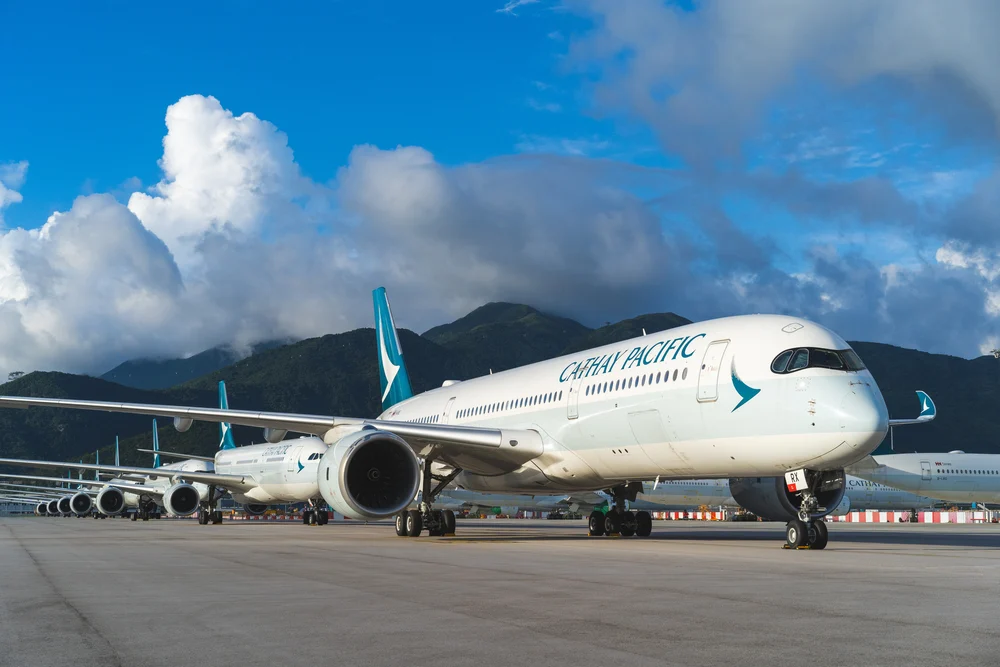
The Cathay Group has reported a 9% year-on-year increase in both passenger and cargo traffic for June 2026, a performance that underscores the resilience of Hong Kong’s flagship carrier amid elevated jet fuel costs. The combined operations of Cathay Pacific and HK Express carried over 3.1 million passengers during the month, while Cathay Cargo handled approximately 145,000 tonnes of freight.
Lavinia Lau, Chief Customer and Commercial Officer, attributed the growth to sustained demand across key markets. “Despite the pressure from high jet fuel prices, we have seen strong momentum in both passenger and cargo segments,” she said. The group’s first-half 2026 passenger numbers rose 17% compared to the same period in 2025, reflecting a steady recovery trajectory.
Passenger Performance: Cathay Pacific Leads, HK Express Adjusts
Cathay Pacific recorded a 12% increase in passenger numbers in June 2026 versus June 2025, with Available Seat Kilometres (ASKs) growing 6%. Lau noted that geopolitical developments in the Middle East have driven additional transit traffic through Hong Kong, while the Dragon Boat Festival holiday boosted short-haul demand. The airline’s network expansion, including deeper ties with partners like Iberia, has also contributed to load factors. (See related: Cathay Pacific Deepens Latin American Ties with Iberia Codeshare, Adds Four New Destinations.)
HK Express, the group’s low-cost unit, saw a 4% decline in passenger numbers year-on-year in June, with ASKs down 7%. However, the carrier maintained load factors above 85% on routes to the Chinese Mainland, the Philippines, and Thailand, indicating disciplined capacity management. The overall group passenger mix remains balanced, with full-service and low-cost segments catering to different demand profiles.
Cargo: Steady Demand from Chinese Mainland and Specialist Solutions
Cathay Cargo’s tonnage grew 9% year-on-year in June, with Available Freight Tonne Kilometres (AFTKs) up 1%. Strong demand from the Chinese Mainland to Southeast Asia, coupled with resilient inbound shipments into Hong Kong, drove the increase. Specialist products such as Cathay Expert and Cathay Pharma saw heightened demand, particularly for semiconductor and pharmaceutical logistics. The cargo division’s performance aligns with broader trends in air freight, where e-commerce and high-value goods continue to drive volumes.
The group’s cargo network has benefited from increased transit traffic via Hong Kong, a hub that remains critical for intra-Asia and long-haul freight. Cathay Cargo’s focus on premium verticals positions it well against competitors like Air India Cargo, which recently opened a new export route from Navi Mumbai to Abu Dhabi. (See: Air India Cargo Opens Navi Mumbai with First Export Flight to Abu Dhabi.)
Financial Outlook: Profit Surge on Strong Demand
The Cathay Group expects to report a consolidated profit of approximately $770 million to $835 million (HK$6.0 to HK$6.5 billion) for the first half of 2026, nearly double the $475 million (HK$3.7 billion) recorded in the same period of 2025. This improvement is driven by robust demand for Cathay Pacific and Cathay Cargo, better performance from HK Express, and improved contributions from associates. The finalised results are scheduled for release in August 2026.
The profit guidance reflects the group’s ability to navigate cost pressures while capitalising on traffic growth. For travel industry professionals, the data points to sustained demand in the Asia-Pacific region, particularly for premium and cargo services. The group’s dual-brand strategy—combining full-service Cathay Pacific with low-cost HK Express—offers a template for managing diverse market segments.
Looking ahead, Cathay’s performance will be closely watched by airline executives and investors as a bellwether for the broader aviation recovery in Asia. The group’s focus on network connectivity, cargo specialisation, and cost discipline will be key to maintaining momentum in the second half of 2026.