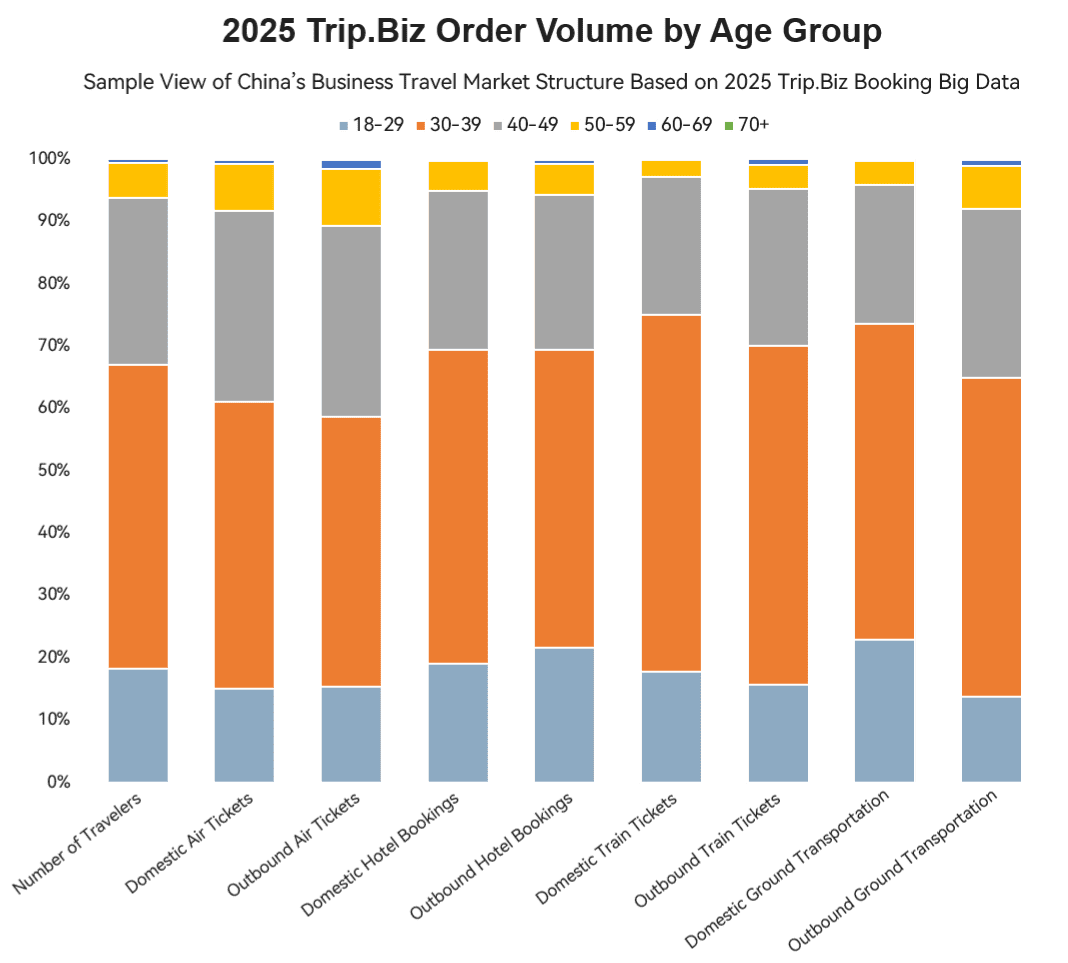
China's corporate travel market is increasingly shaped by professionals in their prime career years, with the 30–39 age bracket now accounting for roughly half of all business travel demand. This demographic concentration has significant implications for airlines, hotel groups, cruise lines, and travel technology vendors targeting the world's second-largest economy.
According to recent market analysis, the 30–39 cohort dominates across various business travel scenarios, from domestic flights between Shanghai Hongqiao and Beijing Capital to international routes such as China Southern's Guangzhou–Sydney service. The 40–49 age group follows, representing more than a quarter of total demand, while younger employees aged 18–29 contribute about one-fifth.
Implications for Travel Suppliers
For carriers like Air China and China Eastern, this age skew means adjusting cabin configurations and service offerings. The 30–39 segment tends to value efficiency, digital booking tools, and seamless connectivity—preferences that align with investments in NDC (New Distribution Capability) and direct channels. Hoteliers, including Marriott International and Hilton, are tailoring loyalty programs and business-class amenities to this cohort's expectations for mobile check-in, co-working spaces, and wellness options.
Travel management companies and GDS systems such as Amadeus and Travelport are also adapting. The demand for integrated expense management and real-time data analytics is rising, as this age group often combines business trips with bleisure elements. As noted in recent industry coverage, Dida's Engage Roadshow 2026 highlighted AI-driven distribution tools that cater to such evolving corporate travel patterns.
The 30–39 demographic's dominance also affects MICE (Meetings, Incentives, Conferences, and Exhibitions) planning. Event organizers are increasingly targeting this age group with interactive formats, sustainability-focused venues, and tech-enhanced experiences. Cruise lines like Royal Caribbean are seeing a shift in corporate charter bookings, as younger executives prefer shorter, experience-rich itineraries over traditional long-haul conferences.
Tour operators and destination management companies (DMCs) are recalibrating packages for Chinese corporate groups. Destinations such as Singapore, Bangkok, and Dubai remain popular, but secondary cities like Chengdu and Xi'an are gaining traction for incentive travel. The 30–39 cohort's familiarity with digital platforms also drives demand for contactless payments and mobile concierge services.
Travel technology vendors are responding with AI-powered booking engines and predictive analytics. The insights from Dida's Frank Wöller on source markets underscore how understanding demographic nuances can optimize distribution strategies for both outbound and inbound Chinese travel.
For luxury travel providers, the 30–39 segment represents a growing opportunity. High-end resorts in the Maldives, for instance, are diversifying their guest mix to attract Chinese corporate travelers who value privacy and bespoke experiences. As Raffaele Solferino noted, adapting to shifting demographics is key to maintaining occupancy rates.
The data reinforces that China's business travel market is not monolithic. Suppliers that tailor their offerings to the preferences of the 30–39 age group—whether through flexible booking policies, enhanced digital tools, or curated experiences—will be best positioned to capture a larger share of this lucrative segment.