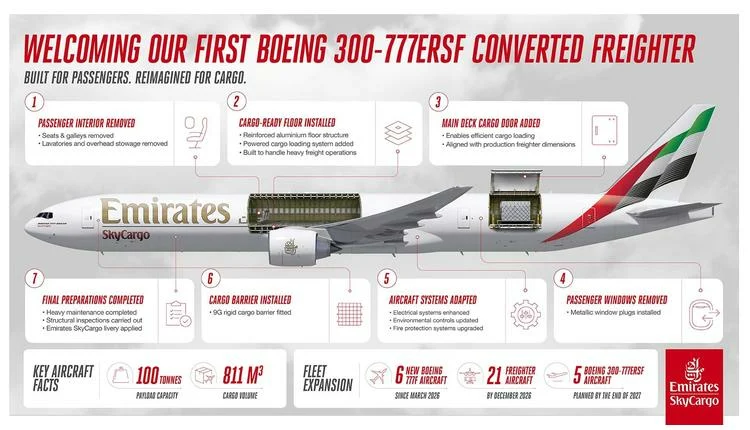
Emirates SkyCargo has taken a significant step in expanding its freighter capacity with the introduction of a converted Boeing 777-300ER, registered as A6-EBK. The aircraft, which was originally configured for passenger service, has undergone a comprehensive transformation to serve as a dedicated cargo carrier. It is now operational, moving goods through the carrier's Dubai hub to destinations across its global network.
Conversion Process and Structural Upgrades
The conversion of the 777-300ER into a freighter required extensive modifications over several months. The passenger cabin was completely stripped, and a large main deck cargo door was installed to facilitate loading. The fuselage was reinforced, and a rigid barrier was added to separate the cargo area from the flight deck. The floor structure was replaced to handle heavier pallet loads, and a full cargo loading system was integrated to streamline operations.
These changes were accompanied by upgrades to the flight deck, including additional controls for cargo transport. The aircraft also received advanced environmental control systems capable of maintaining precise temperature ranges, a critical feature for transporting temperature-sensitive pharmaceuticals and other perishable goods. The entire process underwent rigorous safety certification to meet structural and operational standards before entering service.
Emirates SkyCargo's decision to convert a passenger aircraft reflects a strategic response to growing demand for air cargo capacity, particularly in the wake of global supply chain pressures. The carrier has already taken delivery of six new Boeing 777F production freighters this year, with additional units expected in 2026. This expansion aligns with the airline's broader fleet renewal efforts, similar to moves by other carriers like Air India, which recently added a third Boeing 787-9 to its fleet.
The converted freighter offers operational flexibility, allowing Emirates SkyCargo to deploy it on routes where dedicated freighter capacity is most needed. The aircraft's range and payload capabilities make it suitable for long-haul routes from Dubai to key markets in Europe, Asia, and the Americas. This is particularly relevant as the airline continues to invest in its cargo infrastructure, including the expansion of its hub at Dubai World Central (DWC).
Industry observers note that the conversion of passenger aircraft into freighters is a growing trend among carriers seeking to optimize fleet utilization. Emirates SkyCargo's move follows similar conversions by other operators, though the 777-300ER is less commonly converted due to its size and complexity. The carrier's engineering team worked closely with Boeing and regulatory authorities to ensure the aircraft met all safety and performance criteria.
For travel professionals, this development underscores the importance of air cargo in supporting global trade, particularly for time-sensitive and high-value goods. The enhanced capacity also benefits the broader travel ecosystem, as cargo revenues help offset fluctuations in passenger demand. Emirates SkyCargo's investment in freighter capacity is a signal of confidence in the long-term growth of air freight, especially in sectors like pharmaceuticals and e-commerce.
As the carrier prepares to receive additional freighters in 2026, the converted 777-300ER will serve as a bridge, providing immediate capacity while new-build aircraft are delivered. This strategy mirrors the approach of other airlines, such as Akasa Air, which recently reached a 40-aircraft fleet milestone with Boeing 737 MAX deliveries. The focus on fleet modernization and capacity expansion is a common theme across the industry, driven by evolving market demands.
Emirates SkyCargo's latest addition is a practical solution to a pressing need, and its successful entry into service demonstrates the viability of aircraft conversion programs. For logistics partners and forwarders, the new freighter offers additional options for moving cargo through Dubai, a key global transshipment hub. The carrier's commitment to maintaining high standards for sensitive cargo, such as pharmaceuticals, also reinforces its reputation as a reliable partner in the cold chain logistics space.