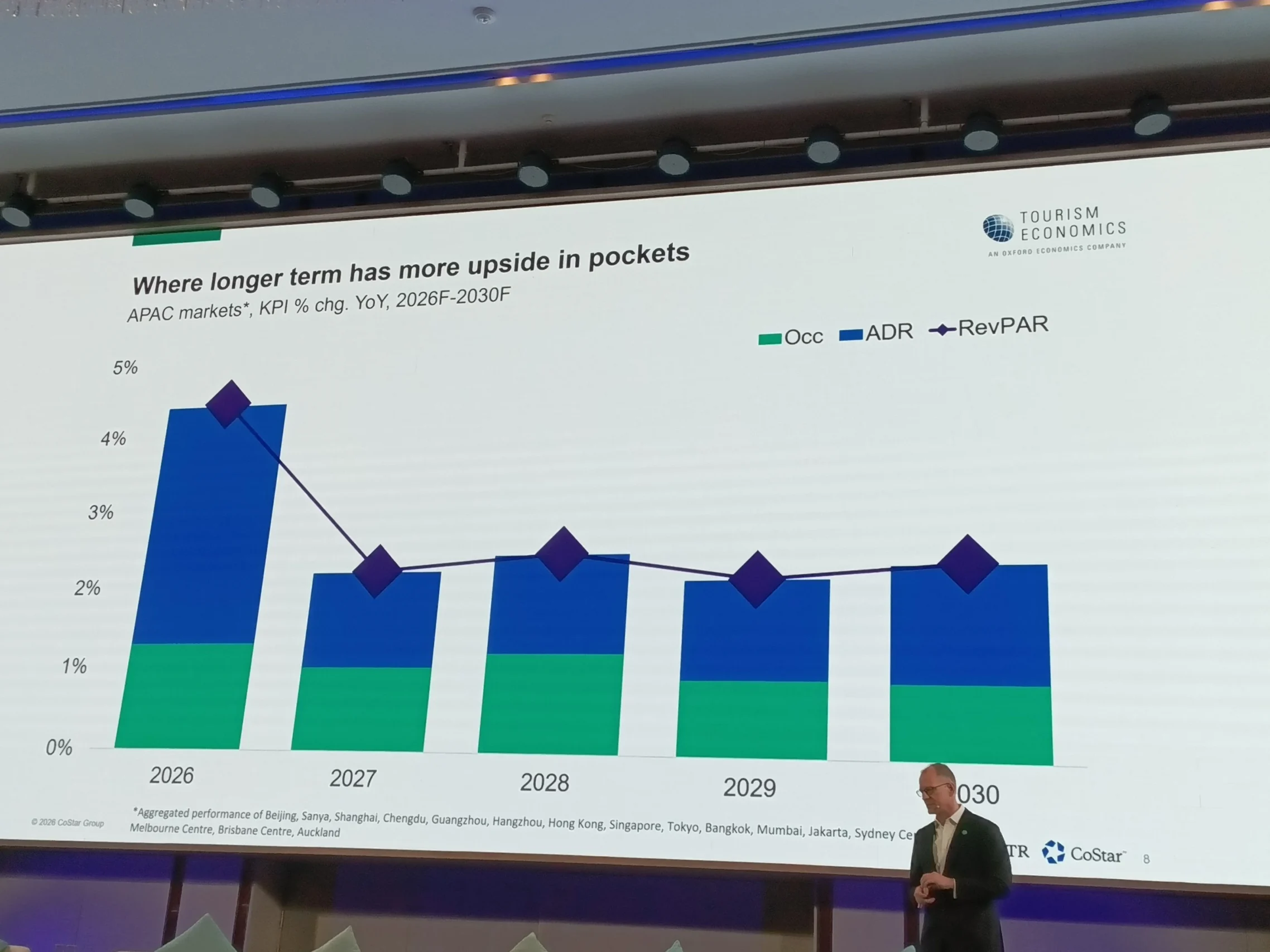
At the South East Asia Hotel Investors’ Summit (SEAHIS) in Bangkok on 15 June, STR’s Asia Pacific director Jesper Palmqvist presented a data-driven analysis of regional hospitality performance, underscoring APAC’s resilience in a cooling global market. Despite a worldwide slowdown in travel demand, hotels across the region have posted stronger average daily rate (ADR) growth than any other part of the world, a trend Palmqvist attributes to disciplined supply management.
“Demand across the world has slowed down, and so also in Asia Pacific. But we still get more rate growth here than in most parts of the world; we’re in that part of the cycle where we’re not releasing too many rooms into the market,” Palmqvist told attendees. The STR outlook for the remainder of the year points to decent year-over-year growth, tapering into low single digits toward the end of the decade.
Japan’s Structural Shift and the Osaka Expo Hangover
Palmqvist cautioned against viewing Asia through a single lens, urging stakeholders to examine pockets of supply and demand. In Japan, structural changes are reshaping the market. Tokyo has successfully shifted its source mix, insulating itself from a 55% drop in inbound travel from Mainland China. “The source shift so far here today means higher ADRs and longer length of stay... It’s not about new supply in Japan. It’s about repurposing,” he said.
In contrast, western Japanese cities like Osaka are feeling a double crunch: fewer Chinese group travelers and tough comparisons against the previous year’s expo-driven performance. The end of the 2025 Osaka Expo has left a void that operators are still navigating.
Bangkok’s Divergent Sub-Markets and Thailand’s Leisure Resilience
Palmqvist highlighted the need for granular asset management, using Thailand as a case study. In Bangkok, sub-markets are diverging sharply. Sukhumvit continues to struggle to reach peak occupancy levels, while other parts of the Thai capital have fully recovered from the pandemic slump. “Sukhumvit continues to see that challenge to really get those peaks; that green line just doesn’t get what the other sub-markets here do,” Palmqvist noted.
Meanwhile, lesser-known Thai destinations such as Phuket and Krabi have marked three years of sustained growth. Leisure markets have safeguarded their gross operating profit per available room (GOPPAR) through strict seasonality management and by protecting F&B margins from erosion. For travel professionals eyeing Thailand, these insights underscore the importance of micro-market analysis, as highlighted in Thailand’s wellness tourism push.
Vietnam’s Resort Hubs: Nha Trang vs. Phu Quoc
In Vietnam, Palmqvist drew a sharp contrast between Nha Trang and Phu Quoc. Nha Trang benefits from a balanced historic international mix, yielding stable rates and less volatility. Phu Quoc, by contrast, relies heavily on domestic travelers, forcing it to contend with extreme seasonal spikes. Yet its peak-season performance rivals the best in the region.
“What’s the difference between Phu Quoc and Phuket? Well, nothing; there is no difference in the last two years on peak season either. We’re having the same occupancy in peaks. Phu Quoc has come and already shown that. Can we compete in Southeast Asia? They can,” Palmqvist asserted. This parity underscores the potential for secondary destinations to capture premium demand, a trend also visible in Australia’s hotel investment surge.
For hoteliers and investors, the message is clear: APAC’s rate growth is not a monolith. Success requires deep dives into local supply-demand dynamics, source market shifts, and seasonality patterns. As global demand cools, those who master micro-market intelligence will be best positioned to sustain profitability.