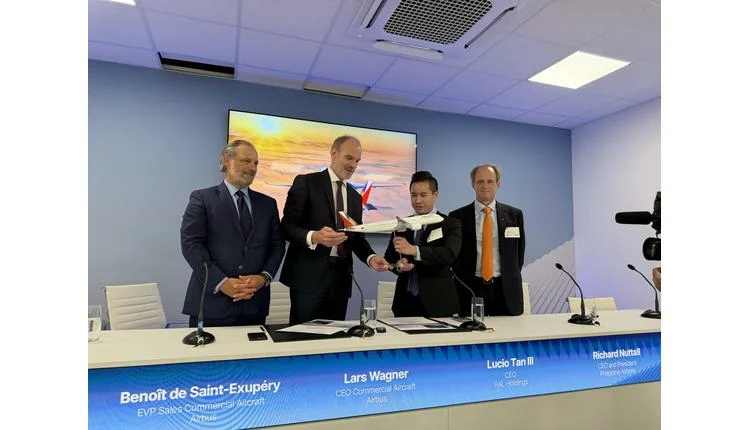
Philippine Airlines (PAL) is doubling down on its long-haul strategy with a firm commitment to acquire nine Airbus A350-1000 widebody jets, plus purchase rights for five more. The memorandum of understanding, signed at the Farnborough International Airshow, signals the carrier’s intent to modernize its fleet and expand its presence on premium long-distance routes.
The deal was finalized by PAL Holdings President Lucio C. Tan III, Philippine Airlines President Richard Nuttall, and Airbus executives. Tan emphasized that the A350-1000 will serve as the airline’s flagship for intercontinental operations, building on the two examples already in service on the Manila–New York and Manila–Toronto sectors. Seven additional A350-1000s from a prior order are expected to join the fleet by 2028.
Fleet Modernization and Sustainability
The A350-1000 brings significant operational advantages, including a range of up to 8,700 nautical miles and fuel burn reductions of around 25% compared to older-generation aircraft. PAL’s decision aligns with broader industry efforts to lower carbon emissions, as the aircraft’s advanced composite materials and aerodynamic design contribute to a smaller environmental footprint.
“The A350-1000 will continue to define the future of our international operations,” Tan said in a statement. The aircraft will be configured in a three-class layout featuring Business Class suites, a dedicated Premium Economy cabin, and an enhanced Economy Class. This configuration is designed to appeal to both corporate travelers and leisure passengers on long-haul routes.
Benoît de Saint-Exupéry, Airbus’s executive vice president for commercial aircraft, called the agreement “an important milestone in deepening our partnership with Philippine Airlines.” The purchase rights give PAL flexibility to respond to future market demand, particularly as travel rebounds across Asia-Pacific.
Strategic Context and Competitive Landscape
PAL’s expansion comes as other Asian carriers also invest in widebody fleets. For example, Turkish Airlines recently expanded its pilot training capacity, while PAL itself selected GE engines for 15 Boeing 787-10 Dreamliners earlier this year, underscoring a dual-track fleet strategy. The A350-1000 order complements PAL’s existing Boeing 777-300ER and 787-9 fleets, giving the airline a mix of aircraft optimized for different route lengths and passenger densities.
The new A350-1000s are scheduled for delivery between 2034 and 2036, a timeline that reflects the long lead times typical of widebody orders. In the interim, PAL will rely on its current fleet and the seven A350-1000s from the earlier order to maintain service on key routes to North America, Europe, and the Middle East.
Impact on Travel Trade
For travel agents and tour operators, PAL’s fleet upgrade means more consistent premium cabin inventory on long-haul sectors, particularly to the U.S. and Canada. The airline’s focus on Premium Economy and Business Class aligns with growing demand for upscale travel experiences among Asian and North American passengers. GDS systems such as Amadeus and Sabre will see updated seat maps and fare structures as PAL rolls out the new configuration.
The order also reinforces Manila’s position as a hub for transpacific travel, competing with other Asian gateways like Singapore, Hong Kong, and Bangkok. As PAL expands its long-haul network, hoteliers and destination management companies in the Philippines stand to benefit from increased inbound traffic.
Airbus’s continued success with the A350-1000—now ordered by carriers including Qatar Airways, British Airways, and Cathay Pacific—underscores the type’s appeal for airlines seeking a balance of range, capacity, and efficiency. PAL’s commitment further validates the platform for the Asia-Pacific market.