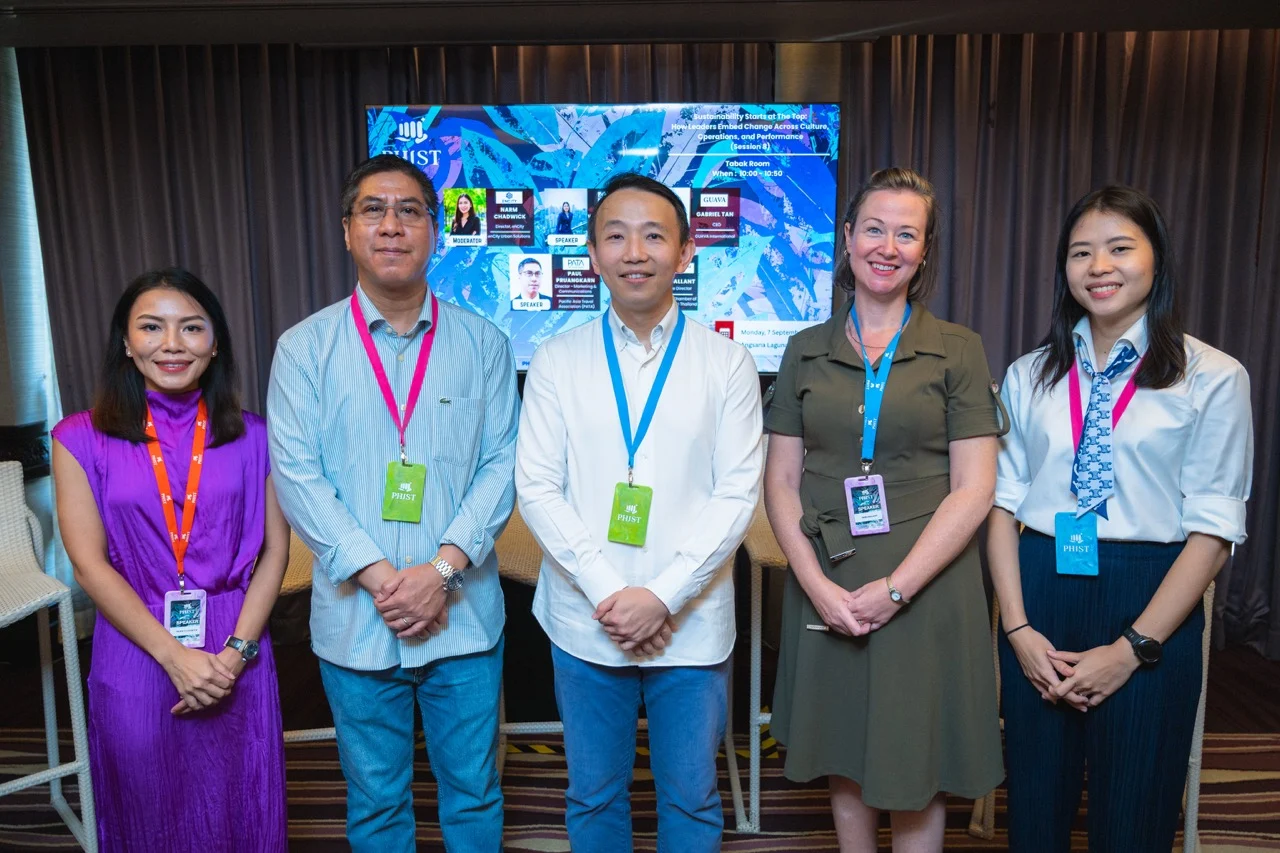
At PHIST 2026 (Phuket Hotels for Island Sustaining Tourism), a panel of senior executives from the Pacific Asia Travel Association (PATA), 137 Pillars Hotels & Resorts, the American Chamber of Commerce in Thailand (AmCham) and GUAVA International made a clear case: sustainability in tourism can no longer be an add-on or a marketing badge. It must become a core driver of how businesses operate, invest, hire and create value.
The session, titled “Sustainability Starts at the Top: How Leaders Embed Change Across Culture, Operations, and Performance,” brought together Paul Pruangkarn, Director of Marketing & Communications at PATA; Heidi Gallant, Executive Director of AmCham Thailand; Nida Wongphanlert, Managing Director of 137 Pillars Hotels & Resorts; and Gabriel Tan, CEO of GUAVA International and UN SDG Pioneer for Circular Economy. Their collective message: the future of sustainable tourism depends less on what companies say and more on whether sustainability is embedded in decision-making at every level.
Beyond the certificate
Pruangkarn argued that the gap between genuine sustainability and greenwashing is increasingly visible in what happens beyond a hotel’s walls. Organisations making the greatest impact, he said, are those that go beyond basic environmental measures and demonstrate tangible benefits for local communities and destinations. “It’s organisations that give back to the communities, local communities,” he noted.
He cited examples from Cambodia, Thailand and Sri Lanka, including Jetwing Hotels in Sri Lanka, which integrates food production and food-waste management into its operations while recruiting from underserved communities and providing training and accommodation. For Pruangkarn, this illustrates a fundamental point: sustainability is ultimately about people. “Whatever you do for the environment, at the end of the day is also for the people and you are working with people,” he said. Sustainability, therefore, is not just about reducing today’s environmental footprint but about strengthening destinations against future pressures, including climate change and increasingly severe storms.
Start with the “why” — and make it habitual
For Wongphanlert, sustainability became practical only when her team understood why they were being asked to change. Rather than setting a distant target of obtaining a major certification, 137 Pillars started with a smaller sustainability programme that allowed the team to build confidence across operations, procurement and engineering. “If I had a target, okay, let’s get a certificate by five years, and they don’t know why they’re doing it, then I’m not getting them to work with me,” she said.
The approach has since filtered into everyday hotel operations, from procurement and packaging to waste separation and food consumption. The hotel also seeks out local and women-led suppliers where possible, and sustainability choices have become part of the guest experience and storytelling. The objective is to make sustainable behaviour habitual rather than exceptional. At the staff canteen, for example, a “no waste Monday” encourages employees to take only what they intend to eat. “It’s beyond operation. It goes to their daily life, their new habit,” Wongphanlert said.
This small example reflects the broader challenge of embedding sustainability into organisational culture rather than leaving it as the responsibility of a dedicated sustainability team. As PHIST 2026’s broader agenda highlighted, the industry is moving beyond green credentials toward operational integration.
Sustainability needs a business case
Gabriel Tan took the argument a step further, saying sustainability will struggle to survive if it is treated simply as compliance. Boards and funders increasingly want to know what an investment delivers. “If there’s no outcome, meaning good to have, not a must have… they will either reduce the budget or number two, they will just remove it completely,” Tan said. The answer, he argued, is value creation. That could mean higher revenue or profitability, but it can also include stronger brand reputation, higher asset value and — particularly important for hospitality — the ability to attract and retain talent.
Hotel and tourism businesses are highly dependent on people to deliver service, making recruitment and retention an increasingly important part of the sustainability equation. “If you cannot attract people or you cannot retain people, then you have a problem,” Tan said. The shift is not necessarily from “profit” to “sustainability”, but towards understanding how the two can reinforce each other. For businesses, that means asking not only what sustainability initiative should we implement, but also what value will it create, and how will we know?
This aligns with a growing recognition across the region that sustainability must be tied to measurable outcomes. As Queensland operators face a September deadline for a sustainability subsidy, the pressure to demonstrate tangible results is mounting. Similarly, wellness and sustainability are reshaping Southeast Asia’s luxury property market, where buyers and investors increasingly expect ESG performance to be part of the asset’s value proposition.
The biggest challenge: alignment
Perhaps the most difficult issue is alignment — between sustainability goals and business strategy, between departments, and between short-term pressures and long-term resilience. The panel agreed that leadership must set the tone, but that sustainability cannot be imposed from the top alone. It requires buy-in from every employee, from housekeeping to the boardroom.
Heidi Gallant, representing AmCham Thailand, emphasised the role of cross-sector collaboration and the need for clear metrics that investors and partners can trust. She noted that while many companies have made public commitments, the real test is whether those commitments translate into operational changes and measurable impact.
As tourism continues to recover and evolve, the industry’s next test will be whether it can turn good intentions into business value. The leaders at PHIST 2026 made it clear that the time for symbolic gestures is over. Sustainability must be embedded in the way tourism businesses create value — for customers, employees, communities, shareholders and destinations alike.