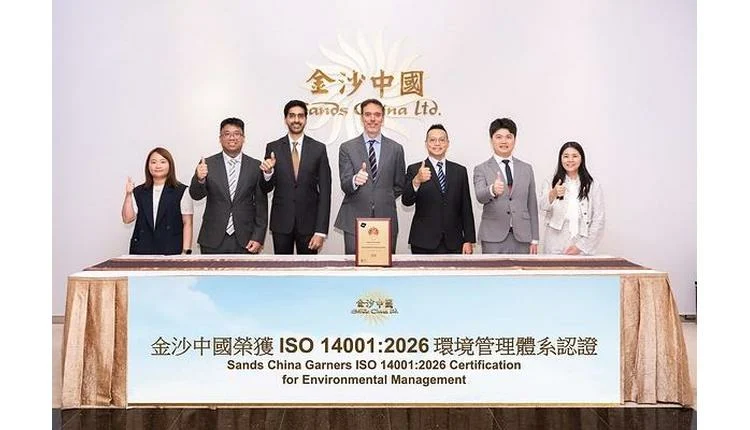
Sands China has become the first integrated tourism and leisure enterprise worldwide to secure the ISO 14001:2026 Environmental Management System (EMS) certification, awarded by the British Standards Institution (BSI) Group. The certification applies across all of the company's resort properties in Macao, including The Venetian Macao, The Parisian Macao, and The Londoner Macao, marking a significant milestone in the region's hospitality and tourism sector.
The ISO 14001:2026 standard, released by the International Organisation for Standardisation (ISO) in April, introduces a more rigorous framework for environmental management, with heightened focus on climate change adaptation, natural resource efficiency, and biodiversity protection. Sands China's early adoption of this updated standard signals its proactive stance in aligning its operations with the latest global sustainability benchmarks.
Leadership commitment to sustainability
Grant Chum, chief executive officer and executive director of Sands China, emphasized the strategic importance of this achievement. "Sustainability is a cornerstone of the company’s long-term development," he said. "This achievement demonstrates that our environmental management efforts and performance meet the latest international standards." Chum's remarks underscore the company's view of environmental stewardship as a core business priority rather than a peripheral initiative.
The certification process involved a comprehensive audit of Sands China's environmental policies, operational procedures, and performance metrics across its entire portfolio. BSI Group, a leading global standards and certification body, verified that the company's management systems comply with the new standard's stringent requirements, which include enhanced climate risk assessment and biodiversity considerations.
Tangible environmental gains
Sands China's sustainability record is backed by measurable results. The company reports a 61% reduction in Scope 1 and Scope 2 greenhouse gas emissions since 2018, a figure that aligns with the Paris Agreement's targets for limiting global temperature rise. Additionally, potable water consumption fell by 9% in 2025, reflecting ongoing investments in water-efficient technologies and operational improvements.
These reductions are part of a broader environmental strategy that includes energy-efficient building systems, waste reduction programs, and sustainable sourcing practices. The company has also invested in on-site solar energy generation and smart building management systems to further lower its environmental footprint.
The achievement places Sands China alongside other hospitality leaders pursuing rigorous sustainability certifications. For instance, Atlantis Dubai's recent trio of certifications highlights a growing trend among major resort operators to adopt internationally recognized environmental standards. Similarly, Marina Bay Sands' $1.5 million pledge to wildlife rehabilitation demonstrates the broader commitment of integrated resort operators to environmental causes.
Implications for Macao's tourism industry
Sands China's certification is expected to influence sustainability practices across Macao's tourism and leisure sector. As the city positions itself as a global hub for business and leisure travel, environmental credentials are becoming a differentiator for attracting environmentally conscious travelers and corporate clients. The company's leadership in this area may prompt other operators in the region to accelerate their own sustainability programs.
Looking ahead, Sands China aims to continue driving sustainable practices within Macao's tourism industry, contributing to the city's vision of a more sustainable future. The company's efforts are also aligned with broader industry trends, such as China's shift toward immersive travel experiences, where sustainability is increasingly a factor in destination choice.
For travel professionals, this development underscores the growing importance of environmental management systems in the hospitality sector. As more operators pursue certifications like ISO 14001, sustainability is becoming a key competitive differentiator in the global travel market.