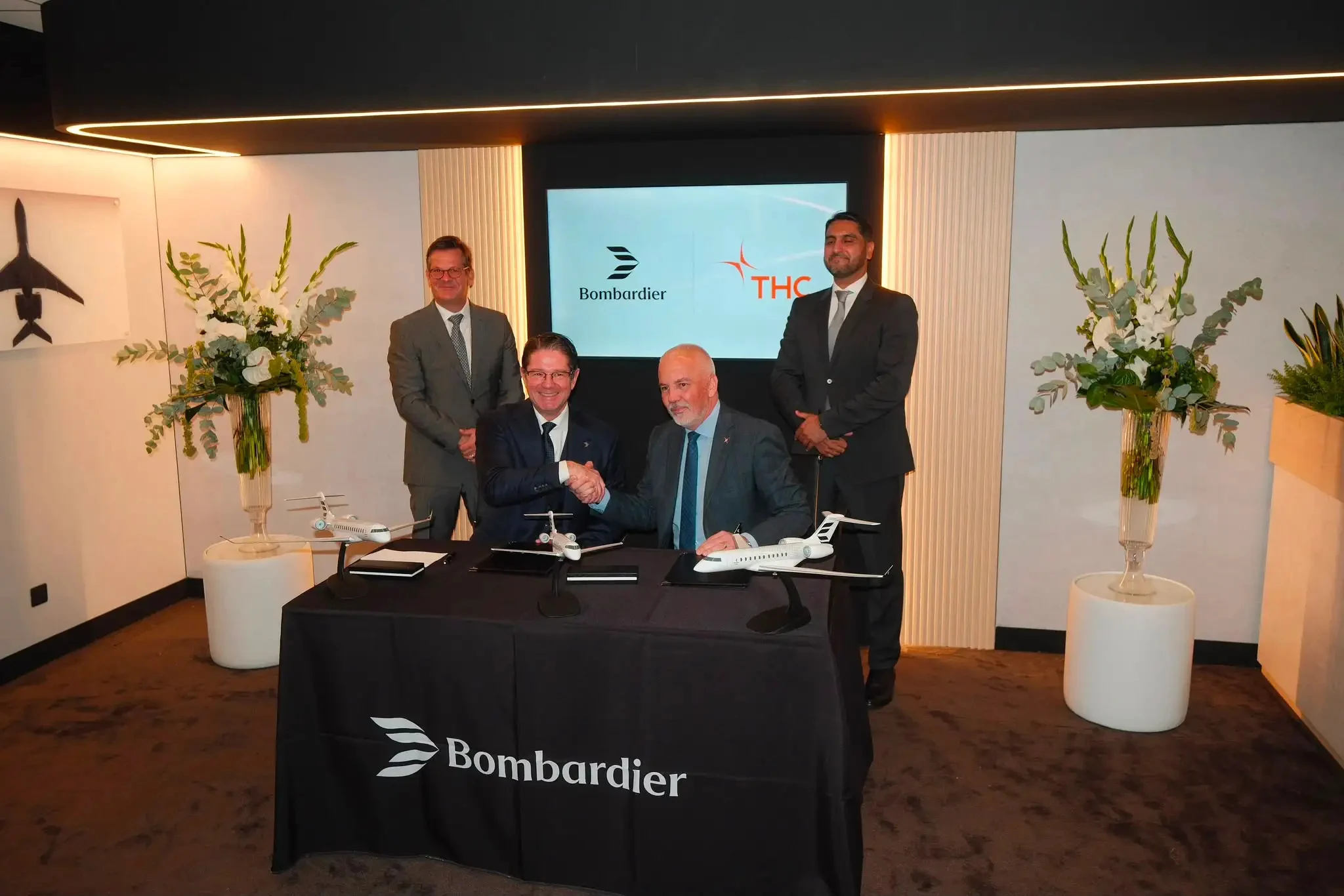
The Helicopter Company (THC), owned by Saudi Arabia's Public Investment Fund (PIF), is making a strategic pivot from rotary-wing operations into fixed-wing business aviation. At the Farnborough International Airshow, THC signed a letter of intent with Bombardier for a firm order of 12 business jets, with options for an additional 48 aircraft. If fully exercised, the fleet could reach 60 Bombardier jets across the Challenger and Global families.
THC was established in 2018 and has grown into the Kingdom's leading commercial helicopter operator. The move into fixed-wing aviation will see the company offer private charter and aircraft management services, tapping into rising demand for premium and flexible air travel across Saudi Arabia. The initial order comprises five Challenger 3500 aircraft, five Global 5500 aircraft, and two Global 8000 aircraft.
From Helicopter Operator to Aviation Group
THC's expansion marks a natural evolution from a specialist helicopter operator into a broader general aviation business with regional ambitions. CEO Captain Arnaud Martinez stated, "As a portfolio of companies, The Helicopter Company was always poised to expand beyond rotary-wing aviation into fixed-wing operations. Our vision has always been to become the General Aviation Champion from Saudi Arabia to the world."
The new business aviation segment is designed to meet demand generated by Saudi Arabia's expanding economy, rising business activity, tourism development, and giga-projects such as NEOM, The Red Sea, Diriyah, and Qiddiya. THC aims to become the national carrier of choice for private charter and business aviation, serving both regional and intercontinental routes. The Challenger 3500 targets the super-midsize segment, the Global 5500 offers long-range capability, and the Global 8000 provides ultra-long-range capacity for some of the world's longest business aviation routes.
Why Saudi Arabia Needs a Business Aviation Champion
Business aviation is increasingly positioned as an enabler of economic growth and connectivity under Vision 2030. Executives, government delegations, investors, and project teams frequently need to travel between Riyadh and rapidly developing destinations. THC's expansion reflects a shift from viewing private aviation as a luxury product to a critical infrastructure component supporting investment, tourism, and major events. Martinez added, "Every investment we make is guided by the same philosophy, to build an integrated aviation ecosystem that supports Saudi Vision 2030 through innovation, operational excellence and long-term value creation."
This aligns with broader Saudi initiatives such as the multi-entry Umrah visa opening year-round pilgrimage travel and the package visa streamlining luxury bookings for the travel trade. THC's fleet commonality and commitment to sustainable operations are fundamental to delivering high safety and service standards.
Bombardier Deepens Its Saudi Arabia Ambitions
For Bombardier, the agreement expands its presence in one of the Middle East's fastest-developing aviation markets. CEO Éric Martel said, "Bombardier's aircraft are uniquely positioned to meet the evolving needs of customers around the world, offering exceptional versatility, dispatch reliability and a world-class customer experience." The manufacturer plans local investments to support THC's operations and provide access to its global maintenance and service network.
Martel highlighted the Challenger 3500's fit for the super-midsize category, the Global 5500's industry-leading range, and the Global 8000 as the pinnacle of business aviation. THC's fixed-wing expansion was accompanied by another major fleet announcement at Farnborough: a firm order for eight additional Airbus helicopters, reinforcing its rotary-wing base.
As Saudi Arabia's giga-projects like Six Senses AMAALA come online, demand for premium aviation services will only intensify. THC's transformation positions it as a key player in the region's business aviation landscape, supporting the Kingdom's ambitious economic diversification goals.