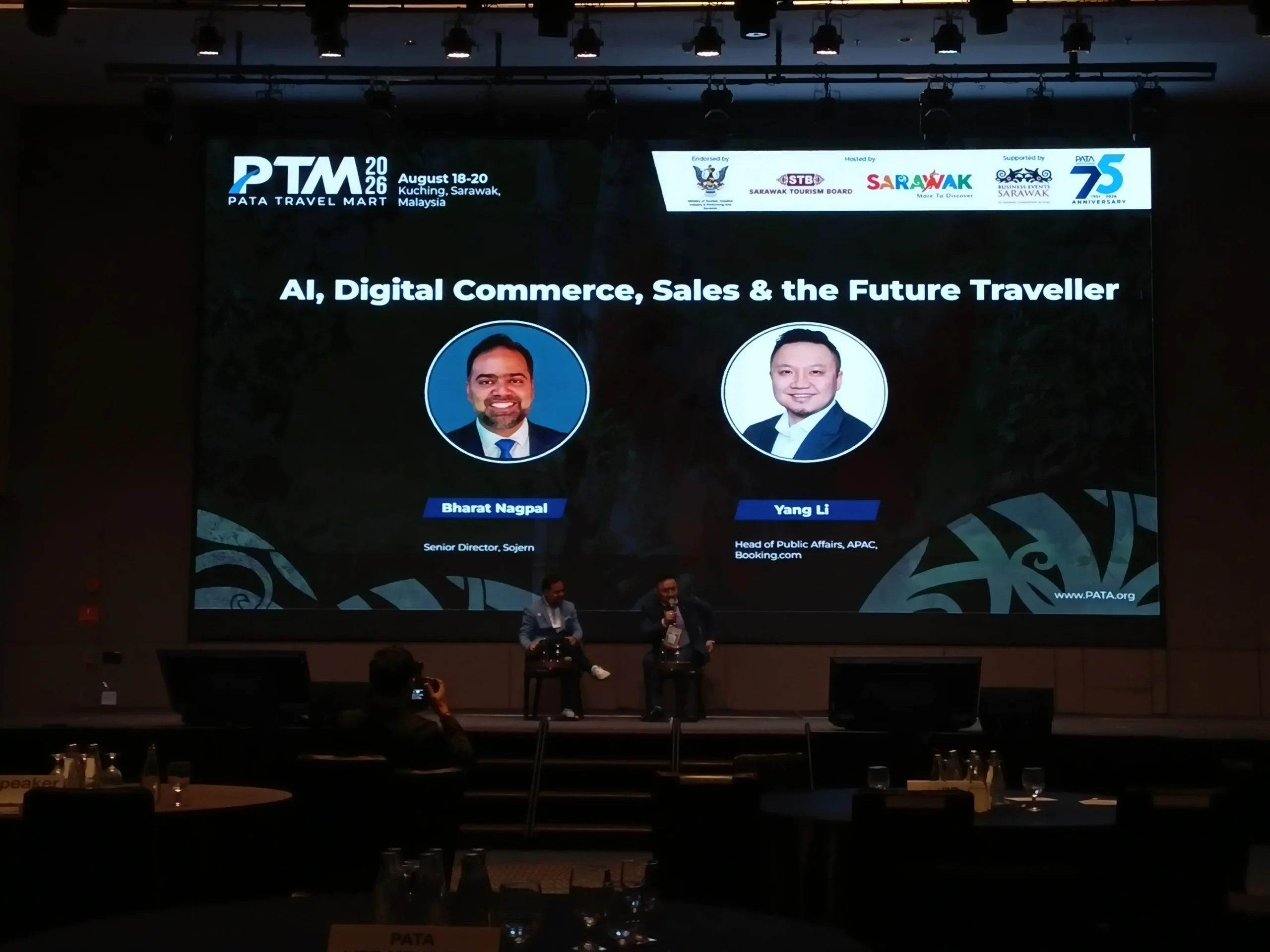
At the 2026 PATA Knowledge Forum in Kuching, senior travel technology executives warned that while artificial intelligence is reshaping digital commerce and sales, the industry must not rush toward full AI autonomy. In a fireside chat titled "AI, Digital Commerce, Sales, and the Future Traveller," Sojern senior director Bharat Nagpal and Booking.com head of public affairs for APAC Yang Li addressed the shifting role of AI across the traveler journey, offering key insights into how destinations and small businesses can harness these tools responsibly.
Li cited Booking.com’s global AI sentiment survey, which found that 90 percent of travelers expressed excitement about AI applications, with 89 percent intending to use it for trip planning. However, a striking trust gap remains: only 12 percent of respondents said they would trust an AI agent to make independent travel decisions on their behalf. As Li put it: "Efficiency gains are real, but there is still a major trust gap when allowing AI to do more than search."
Trust deficit and the risk of generic content
Both panellists cautioned against over-reliance on generic AI content. Nagpal noted that while 66 percent of businesses use AI for content development, modern travelers easily spot synthetic imagery. Li echoed this sentiment, pointing out that uncalibrated enterprise models risk making destinations sound identical, stripping local culture of its distinct identity.
The discussion underscored that the travel sector is navigating a critical evolution: moving beyond mere technology adoption to balancing automated efficiency with genuine human connection. As AI becomes more embedded in the traveler journey, the industry must ensure that technology enhances rather than replaces the human touch that defines memorable travel experiences.
From funnels to real-time intent marketing
The panelists noted that the traditional travel funnel—progressing from awareness to booking—has vanished. Nagpal highlighted findings from Sojern’s State of Distribution report, revealing that discovery now originates directly within conversational AI environments like ChatGPT and Gemini. Consequently, 51 percent of destinations are preparing for this shift, while 31 percent are positioning their websites as verified sources of truth for AI engines.
This transformation has shifted digital sales from demographic targeting to precise, intent-based marketing. By analyzing real-time transaction signals, destinations can engage travelers in-destination to boost economic impact. For example, a hotel in Kuala Lumpur could use AI to offer a last-minute dining reservation at a local restaurant, or a tour operator in Sarawak could suggest a cultural experience based on the traveler's current location and preferences.
Democratised technology for smaller players
The panelists also noted that generative AI has democratised data analytics, granting small and medium enterprises (SMEs) access to insights that once required dedicated data science teams. However, the wider rollout of such technologies may take time as resource constraints remain a challenge.
Initiatives like Sarawak’s Tourism Ecosystem Fund, which offers eligible businesses up to MYR 5,000 for AI enablement alongside public-private co-op marketing models, provide vital catalysts for regional growth. By combining public backing, first-party data literacy, and authentic storytelling, travel operators can deliver the hyper-personalised experiences the modern traveler demands.
As AI continues to evolve, the industry must remain vigilant about the trust gap. While efficiency gains are real, the human element remains irreplaceable. Travel companies that strike the right balance—leveraging AI for personalization and efficiency while maintaining authentic human connection—will be best positioned to thrive in the AI-driven future.