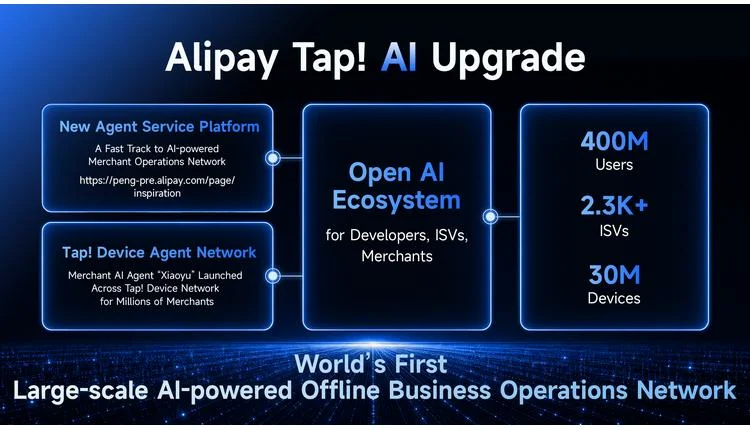
Alipay has rolled out a major upgrade to its Tap! ecosystem, embedding AI agents directly into its widely deployed point-of-sale devices. The move creates what the company describes as the world's first large-scale AI-powered offline business operations network, with significant implications for travel merchants, from small tour operators to large hotel chains.
AI Agent 'Xiaoyu' Brings Intelligent Operations to Merchants
The centerpiece of the enhancement is the AI agent named Xiaoyu, now connected to Alipay Tap! devices. Merchants gain access to intelligent analysis and actionable insights covering top-selling product marketing, membership management, and integration with Taobao Instant Commerce. For small and medium-sized enterprises (SMEs) that lack in-house AI development capabilities, the service offers tailored integration, AI-generated marketing materials, and round-the-clock business analytics.
This development is particularly relevant for travel industry players such as hoteliers, tour operators, and destination retailers who rely on Alipay for cross-border transactions. The ability to leverage AI for real-time operational decisions could reshape how these businesses manage inventory, promotions, and customer loyalty programs.
Broader AI Strategy: AI Pay, AI Wallet, and Token Pay
The Tap! upgrade is part of Alipay's wider AI strategy, which includes the recent launch of a next-generation AI payment infrastructure. This infrastructure features AI Pay, AI Wallet, and Token Pay, all underpinned by China's first Agentic Commerce Trust Protocol. The protocol is designed to ensure secure AI-driven transactions, a critical requirement as the agentic economy scales.
According to Alipay, agentic commerce is gaining rapid traction in China, with over 300 million transactions processed through Alipay AI Pay as of May 2026. Businesses are integrating Alipay AI payment with Tap! services to enhance operations and consumer experiences. For example, consumers can now interact with Haier's AI agent via smartphone to receive personalized recommendations and complete payments seamlessly.
Travel Industry Implications
For travel professionals, the integration of AI agents into offline payment networks opens new avenues for customer engagement and operational efficiency. Hotel chains, for instance, could use Xiaoyu to analyze booking patterns and optimize room pricing in real time. Tour operators might leverage AI-generated marketing materials to target specific traveler segments. The technology also aligns with trends highlighted in recent industry reports, such as ZentrumHub's finding that AI agents could handle 58% of OTA hotel bookings by 2027.
Alipay's move also complements the broader shift toward AI-native platforms. In June 2026, the company launched an upgraded AI agent named Ah Bao, transforming Alipay into what it calls the world's first AI-native super app, facilitating easier access to services for its one billion users. This evolution mirrors the reshaping of travel industry dynamics by AI agents, from discovery to booking in a single layer.
What This Means for Travel Technology Vendors
Travel technology vendors should take note of Alipay's commitment to agentic commerce. The company's Trust Protocol provides a framework for secure AI transactions that could be adopted by other payment systems globally. For GDS systems and booking platforms, the ability to integrate with Alipay's AI agents could become a competitive differentiator, especially in markets like China where Alipay dominates mobile payments.
As the travel industry continues to digitize, the convergence of AI agents and payment infrastructure is likely to accelerate. Alipay's Tap! upgrade represents a concrete step toward a future where merchants of all sizes can harness AI without significant upfront investment. For travel professionals, staying abreast of these developments is essential to remain competitive in an increasingly automated marketplace.