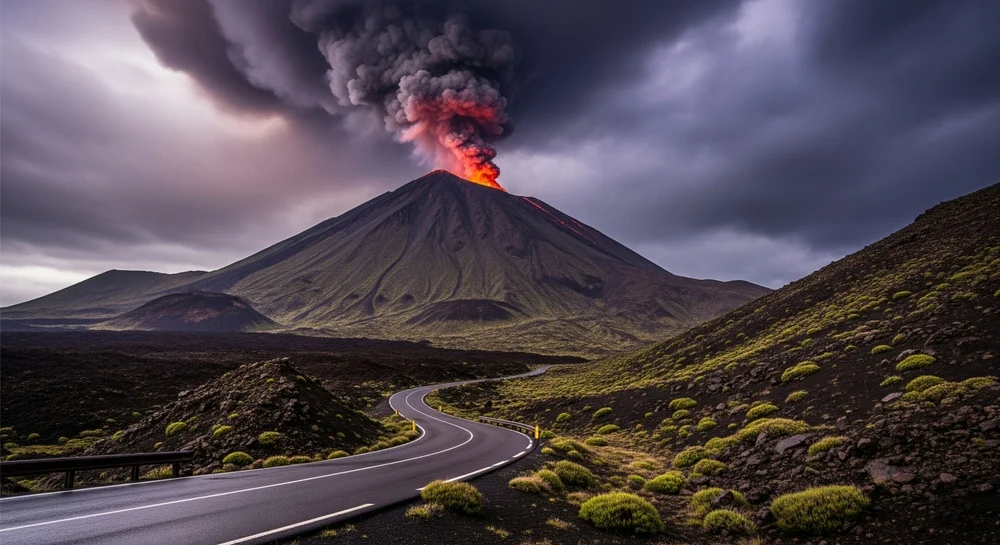
Five days of volcanic ash from Mount Etna forced the closure of Catania airport during Italy's peak Ferragosto holiday week, grounding hundreds of flights and leaving travellers scrambling for alternatives. The shutdown, the longest linked to Etna since 2002, exposed the fragility of Europe's summer aviation network, which is already operating near capacity.
Between August 6 and 12, nearly 36% of the roughly 2,000 scheduled flights were cancelled, and more than 600 were diverted to Palermo, Trapani, Comiso, or Lamezia Terme on the mainland. Trenitalia added extra services to help stranded passengers cross Sicily by rail.
Etna's eruption is not a climate event, but it collided with a summer already marked by extreme heat, drought, and wildfires across Europe. The episode illustrates how unrelated environmental hazards can strike at peak demand, leaving airports with little room to recover.
Operational impact ripples beyond Catania
Catania sits about 30 kilometres south of Etna, and volcanic activity is nothing new. What made this event so disruptive was the persistence of the ash cloud. Northerly winds carried fine particles towards Malta and North Africa, and Boris Behncke of Italy's National Institute of Geophysics and Volcanology's Etna Observatory told AP that ash can enter aircraft engines and potentially cause them to stall. With that risk, there is little scope for compromise.
The disruption showed up in European traffic figures. EUROCONTROL recorded an average of 36,174 flights per day across its network between August 10 and 16, 3% above the same week in 2025. Italy, however, saw traffic fall 4% week on week, largely due to Catania's closure.
For Sicily's tourism industry, the damage extends beyond the terminal. Late and cancelled arrivals disrupt hotel inventory, transfers, and package itineraries. Diversions shift car-rental demand to other gateways. Airlines face the costly task of repositioning aircraft and crews once operations resume.
Italy's federation of travel agencies and tour operators has called for a task force to improve coordination during future Etna events and for scrutiny of how airlines handle cancellations. The demand reflects a broader concern: repeated disruption is becoming an operating issue for the entire tourism supply chain, not just an airport problem.
Heat and wildfire risk add pressure
Across the continent, other pressures are building. Europe, already the world's fastest-warming continent, has endured another summer of exceptional temperatures and fires. Austria recorded a national high of 41.2°C in early August, while Italy placed major cities under red heat alerts and firefighters battled blazes in Greece and Albania.
Drought has amplified the problem. Reuters reported that record heat and water shortages were disrupting power generation, shipping, and public health, while Europe's wildfire season was on course to rank among its most severe. Aviation is directly exposed: hotter air reduces aircraft performance, potentially lengthening take-off requirements or forcing weight restrictions. Airports must also manage heat stress among ground crews, higher cooling demand, and pressure on runways.
Fire is becoming a more immediate airport risk. A 2026 study in the Copernicus journal Natural Hazards and Earth System Sciences projected that 37% of European airports could face increased wildfire exposure by mid-century, with a further 16% encountering it for the first time. That changes the resilience calculation for airport operators. Climate adaptation is no longer just a long-term infrastructure concern; it is increasingly part of summer capacity planning.
Europe's network has little slack
The timing could hardly be worse. European aviation traffic continues to rise, packing more flights into a network already vulnerable to congestion. During the week dominated by Etna's disruption, EUROCONTROL recorded more than 36,000 flights a day. Weather accounted for 40% of en-route air traffic flow management delays, behind only air traffic control capacity and staffing.
A week later, average daily traffic climbed to 36,372 flights, and adverse weather contributed to an 11% increase in air traffic flow management delays, according to EUROCONTROL. That leaves little margin when a major leisure gateway drops out of the system for several days. At Catania, traffic shifted to other Sicilian and southern Italian airports. Elsewhere, the trigger could be wildfire smoke, extreme heat, flooding, or storms. Different hazards, similar consequences: diversions, cancellations, displaced passengers, and disruption rippling into airports hundreds of kilometres away.
Europe's airports have spent much of the past decade preparing for higher passenger numbers. They now face a more complicated summer equation — growing demand alongside a changing climate and more frequent extreme weather. Etna remains the outlier, a volcanic hazard rather than a climate-driven one. But Catania has provided a useful stress test. When Europe's airports are at their busiest, even a local emergency can expose weaknesses across the wider network.
For airlines and airport operators, resilience is no longer a distant climate strategy. Increasingly, it is a peak-season operating requirement. As the industry looks to Europe's leisure travel spending and cruise lines redeploying to Europe, the need for robust contingency planning has never been clearer.