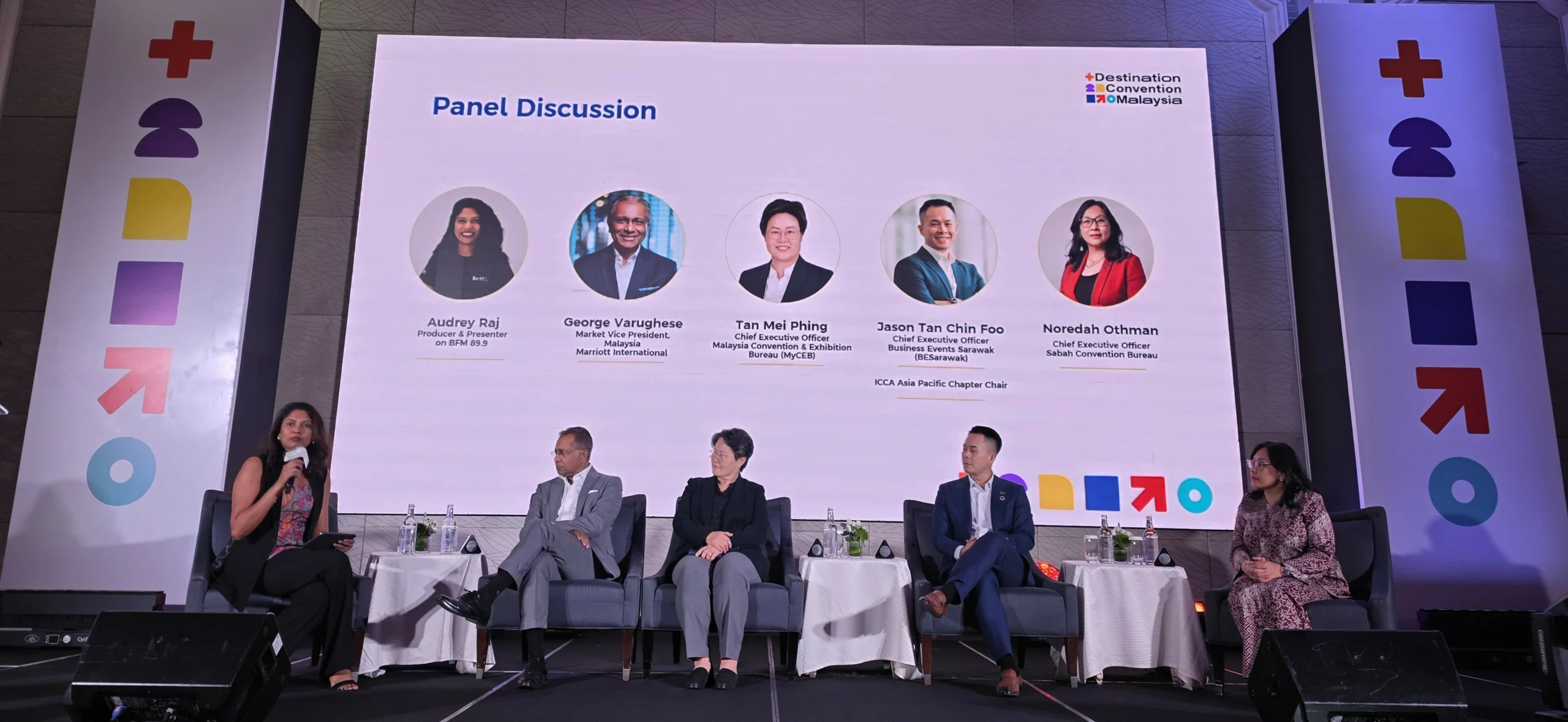
Malaysia's business events sector is entering a new phase where growth is increasingly driven by destinations outside the traditional Kuala Lumpur hub. Sabah and Sarawak are building their MICE credentials, and industry leaders are advocating a more collaborative approach to keep international events within the country.
This was the central theme of the Destination Convention Malaysia panel discussion held in Kuala Lumpur, featuring George Varughese, Market Vice President for Marriott International Malaysia; Tan Mei Phing, CEO of the Malaysia Convention & Exhibition Bureau (MyCEB); Jason Tan Chin Foo, CEO of Business Events Sarawak (BESarawak); and Noredah Othman, CEO of the Sabah Convention Bureau.
Kuala Lumpur remains Malaysia's primary international gateway and the natural first choice for many organisers. However, increasing hotel investment, improving air connectivity, government backing, and unique destination experiences are broadening the country's appeal. As the panel noted, "Every destination has its own uniqueness and own story to tell. Kuala Lumpur is the gateway," but other destinations are becoming increasingly relevant as international links and private-sector investment expand.
For event planners, this shift opens opportunities to design programmes around destinations with distinct cultural, leisure, and experiential offerings, rather than concentrating business in a single convention hub.
Sarawak's 'non-capital' positioning
Sarawak is among the destinations redefining its place in Malaysia's business events landscape. Jason Tan, representing BESarawak, argued that destinations should be supported by an entire ecosystem rather than relying solely on convention centres or hotels. "When you bring a conference to Sarawak, Kuching, everyone in the ecosystem plays a role in taking care of the conference," he said, highlighting the involvement of government, industry partners, communities, and media. Government support, including funding for events, has been crucial to Sarawak's development.
Tan emphasised that Sarawak deliberately describes itself as a "non-capital city" destination rather than using the traditional "second-tier" label. The distinction is more than semantic; calling destinations second-tier can imply inferior experience or infrastructure, whereas Sarawak's proposition is about offering something different from a capital-city convention experience. The state is also looking beyond visitor numbers when evaluating events, aligning conferences and exhibitions with government priorities and using them as enablers for sector development. Renewable energy and green hydrogen were cited as examples, with business events providing platforms for knowledge exchange and investment in industries the state wants to grow.
Sabah leverages leisure strength
Sabah is working to convert its established leisure appeal into a stronger business events proposition. The state has participated in MICE for years, but the Sabah Convention Bureau is relatively young. Its opportunity lies in combining established tourism assets with access to major Asian source markets. Kota Kinabalu receives direct international services from multiple regional cities and sits within roughly three to four hours' flying time of several major Asian hubs and capitals. That accessibility has helped Sabah attract incentive groups, particularly from China and Korea. The challenge is to translate those advantages into a broader pipeline of meetings, conferences, and incentive programmes.
Like Sarawak, Sabah sees destination-wide cooperation as critical. "To be positioned as a MICE destination, the ecosystem is very important," the panel heard. "The support from the state government is very important."
Selling the destination, not just the hotel
The emergence of destinations outside Kuala Lumpur is also changing expectations for hotels and other suppliers. Tan argued that hoteliers cannot simply sell rooms and meeting facilities when pitching for international events. "When a venue or hotel sells their property, they are not selling a property. They need to sell the destination together," he said. Destination knowledge becomes part of the sales process, requiring an ability to explain local culture, food, experiences, accessibility, and the wider business ecosystem alongside ballroom capacity, room inventory, and meeting packages.
Marriott's George Varughese echoed this, stating that events cannot succeed through hotel infrastructure alone. Government support, accessibility, destination experiences, culture, food, hotels, and conference facilities all form part of the proposition. Business events have also evolved, particularly since the pandemic. "People are eager to meet, people are looking for special experiences," Varughese said, adding that delegates often remember the destination, people, and experiences long after the conference itself.
Perhaps the most significant aspect of Malaysia's multi-destination strategy is the willingness of destinations to cooperate rather than view every event as a one-off competition. The panel discussed the possibility of an association meeting being staged in Kuala Lumpur in one cycle, Kuching in another, and Kota Kinabalu in a third, with each destination playing to its strengths and supporting the others. This collaborative approach is seen as key to keeping international events within Malaysia and competing effectively against regional rivals such as Sri Lanka's high-yield MICE push.
As Malaysia's business events landscape diversifies, the message to international planners is clear: look beyond the capital. With improved air links, government backing, and unique experiences, Sabah and Sarawak are positioning themselves as compelling alternatives, and the industry is working together to ensure that Malaysia remains a top choice for global meetings and incentives.