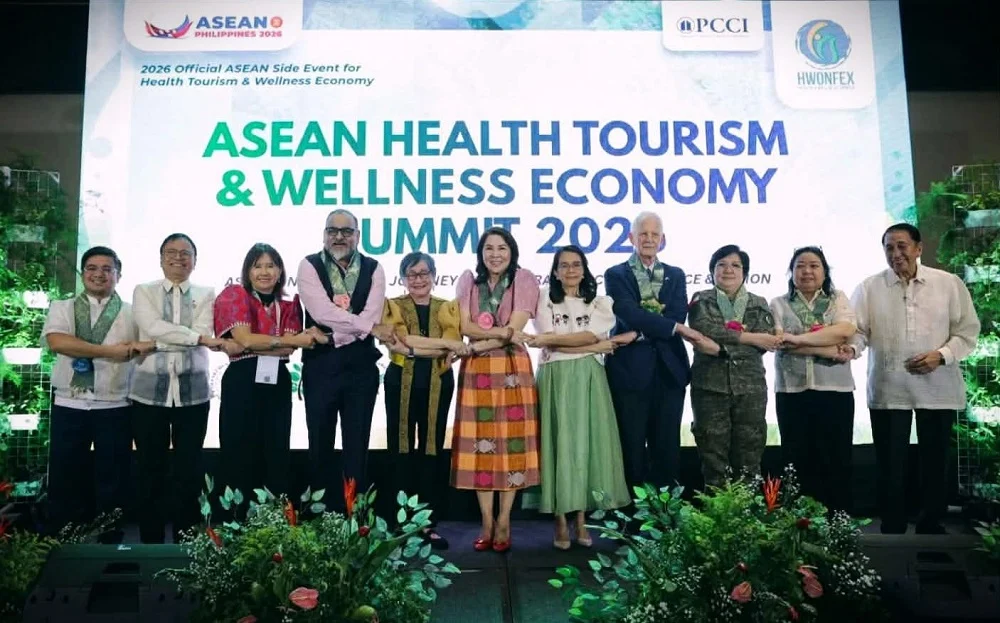
The ASEAN Health Tourism & Wellness Economy Summit opened September 4, 2026, at the SMX Convention Center Manila, drawing trade ministers, diplomatic envoys, corporate investors, and health leaders from across the region. Running as an Official ASEAN Side Event under the theme "Go Explore, Grow Communities, and Glow Together," the summit is co-presented by the Philippine Chamber of Commerce and Industry (PCCI) and endorsed by the Department of Social Welfare and Development (DSWD).
The core objective: consolidate Southeast Asia's fragmented health services, cross-border investment frameworks, and agricultural supply chains into a unified, high-yield regional health and longevity economy. For travel professionals, the implications are direct—wellness tourism, medical travel, and retirement migration are becoming structured, policy-backed growth sectors.
Policy frameworks and investment signals
The ministerial session opened with a briefing by Dr. Paulo Benito S. Tugbang, DOT Director for Health and Wellness Tourism, supported by DFA Undersecretary Leo M. Herrera-Lim, PCCI President Perry A. Ferrer, and ASEAN Business Advisory Council Philippines Chairman Jose Ma "Joey" Concepcion III. Their remarks set the tone: wellness is no longer a niche—it is a macroeconomic pillar.
Panel I focused on unlocking investor pathways. Roberto Z. Zozobrado, General Manager/CEO of the Philippine Retirement Authority, detailed new Specialized Resident Retiree Visa (SRRV) policies designed to attract the global silver market. Emmanuel Cortero, PEZA Deputy Director General, mapped out institutional tax incentives and developer benefits for constructing health zones and regional sports hubs. These measures are aimed squarely at hospitality and real estate investors eyeing wellness-anchored developments.
Former Undersecretary Nora Terrado delivered Plenary II, outlining a strategic roadmap to position the Philippines as a premier digital health and global capability hub for international healthcare tech firms. That ambition aligns with broader travel-tech trends, where data-driven wellness and remote monitoring are reshaping guest experiences.
Integrating the wellness value chain
Panel II connected market demand to grassroots production. Board of Investments Director Francis Peñaflor, Department of Agriculture Undersecretary Cheryl Marie Natividad-Caballero, and PITAHC Director General Dr. Ma. Teresa C. Iñigo aligned local medical tourism infrastructure with indigenous traditional medicine standards. For tour operators and destination marketers, this signals a push to package authentic, community-based wellness experiences alongside clinical offerings.
Global benchmarks came in Panel III from Dr. Junhyung Park (Director, Triohealix, Inc.) and Satoshi Geng (CEO, MedVigilance, Japan), who outlined how national policy frameworks can leverage healthcare big data, predictive tracking, and remote patient monitoring to scale longevity networks. These technologies are increasingly relevant for hotel groups and cruise lines developing wellness programs.
Public health as the ultimate safety net
The summit's central theme: national productivity and macroeconomic resilience are permanently tied to preventative, community-led healthcare. DSWD Secretary Rexlon Ting Gatchalian delivered the cornerstone keynote, framing wellness as a social and economic imperative.
"A resilient economy cannot be built on reactive healthcare; it must be anchored on proactive wellness and the systemic protection of human capital," Gatchalian said. "By endorsing HWONFEX 2026 as an Official ASEAN Side Event, the DSWD recognizes that preventative health, nutritional sustainability, and holistic well-being serve as the ultimate social safety net for our people."
He added: "True social development means shifting from simply managing vulnerabilities to actively empowering our grassroots workforce to thrive. When we bridge public welfare policy with high-value health trade, we build healthier local communities and elevate the entire ASEAN region into a unified, wealthy economic bloc."
Commercial momentum and public access
Policy dialogues translated into live transactions through concurrent B2B business matching channels, connecting international hosted buyers with regional suppliers. While premium summit tracks convened decision-makers, the public gates opened for HilomX—the Philippine Traditional, Complementary, and Integrative Medicine (TCIM) eXposition—and the main trade floor, both free to the public to encourage grassroots wellness access.
The summit concludes with resolutions and a structured framework for regional action, presented by PCCI Director for Health and Wellness, Dr. Hernando B. Delizo. Event partners include the Wellness Tourism Association of the Philippines (WeTAP), the Department of Agriculture, PhilFIDA, DSWD, DOT, PITAHC, and the Department of Migrant Workers. Minor partners include PAGCOR, the Philippine Retirement Authority, and the Tourism Promotions Board. Newport World Resorts serves as official host venue, with Treston International College as culinary and hospitality partner. Platinum sponsors Castle Rock and IAM Worldwide lead the corporate roster, joined by Gold sponsor Biovitalis and Silver sponsors Enjoy Health and Glorious Industr...
For travel industry stakeholders, the summit signals a shift toward structured, policy-backed wellness tourism across ASEAN. As Philippine developers pivot to regenerative design, and with Bangkok's first integrated wellness club on the horizon, the region is positioning itself as a global longevity hub. The Manila framework could accelerate similar initiatives, from Four Seasons Langkawi's wellness immersions to Novotel's Longevity Week.