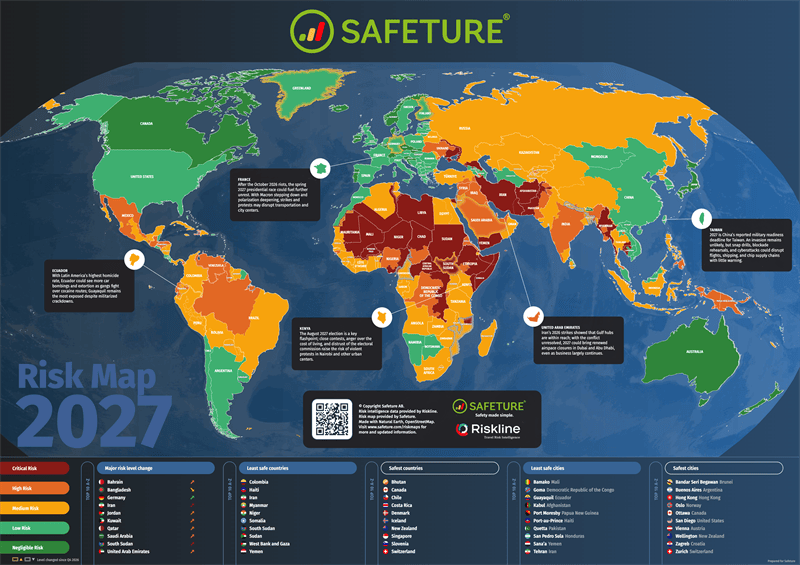
The latest Risk Map from Safeture and Riskline, covering 2027, delivers a stark reminder that the global risk landscape for business travel is in constant flux. The map, which assesses destinations on a five-level scale—from Low to Extreme—incorporates security, crime, health, and environmental factors. This year's edition shows six countries improving their risk posture, while 15 have deteriorated, underscoring the need for dynamic duty-of-care strategies.
Middle East: A New Risk Frontier
The most dramatic changes are in the Middle East. Bahrain, Kuwait, Qatar, and the United Arab Emirates have all been elevated from Moderate to High risk. Iran has escalated to the Extreme category. These shifts are particularly consequential for the travel industry, as the Gulf states serve as pivotal hubs for both leisure and corporate travel, connecting Europe, Asia, and Africa. For airlines like Emirates, Qatar Airways, and Etihad, and for hotel groups operating in Dubai and Doha, this means reassessing risk protocols and traveler support.
Jonas Brorson, Chief Marketing Officer at Safeture, emphasized the volatility: “This year’s map shows how quickly the risk picture can change.” The elevation of these key business destinations will likely prompt multinational corporations to review travel policies, especially for high-frequency routes such as London–Dubai or Frankfurt–Doha.
Safest and Riskiest Destinations
At the opposite end of the spectrum, Bhutan, Canada, and Switzerland retain their status as the safest countries. In Europe, Denmark and Iceland continue to be low-risk, while Germany and Finland have slipped from Low to Moderate, joining Cyprus and Greenland. This shift may influence corporate travel managers when planning meetings and incentives, possibly favoring regional destinations that offer stability.
On the city level, Zurich and Ottawa are highlighted as safe, with Ottawa making the safest list for a second consecutive year. Conversely, Kabul and Port-au-Prince are deemed high-risk, reflecting ongoing instability. For tour operators and travel agents, these rankings are crucial when advising clients on destination choices.
Positive Developments and Regional Shifts
Encouraging news comes from Bangladesh and Nepal, which have improved from High to Medium risk, and El Salvador and the Maldives have moved to Moderate. These upgrades could open new opportunities for tour operators looking to diversify itineraries. The Maldives, a luxury beach destination, may see increased interest from high-end travelers, while Nepal’s trekking routes become more appealing for adventure tourism.
For the travel industry, the Risk Map is more than a static list; it is a tool for proactive planning. As Brorson notes, “Organizations need up-to-date intelligence to ensure traveler safety.” The map is available for download on Safeture’s website, offering a resource for risk managers, travel managers, and security teams.
The implications extend beyond safety. For airlines, changes in risk levels can affect route planning and insurance costs. For hoteliers, a destination’s risk rating influences corporate booking volumes. For travel management companies, it shapes the advice they give to clients. The 2027 map is a call to action for the industry to integrate real-time risk data into their operations.
As the travel landscape evolves, the Risk Map serves as a benchmark. The Middle East’s elevation to High risk is a reminder that even established business hubs can face new challenges. Meanwhile, the improvements in South Asia and Central America show that progress is possible. For travel professionals, staying informed is not just prudent—it is essential.