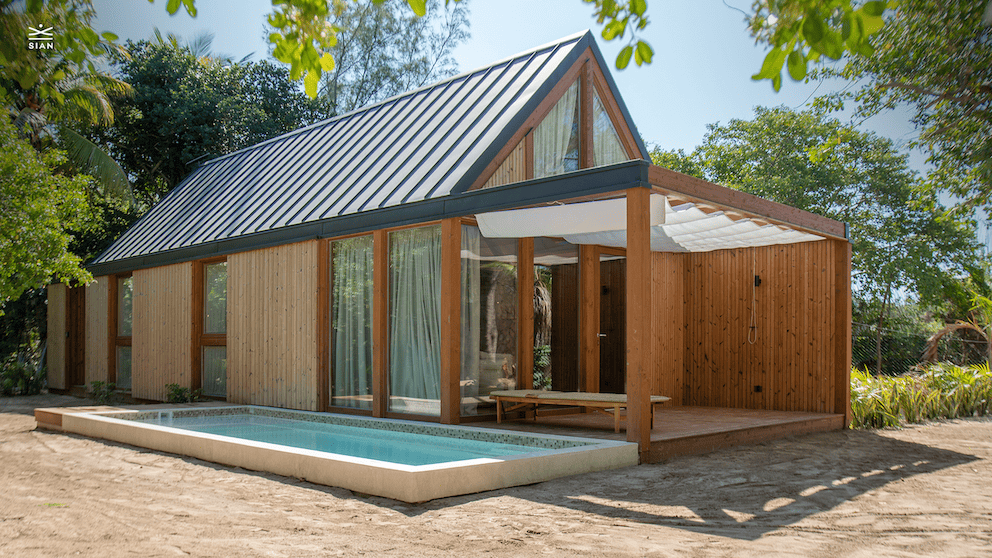
Mexican modular architecture firm SIAN has introduced a hotel expansion model that lets operators add rooms in as little as three to five months, a fraction of the one-to-two-year timeline typical of conventional construction. The first unit, SIAN Yáax, is already welcoming guests in Isla Mujeres, with additional projects slated for Tulum.
The system relies on off-site manufacturing in a controlled factory environment, followed by transport and on-site assembly. Manufacturing takes 30 to 60 days, shipping roughly 30 days, and installation about four weeks. If a unit is pre-manufactured, the entire process can be completed in two to three months.
For hoteliers, the appeal is clear: expanding inventory without years of construction noise, dust, and disruption to existing operations. SIAN's units are anchored with foundation screws instead of concrete, so no heavy machinery is needed. Properties can add guest rooms, wellness spaces, or even entire wings while remaining fully operational.
“Hotels need more flexibility in how they grow,” said Luis Gutiérrez Ureña, CEO and co-founder of SIAN. “Expanding a property shouldn’t necessarily mean committing to years of construction or disrupting operations.”
Environmental footprint by design
SIAN's approach also addresses sustainability concerns. SIAN Yáax was built without concrete foundations, using removable screws that preserve the natural terrain. The structures use FSC-certified wood, and precision manufacturing reduces material waste. This aligns with a broader industry push toward nature-first modular concepts that minimize ecological impact.
The modular model is particularly relevant for destinations facing rapid demand fluctuations or seasonal peaks. Rather than committing to permanent structures, operators can scale capacity up or down as needed, a flexibility that traditional construction cannot match.
SIAN is now eyeing international expansion, with projects under discussion in Mexico and Spain, and exploratory talks in Europe, Canada, the Caribbean, and the United States. The company aims to offer a faster, more adaptable path to hotel growth, allowing operators to respond to market conditions without long-term capital lock-in.
As the hospitality industry grapples with rising construction costs and labor shortages, modular solutions like SIAN's are gaining traction. The ability to add rooms in months rather than years could reshape how hotels approach expansion, particularly in high-demand markets where speed is critical.
For travel professionals, the implications are significant. Hoteliers can now consider incremental growth strategies, adding capacity as demand warrants, while minimizing disruption to guest experience. The model also opens doors for new entrants in markets where traditional development is prohibitively slow or expensive.
SIAN's first project in Isla Mujeres serves as a proof of concept, demonstrating that modular construction can deliver quality, speed, and sustainability in a real-world hospitality setting. With further projects in the pipeline, the company is positioning itself as a key player in the evolving landscape of hotel development.