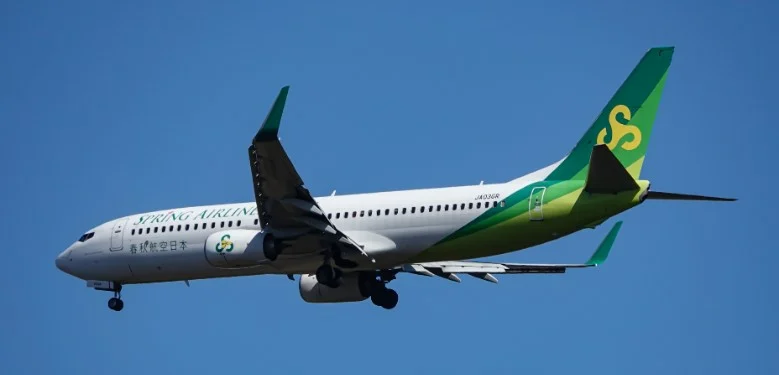
Spring Japan, the low-cost carrier under the Japan Airlines (JAL) Group, is set to significantly expand its fleet and capacity on China routes. On October 26, the airline announced plans to increase its Boeing 737-800 fleet from six to ten aircraft by 2030, with the additional planes entering service gradually from fiscal 2027. The move is aimed at strengthening its position on China routes, where it holds a competitive edge.
The four additional aircraft will be refurbished from existing JAL-owned 737-800s. While the current six aircraft each seat 189 passengers, the new arrivals will feature a 183-seat configuration. Once all four are in service, Spring Japan's available seat kilometers (ASK) — a key measure of passenger capacity — will double compared to fiscal 2025 levels.
Based at Narita International Airport, Spring Japan currently operates seven routes to Chinese cities, including Beijing and Shanghai, alongside four domestic routes within Japan. The airline's expansion strategy is built around its slogan of creating a “bridge between China and Japan,” with plans to grow existing routes and launch new ones as the fleet expands.
“We will develop routes not currently served by other airlines,” said company president Tatsuro Asami at a press conference on October 26. This approach could see Spring Japan target secondary Chinese cities or less-served pairs, potentially differentiating it from larger carriers like Air China and China Eastern.
Market challenges and recovery outlook
The expansion comes amid a challenging environment for China-Japan air travel. In August, the number of take-offs and landings on China routes at Narita was roughly half of the same month a year earlier, partly due to the Chinese government's advisory urging citizens to exercise caution when traveling to Japan. The advisory, issued in response to bilateral tensions, has dampened demand, but Asami remains optimistic.
“The market has always been substantial, and China routes remain at the core of our business. We believe passenger traffic will eventually recover,” he said. This confidence is echoed by broader industry trends: Asia Pacific carriers have recently posted their first passenger growth in six months, suggesting a gradual rebound in regional travel.
Spring Japan's focus on China is part of a wider pattern of carriers adjusting their networks. For instance, Alaska Airlines plans to link Anchorage and Tokyo Narita from spring 2027, adding new transpacific capacity. Meanwhile, Air China will connect Chengdu Tianfu with Hanoi from January 2027, underscoring the dynamic shifts in Asian aviation.
Spring Japan's fleet expansion is not just about capacity; it also involves a brand refresh. The airline announced on October 26 that it would update its aircraft livery and logo, with a new design featuring green as the primary color, accented by pink cherry blossoms to highlight its Japanese identity. This rebranding aligns with the carrier's goal of strengthening its presence as a Japan-China bridge.
The additional aircraft will be deployed strategically, with the airline planning to increase frequencies on existing routes and open new ones. Asami's commitment to unserved routes suggests a focus on niche markets where competition is limited, potentially including cities like Shenzhen, Chengdu, or Xiamen, which are not yet served by Spring Japan.
From an operational standpoint, the refurbished 737-800s will be configured with a single-class layout, consistent with the LCC model. The slight reduction in seat count (from 189 to 183) may allow for a more comfortable pitch, which could appeal to both leisure and business travelers on the China-Japan corridor.
Spring Japan's parent, JAL Group, has been supportive of the LCC's growth, leveraging its own aircraft assets to facilitate the expansion. This synergy allows Spring Japan to grow without the lead time and capital outlay of new aircraft orders, a strategy that could be replicated by other airline groups seeking to expand their low-cost subsidiaries.
As the airline prepares for its fleet growth, it will also need to navigate regulatory approvals and slot availability at Narita, which is a key hub for both domestic and international services. The airport has been a focal point for China-bound traffic, and Spring Japan's expansion could help solidify its position as a leading LCC on these routes.
For travel professionals, Spring Japan's move signals a renewed commitment to the China-Japan market, which has faced headwinds but remains fundamentally strong. The airline's strategy of differentiating through unserved routes and its capacity doubling could offer new opportunities for tour operators, agents, and corporate travel managers seeking competitive fares and new connections.
In the broader context, the expansion of LCCs on international routes is a trend to watch. As legacy carriers adjust their networks, low-cost carriers like Spring Japan are stepping in to fill gaps, often with more efficient cost structures. This could lead to increased competition and lower fares on key Asian corridors, benefiting travelers and stimulating demand.
Spring Japan's announcement also comes at a time when other carriers are making strategic moves in the region. For example, Vietjet has opened a Hanoi–Tainan service, becoming the first Vietnamese carrier at Tainan, highlighting the growing connectivity within Asia. These developments collectively point to a dynamic and evolving aviation landscape.
With the first of the additional aircraft expected to arrive in fiscal 2027, Spring Japan has time to prepare its network and marketing. The airline's focus on China, combined with its fleet and brand refresh, positions it well for the anticipated recovery in bilateral travel. As Asami noted, the market's fundamentals remain strong, and Spring Japan is betting on a rebound.