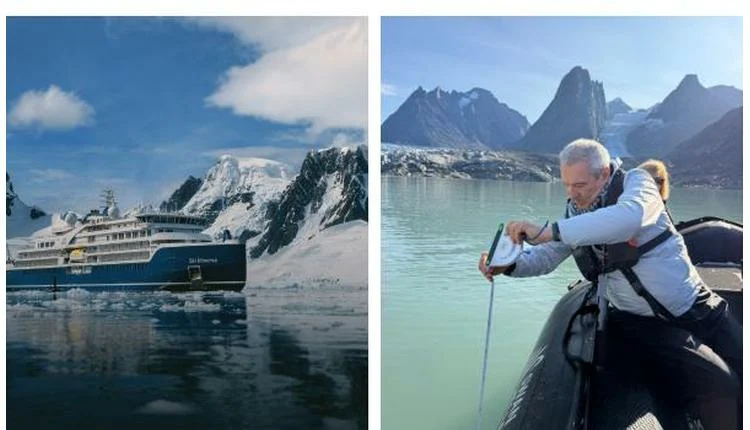
Swan Hellenic has taken a notable step in aligning expedition cruising with marine science. Its Cruising4Oceans initiative has been recognized as a pilot site within the GlobalCoast Network, a program supported by the United Nations Decade of Ocean Science for Sustainable Development. The designation marks the first ship-based and southernmost site in the network, centered on Deception Island in Antarctica.
The initiative leverages Swan Hellenic's three expedition vessels—SH Vega, SH Diana, and SH Minerva—as a "moving ocean observatory." During regular itineraries, these ships gather environmental data that is shared with the global scientific community. Unlike fixed observation stations, this approach capitalizes on vessels already navigating remote and data-scarce waters, building a more detailed picture of local ocean conditions.
From passengers to citizen scientists
Beyond data collection, Cruising4Oceans engages guests in citizen science activities, such as whale observation through Happywhale, and offers educational experiences about marine ecosystems. This model, already in use in regions like Svalbard and Greenland, can be replicated wherever commercial vessels travel in data-poor marine areas.
Andrea Zito, CEO of Swan Hellenic, expressed pride in the initiative's inclusion in the UN-endorsed program. "We want our ships not simply to visit these places, but to contribute to their understanding and protection," he said. Mario Dogliani, President of SDG4MED, added that the initiative provides crucial data from areas where recurring observations are challenging.
The move reflects a broader trend in expedition cruising, where operators are increasingly integrating research and conservation into their offerings. For travel professionals, this signals a growing expectation among luxury and expedition clients for journeys that deliver meaningful impact. As Gulf carriers expand their networks and new routes open, the appetite for purpose-driven travel is likely to grow.
Swan Hellenic's approach demonstrates that expedition ships can actively contribute to science and conservation, transforming journeys into meaningful experiences. For agents and tour operators, this offers a compelling selling point: a cruise that not only explores pristine destinations but also helps protect them.
The GlobalCoast Network recognition also underscores the potential for public-private partnerships in ocean science. By integrating data collection into commercial operations, cruise lines can provide valuable insights without dedicated research vessels. This model could be extended to other regions, such as the Arctic or the South Pacific, where data gaps remain significant.
For the cruise industry, this development highlights the importance of sustainability and scientific collaboration. As UK trade PR for cruise brands evolves, stories like this resonate with both trade partners and end consumers. It also aligns with the growing emphasis on responsible tourism, a key consideration for subscription-based travel networks and loyalty programs.
Swan Hellenic's inclusion in the GlobalCoast Network is a testament to the potential of expedition ships as platforms for research. By turning every voyage into an opportunity for data collection, the company is setting a precedent for the industry. As the network expands, other operators may follow suit, integrating science into their core operations.