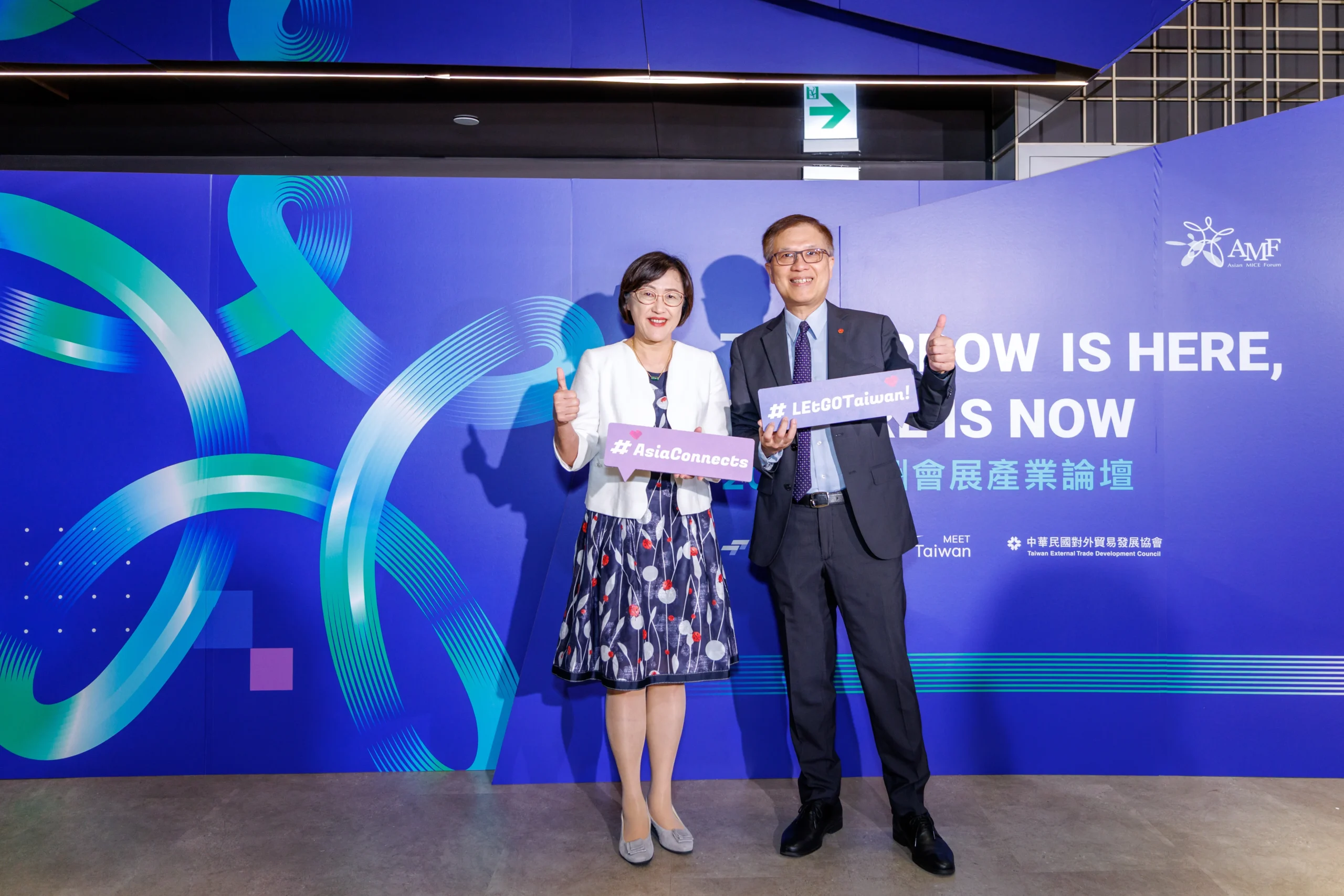
In an era when a video call can replace a flight and AI can summarize any conference in seconds, the question of why professionals still board planes to sit in the same room has become central to the MICE industry. At the 2026 Asian MICE Forum in Taipei, held October 1 at The One @ Taipei 101 under the theme “Tomorrow is Here, Future is Now,” Taiwan’s trade officials and international design leaders offered a clear answer: the human element cannot be replicated.
Joe Chow, Executive Vice President of the Taiwan External Trade Development Council (TAITRA), put it bluntly: “We come for people, we come to exchange ideas, we come to build trust and we come to feel the energy of being together.” While AI can facilitate connections, he stressed, it “cannot replace the human touch.”
The forum, organized by Taiwan’s International Trade Administration and implemented by TAITRA, has linked Taiwan with the global MICE community for over two decades. This year’s edition drew industry leaders, event designers, and architects to explore how business events can foster deeper engagement—a theme that resonates as Taiwan expands its convention infrastructure from Taipei to Kaohsiung.
Taiwan’s MICE corridor: more than venues
Susan Hu, Deputy Director General of the International Trade Administration under Taiwan’s Ministry of Economic Affairs, highlighted the island’s blend of culture, scenery, infrastructure, and competitive industries. She pointed to the synergy between MICE and Taiwan’s industrial clusters—ICT in the north, precision machinery in Central Taiwan, and shipbuilding and green energy in the south. An international exhibition, she noted, can put global buyers directly in touch with Taiwanese manufacturers, while a conference can link international professionals with local expertise.
Hu’s ambition is for delegates to leave with more than business cards. “New partners, new ideas and plans to return,” she said. That vision is supported by a growing network of venues, including the newly opened Taichung International Convention and Exhibition Center (TICEC), which debuted on March 23, 2026, in the Shuinan Economic and Trade Park. TICEC can host up to 12,600 people, with 2,360 exhibition booths and conference space for nearly 5,000 attendees.
The venue sits beside Central Park and the Taichung Green Museumbrary, a cultural complex designed by Pritzker Prize-winning firm SANAA. The result is a MICE district where business and culture intersect—a model that Taiwan hopes will set it apart.
Architecture as a catalyst for connection
German architect Ole Scheeren, known for projects like the Interlace in Singapore, argued that physical spaces shape how people interact. As daily life migrates to the “digital world” and “abstract virtual world,” he said, the relationship between digital and physical environments becomes critical. His design philosophy rests on three pillars: nature, community, and space. Nature means reconnecting with the environment and sustainability; community is about gathering and shared experience; space is the architectural tool that enables connectivity and memory-making.
Scheeren illustrated this with a Singapore residential project that transformed 12 vertical towers into an interconnected horizontal complex, creating courtyards and layered communal spaces. The design, he said, was not just a collection of buildings but a “matrix of experiences” where people could gather, interact, or find solitude.
For convention centers, the implication is clear: capacity and technology remain essential, but the next generation of venues must also consider how people move through a building, whether there are spaces that encourage lingering, and how easily delegates can transition from formal sessions to cultural or outdoor experiences. Taiwan’s expanding MICE infrastructure offers a testing ground for these ideas.
As the industry looks ahead, the forum’s message is that the value of face-to-face events lies not in information transfer—which digital tools handle efficiently—but in the serendipity, trust, and energy that only physical proximity can generate. For Taiwan, that means investing in venues that are not just functional but inspiring, and in destinations that offer more than a convention hall.
Related coverage: Taiwan's campaign for repeat Singapore visitors and Taiwan-themed lounges at Taoyuan Airport.