Uzbekistan has removed visa requirements for Indian citizens, allowing stays of up to 30 days without a visa. The policy, announced during Indian Prime Minister Narendra Modi's state visit to Tashkent on August 29-30, is designed to accelerate what was already one of Central Asia's fastest-growing tourism corridors. The Uzbekistan Tourism Committee also signed a bilateral tourism cooperation programme for 2026-2028, covering joint routes, cultural weeks, film festivals, and other initiatives to boost two-way travel.
The timing is strategic. Indian arrivals to Uzbekistan have been climbing steadily, with 80,800 visitors recorded in 2025, placing India among the country's top ten source markets. Overall, Uzbekistan welcomed 11.7 million foreign visitors last year, a 46.8% increase over 2024. The visa waiver is less about creating a new market than about removing friction from one that is already expanding rapidly.
Momentum in the Indian outbound market
For Indian tour operators, the change comes at a pivotal moment. Uzbekistan is no longer an obscure Central Asian destination that requires extensive explanation at the point of sale. Awareness of Samarkand and Bukhara has grown, air links have improved, and Indian travellers are increasingly looking beyond the familiar Southeast Asian and Gulf circuits. The first five months of 2025 saw 28,500 Indian arrivals, up 22.7% year-on-year, with nearly 18,000 of those trips classified as leisure travel.
Visa-free entry gives agents another lever in a market where short booking windows are common, especially around festival breaks, school holidays, and last-minute international trips. Easier entry also makes Uzbekistan more viable for small groups, incentive travel, and customised departures that previously might not have justified the administrative effort.
Samarkand remains the headline act
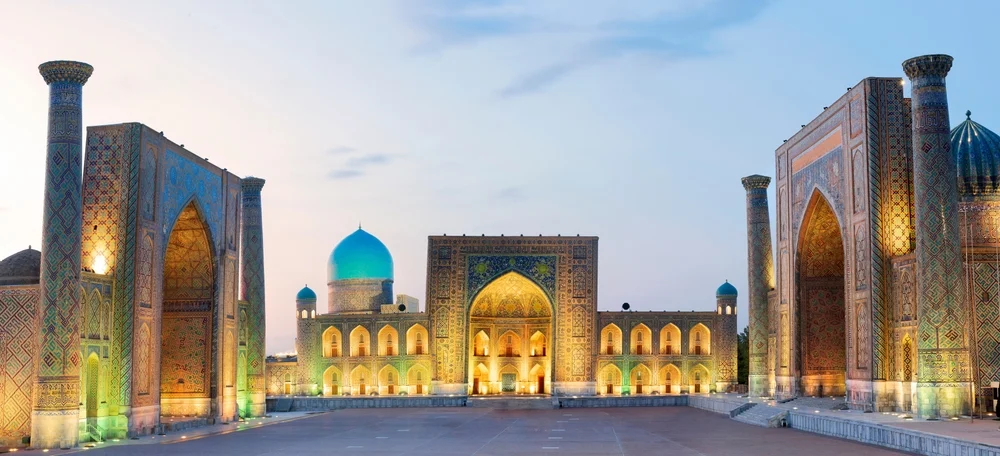
For most first-time Indian visitors, Uzbekistan's appeal starts with its Silk Road cities. Samarkand anchors that proposition, with Registan Square, Shah-i-Zinda, the Bibi-Khanum Mosque, and Gur-e-Amir — the mausoleum of Amir Timur — forming the core of most itineraries. The official Uzbekistan Travel portal also lists ancient Afrasiab among the city's principal attractions.
There is a historical familiarity that gives Indian operators useful storytelling material. The Timurid world that shaped Samarkand also runs through the history of the Mughal dynasty in India. Babur, founder of the Mughal Empire, was born in present-day Uzbekistan. That connection adds an extra layer beyond architecture alone.
Bukhara slows the pace. Its old trading quarters, mosques, madrassas, and the Poi-Kalyan ensemble recall the era when caravans from India and China moved through the region. Uzbekistan's tourism authority notes that Bukhara contains more than 150 medieval architectural monuments, while its Islamic heritage also creates scope for cultural and pilgrimage itineraries. Bukhara and Samarkand are popular in India as Uzbekistan's “crown jewels,” reflecting the destinations that continue to dominate the country's international leisure image.
Tashkent provides the natural urban counterpoint, with Chorsu Bazaar, museums, the Hazrati Imam complex, and its striking Soviet-era metro. Khiva can extend a standard itinerary westwards, while Shakhrisabz adds another chapter to the Timurid story. Uzbekistan's official tourism site lists Samarkand, Bukhara, Shakhrisabz, and Khiva among its UNESCO-linked historical cities.
Commercial opportunity for the trade
The commercial opportunity now lies in turning that cultural inventory into more varied product. Five- to seven-night heritage circuits are the obvious starting point, but family departures, pilgrimage travel, incentive groups, gastronomy, and higher-end private touring offer room to widen the market. The visa waiver will not create demand on its own — air capacity, fares, hotel supply, and stronger distribution in Indian cities will determine how far Uzbekistan can scale. What it does remove is friction, and in a crowded outbound market, that can be enough to move a destination from consideration to booking.
Uzbekistan's move also aligns with broader regional trends. Air Astana's recent sustainability certification highlights Central Asia's growing aviation credentials, while Finnair's Delhi-Helsinki route demonstrates how Indian demand is reshaping European connectivity. For Uzbekistan, the visa waiver is a clear signal that it intends to compete for a larger share of India's outbound travel spend.