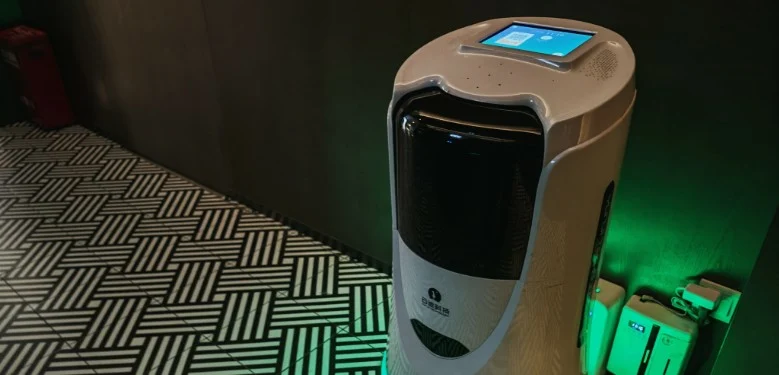
Hong Kong-listed Yunji Technology, a leading supplier of hotel service robots, has secured major clients including Marriott International and Atour, yet the company continues to struggle with profitability. Its H1 2026 performance forecast projects revenue to jump 62% to 79% year-on-year, reaching RMB 177 million to RMB 195 million (USD 26.23-28.90 million). However, net losses are expected to narrow only modestly, by 9% to 27%, landing at RMB 105 million to RMB 130 million (USD 15.56-19.27 million).
The core issue is the dramatic decline in hardware prices. A single delivery robot once cost around RMB 130,000 (USD 19,266); today, the industry average has plummeted to RMB 10,000-30,000 (USD 1,482-4,446). This price erosion compresses gross margins even as research and development and sales expenses continue to climb. The faster Yunji scales, the more cash it burns—a predicament shared across the commercial service robot sector.
Operational gains for hotels
Despite the financial strain, hotel robots are delivering measurable improvements in operating efficiency. An industry study based on 3,187 monthly observations from 357 hotels in China found that each additional 1,000 monthly tasks completed by robots was associated with a 4% increase in occupancy, a 4.57% rise in average daily rate (ADR), and a 9.63% increase in revenue per available room (RevPAR).
For a midscale hotel with 200 rooms, deploying one delivery robot integrated with the property-management system (PMS) can speed up response times to guest requests by 40% and cut front-desk labor costs by 60%. These gains are compelling for operators seeking to optimize staffing and enhance guest experience.
Luxury segment remains hesitant
Yet the same adoption story does not hold at the luxury end of the market. Although Yunji serves Marriott, IHG, and Hyatt, there is a clear divide even within Marriott's portfolio: brands such as Four Points and Fairfield by Marriott use robots, while The Ritz-Carlton and other luxury brands tend to avoid them. This reflects a deeply rooted consumer expectation: luxury hotels sell not just efficiency, but personalized service and a sense of exclusivity.
Data supports this: delivery robot penetration remains below 10% at luxury hotels that emphasize highly personalized service, compared with more than 32% among upper midscale hotels in China's tier-one cities. This divide constrains Yunji's growth. Moving upmarket is difficult because luxury brands remain reluctant to adopt robots, keeping penetration below 10%. Moving downmarket presents another challenge: budget hotels are extremely price-sensitive, and even a RMB 20,000-30,000 robot remains a significant investment.
The upper midscale segment has therefore become the core battleground for hotel robot vendors. Yunji faces fierce competition from numerous rivals fighting for market share in this space. As the industry evolves, the ability to differentiate through software integration, service, and total cost of ownership will be critical.
For travel professionals, the takeaway is that while hotel robots are proving their value in operational metrics, the business model for vendors remains challenging. The rapid price decline suggests a commoditization trend, and vendors must find ways to monetize beyond hardware—perhaps through software subscriptions or data services. The cautious approach to AI autonomy in travel tech may also apply here, as hotels weigh the benefits of automation against guest experience expectations.
As the sector matures, we may see consolidation among robot vendors, with only those achieving scale and cost efficiency surviving. For hoteliers, the current buyer's market offers an opportunity to adopt robotics at lower costs, but they should carefully evaluate long-term support and upgrade paths. The operational cross-border strategies being discussed in Asia-Pacific could also influence how robot deployments are standardized across regions.
Ultimately, Yunji's story is a cautionary tale for the broader commercial service robot industry: rapid growth and marquee clients do not guarantee profitability. The path forward lies in innovation, cost control, and finding the right balance between automation and the human touch that luxury travelers expect.