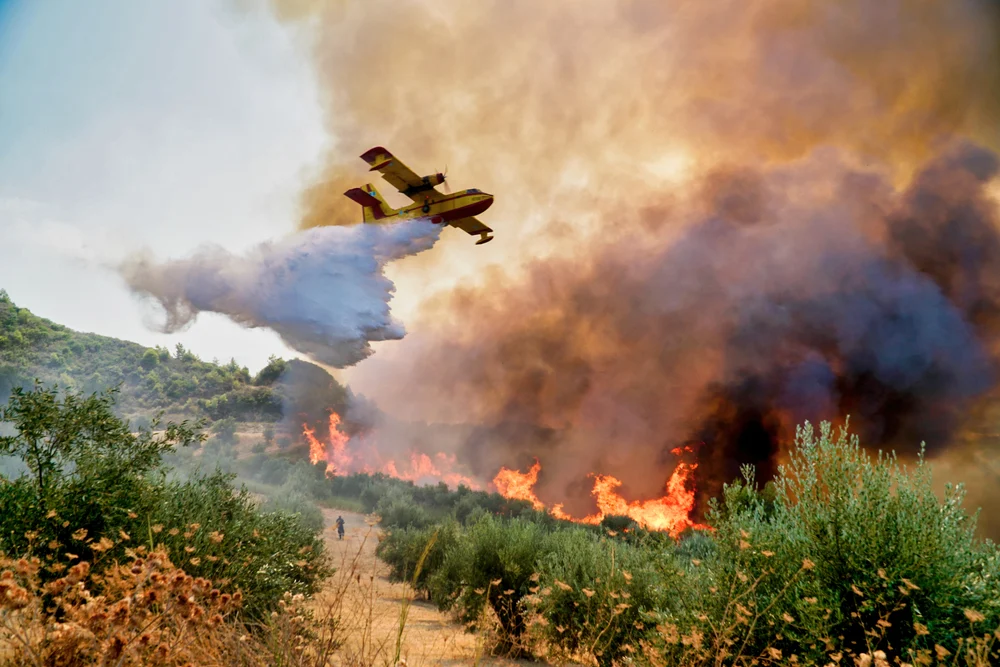
Wildfires that scorched parts of France and Spain have now moved to the heart of Greece, adding fresh strain on tourism businesses during the busiest weeks of the year. The latest blazes, fanned by strong winds and dry vegetation, prompted evacuations northwest of Athens and put regions including Attica, Boeotia, and Evia on high alert. Greek firefighters continue to battle the flames, while their counterparts in France and Spain remain engaged in their own operations.
For Europe's travel sector, the speed at which disruption has crossed borders is the key concern. What began as separate national emergencies is increasingly a rolling regional crisis, shifting with weather systems and leaving little time for operators to adapt. A destination can be operating normally one week and facing evacuation orders the next. That volatility is reshaping how tour companies build itineraries, how hotels assess risk, and how insurers price coverage.
Local fires, global perception
Much of Greece's tourism infrastructure remains open, but the commercial impact of wildfires rarely stays local. Images of flames and smoke travel faster than official updates, and for travellers unfamiliar with geography, a fire near Athens can quickly be seen as a countrywide threat. Cancellations often follow even when airports, resorts, and major attractions are unaffected.
That perception gap is one of the industry's toughest challenges. Hotels and destination management companies must now communicate with guests at speed, clarify exactly which areas are affected, and offer workable alternatives when itineraries can no longer proceed. Airlines and tour operators face their own calculations over rerouting, refunds, and repatriation, particularly when official advice changes at short notice.
The growing trend of late bookings and demand for flexibility is partly a response to this uncertainty. Travellers want the option to shift dates or switch destinations without absorbing the full cost. For businesses, however, flexibility has a price—it affects revenue management, staffing, supplier contracts, and cash flow.
Insurance protection lags behind
The financial exposure extends beyond disrupted holidays. Europe's worsening wildfire season is exposing a widening climate insurance gap, with insurers reassessing their exposure to fires, floods, and other weather-related losses. Hotels in high-risk areas may face higher premiums, narrower coverage, or larger deductibles. Smaller operators, already managing thin margins, could find comprehensive business interruption insurance increasingly difficult to afford. Travel insurers may also tighten conditions around cancellations linked to extreme heat or nearby fires, particularly when official authorities have not advised against travel.
The distinction matters. A traveller may feel unsafe or decide conditions are unsuitable, but unless the destination is formally closed or official advice changes, an insurance policy may not respond. For corporate travel managers, tour operators, and event organisers, policy wording is becoming as important as price. Fire, smoke, transport disruption, and evacuation expenses do not always sit neatly within conventional cancellation clauses. The result is a patchwork of protection at precisely the moment when climate risk is becoming more predictable.
Heat reshapes the European summer
Europe has endured severe wildfire seasons before, but the commercial response is changing. After major fires in Greece in 2023 and repeated outbreaks in Spain, Portugal, France, and Italy, the industry initially treated each summer as an exceptional event. That position is becoming harder to sustain. Extreme heat is now influencing destination choice, holiday timing, and investment decisions across the Mediterranean.
Some travellers are shifting to May, June, September, and October, when temperatures are lower and crowds thinner. Others are moving north, giving destinations in Scandinavia, the Baltics, and parts of Central Europe a stronger role in the summer market. Mediterranean destinations are not losing their appeal, but they are being forced to manage a shorter and less predictable window for traditional peak-season travel. That has consequences for hotel development, air capacity, and seasonal employment. A business model built around near-full occupancy in July and August becomes more vulnerable when those months also carry the highest operational risk.
Resilience moves into the boardroom
Wildfire planning was once handled largely as a safety and emergency-management issue. It is now a commercial priority. Hotel groups are reviewing evacuation routes, backup power, water access, and staff training. Tour operators are mapping alternative itineraries that avoid high-risk zones, and some are already expanding slow-travel options in less exposed regions. Airlines are adjusting schedules and offering more flexible rebooking policies, while destination management companies are investing in real-time communication tools.
The shift is also visible in technology adoption. Revenue management systems, such as those used by Donkey Hotels & Resorts across their Greek properties, are being used to model demand under different climate scenarios. Insurers are developing more granular risk models, and some are starting to reward properties that invest in resilience measures.
For travel professionals, the message is clear: climate risk is no longer a seasonal anomaly but a structural factor in planning. The industry must build flexibility into contracts, pricing, and operations, and communicate transparently with travellers about what is and isn't affected. As the Mediterranean summer becomes more volatile, those who adapt will be better positioned to protect both their customers and their bottom lines.