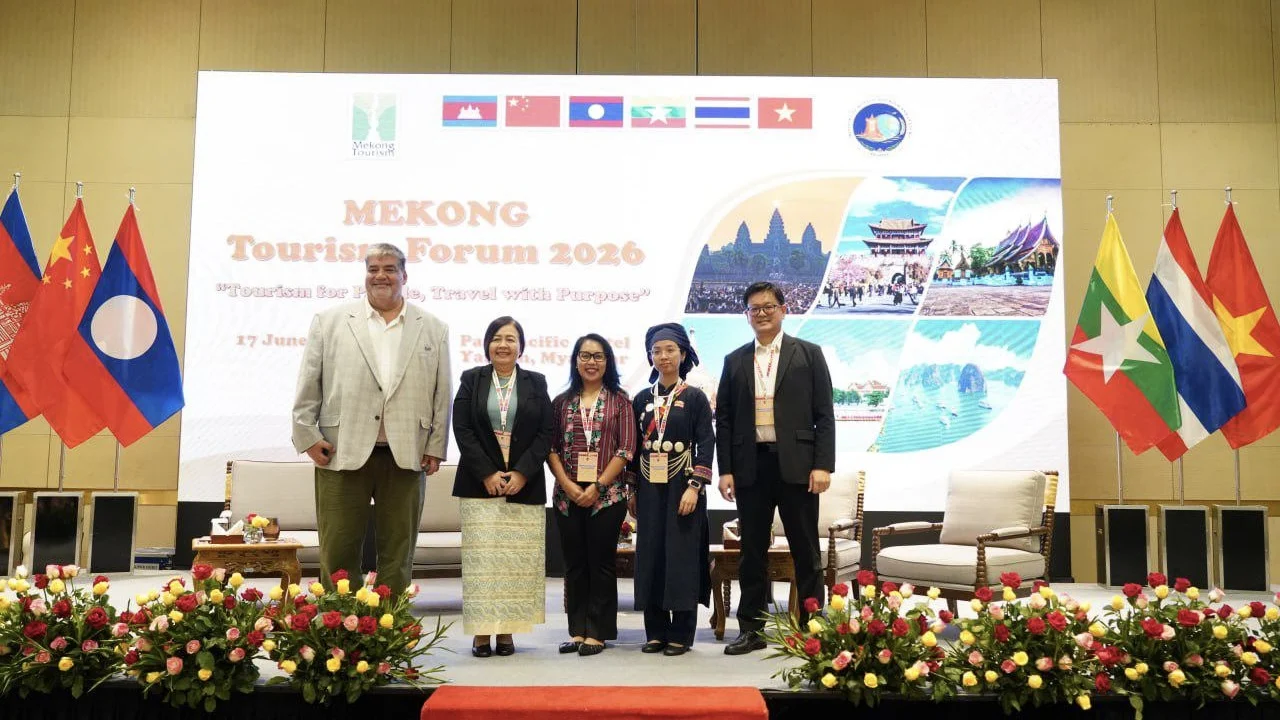
YANGON — The Mekong Tourism Forum 2026, held 16–18 June at the Pan Pacific Yangon Hotel, dedicated a key session to the intersection of tourism and living culture. Titled "Living Culture and Creative Expression," the panel on 17 June brought together heritage experts, community tourism practitioners, and academics to examine how the travel industry can support cultural continuity without commodifying it.
Moderated by Dr. Scott Smith of Assumption University of Thailand, the panel featured Dr. Zhu Jinsheng “Jason” of Guilin Tourism University, Ms. Thuy An Phan of Thai Hai Village in Vietnam, Ms. Maulita Sari Hani of Planeterra, and Ms. Ohnmar Myo of SEAMEO SPAFA. The discussion aligned with the forum's overarching theme, "Tourism for People, Travel with Purpose," and moved beyond standard destination-marketing language to address the lived realities of communities.
Heritage Beyond Monuments
Ms. Ohnmar Myo of SEAMEO SPAFA, the Southeast Asian Ministers of Education Organization Regional Centre for Archaeology and Fine Arts, grounded the conversation in the aftermath of Myanmar’s recent earthquake. She noted that thousands of monuments were damaged, but warned that hasty reconstruction can cause a second wave of harm. "Heritage is not only monuments," she said. "It lives in communities and in the people who give heritage places meaning." Her remarks underscored the need for coordinated recovery involving local knowledge, government agencies, NGOs, and private-sector partners.
Ms. Maulita Sari Hani, Regional Manager of Planeterra, shifted the focus to long-term impact. "Community tourism should never be treated as a checklist," she said. "When we work with communities, there are real people behind the project, and the benefits should continue long after the visitors leave." She cited Planeterra’s work in New Zealand, where traveler income funds scholarships and exchange programs for local youth, creating social and family benefits that outlast any single project.
Ms. Thuy An Phan of Thai Hai Village, recognized by UN Tourism as a Best Tourism Village and often called the "Village of Love," offered a deeply human perspective. "With love, we can do anything," she told the audience. "Love creates our village. Love with nature can create meaningful tourism." She argued that culture should not be performed for tourists but lived daily. "Culture is alive when it is lived, not only performed; when it is shared, not sold," she said. Her message resonated with the panel’s broader theme: tourism should be the result of living culture, not the reason for changing it.
Dr. Zhu Jinsheng “Jason” of Guilin Tourism University distilled the session into a simple mantra: "People, people, people." He called for a shift from demand-side thinking—focused on tourists and markets—to supply-side attention on communities and hosts. "If tourism is truly people-oriented," he said, "then the 'people' must include the communities whose culture, heritage, and daily lives make travel meaningful."
The panel’s insights have practical implications for travel professionals. For hoteliers and tour operators, the message is clear: partnerships with community-based organizations like Planeterra or Thai Hai Village can create authentic experiences that also generate lasting local benefits. For destination marketers, the emphasis on love and pride suggests that storytelling should highlight community values, not just attractions. For airlines and cruise lines serving the Mekong region, the discussion reinforces the importance of supporting heritage recovery efforts, particularly in Myanmar, where the earthquake has created urgent needs.
Related coverage on Travelmao includes Wuhan 2026 Youth Forum Highlights City's Tech and Tourism Ambitions and Beijing CBD Forum 2026: A Gateway for Global Travel and Business Leaders, both of which explore how Asian destinations are balancing modernization with cultural preservation.
The session concluded with a call to action: tourism stakeholders must listen to communities, invest in long-term relationships, and measure success not by visitor numbers but by what local people gain, keep, and pass on. As Dr. Smith summarized, "Living culture cannot be separated from the people who carry it. If tourism is serious about purpose, it must begin asking what communities want to protect, share, and pass on."