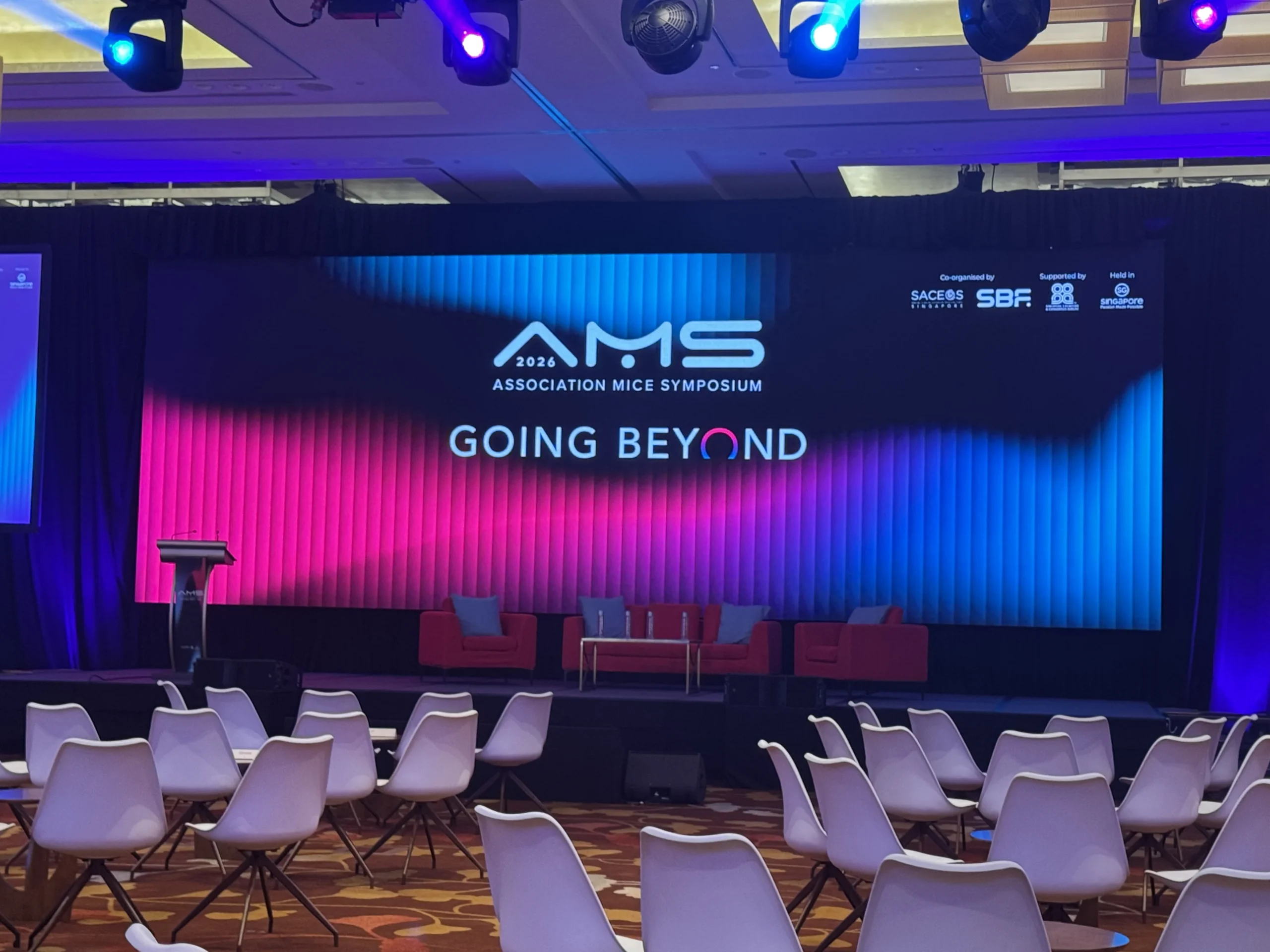
The second Association MICE Symposium (AMS) convened at the Orchid Ballroom of Marina Bay Sands Convention Centre on 29 July, marking the opening of this year's Singapore MICE Forum (SMF). Organised by the Singapore Association of Convention and Exhibition Organisers and Suppliers (SACEOS) in partnership with the Singapore Business Federation (SBF), the event focused on equipping association leaders with strategies to drive growth through well-designed events.
Theme of resilience and innovation
Under the theme Going Beyond, the symposium examined how collaboration and innovation have bolstered the sector's resilience during turbulent times. SACEOS president Richard Ireland set the tone in his opening remarks: “We're meeting at a time of uncertainty, but uncertainty has become the norm. Economic volatility, abstinent political tensions, rapid technological changes and evolving member expectations continue to shape the industries that we as an association serve.”
Ireland noted that current challenges have only reinforced the essential role of associations. “Associations provide trusted knowledge, bring industries together and foster partnerships needed to solve problems and challenges. This is why gatherings like today are more important than ever,” he said.
Record receipts and global standing
According to the latest ICCA Global Watch report, more than 12,400 international association meetings took place worldwide in 2025, a 13% increase over the previous year. Singapore maintained its fifth-place position in the global rankings for international association meetings. The country's MICE industry receipts reached a record SG$2.3 billion in 2025, up 35% year-on-year. Ireland described the figures as encouraging but noted that “the true value of association meetings extends well beyond the economic contribution.”
These developments come as Singapore's broader MICE ecosystem faces cost pressures. A recent analysis highlighted that rising Singapore MICE costs are pushing organisers to consider alternatives such as Bangkok, Hong Kong, Malaysia, and Indonesia, underscoring the need for continued innovation and value creation.
Navigating uncertainty through partnerships and AI
AMS 2026 provided a platform for associations to explore how to navigate uncertainty, build stronger partnerships, and harness artificial intelligence to improve productivity, strengthen member engagement, and deliver greater value. The event also examined how the MICE industry can support these ambitions by offering platforms and experiences that enable associations to convene communities, accelerate knowledge exchange, and amplify their impact.
SBF chief executive Kok Ping Soon remarked: “Associations today are operating in a more complex environment, and this complex environment is shaped by technological destruction, is shaped by geopolitical forces, changing workforce needs and stronger and higher expectations from [association] members. But, at the same time, events are no longer just gatherings.”
The symposium's focus on AI and digital tools aligns with broader travel-technology trends. For instance, Finnair's expansion of its UK-Helsinki schedule to 48 weekly flights for summer events demonstrates how carriers are adapting to increased demand for business travel and MICE-related movement.
Outlook for Singapore's MICE sector
With the Singapore Tourism Board (STB) actively promoting new infrastructure and hotel initiatives, the city-state remains a top-tier destination for international association meetings. The SG$2.3 billion in MICE receipts reflects sustained investment in venues like Marina Bay Sands and the upcoming Changi Airport Terminal 5, which will further enhance connectivity for delegates from key source markets including China, India, and Southeast Asia.
As the global MICE sector navigates economic shifts, Singapore's ability to blend high-quality infrastructure with strategic partnerships and technological adoption will be critical to maintaining its competitive edge. The discussions at AMS 2026 and the broader SMF programme signal that association leaders are proactively adapting to a landscape where uncertainty is the new normal.