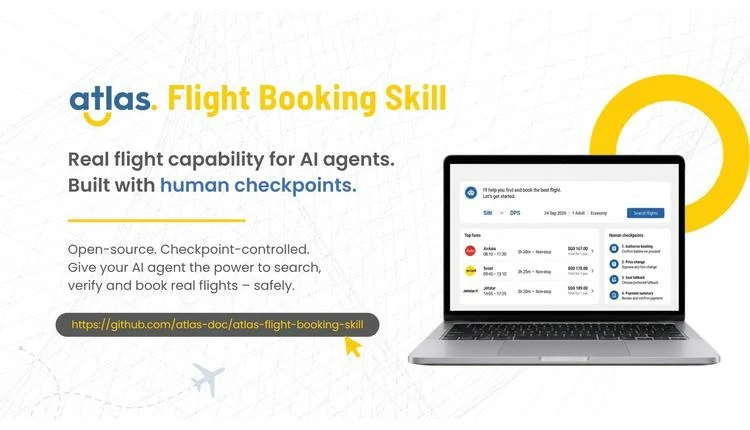
Atlas, a global travel technology provider, has made its Flight Booking Skill available as open source, a move that lets developers integrate real-time flight search and controlled booking capabilities into AI agents without building the functionality from scratch. The skill is now accessible on GitHub and PyPI, targeting a well-known gap in AI travel agents' current abilities.
The skill is structured around four mandatory human approval checkpoints: authorization, price changes, seat fallback, and the final payment summary. This design deliberately prevents AI agents from executing transactions autonomously, maintaining human oversight at every critical decision point. Mary Li, CEO and founder of Atlas, explained the rationale: “We open-sourced our Flight Booking Skill for AI agents — not because we wanted agents to book flights fully autonomously, but because we didn't.”
Expanding low-cost carrier retailing
The release follows Atlas's broader push to extend low-cost carrier (LCC) connectivity to independent travel sellers and developers. The skill supports core booking operations, including search, pricing, availability, and booking creation, with future updates expected to cover refunds, cancellations, and other post-booking processes.
For developers, AI product teams, and agent builders, the skill integrates with existing Atlas ATRIP accounts, eliminating the need for separate commercial agreements. This lowers the barrier for travel tech vendors and agencies looking to add flight booking to their AI-driven offerings.
Atlas continues to position itself as a leader in LCC retailing by unifying content from over 140 carriers and leveraging analytics from more than 1 billion daily searches. The open-source move is likely to accelerate adoption of AI agents in travel, particularly among travel management platforms seeking to streamline booking workflows.
Industry observers note that while AI agents have made strides in itinerary planning and customer service, the ability to complete transactions—especially flight bookings—has remained a sticking point. Atlas's approach, which embeds human checkpoints, could serve as a model for other travel tech firms. As airlines like Delta expand their networks, the demand for efficient, AI-assisted booking tools is only set to grow.
The open-source release also aligns with broader trends in travel technology, where collaboration and shared standards are becoming more common. By making the skill freely available, Atlas aims to foster innovation while ensuring that safety and control remain paramount in AI-driven transactions.
For travel agents and tour operators, the skill offers a way to enhance their digital offerings without significant upfront investment. It also signals a shift toward more transparent and accountable AI systems in the industry, a development that could influence how other vendors approach automation.
As the travel industry continues to rebound, with Gulf carriers rebuilding long-haul networks and new routes being announced, the role of AI in streamlining operations is becoming increasingly critical. Atlas's open-source initiative is a timely contribution to that evolution.